

What goes on a handyman estimate
A handyman estimate is a list, and the list is what makes it work. Customers accumulate jobs — the door, the shelf, the faucet, the fence panel — and hand you all of them at once. Priced individually they can choose. Priced as one figure they can only say yes or no, and the number is bigger than any single item sounded.
- Every job on its own line, with its own price
- The time you expect each to take, where that explains the price
- Materials per job, and whether you are supplying them
- A minimum call-out or half-day rate, and how the list offsets it
- Anything you have priced on sight without investigating
- Jobs you are declining, and why — it builds more trust than taking them
- How long the prices stand
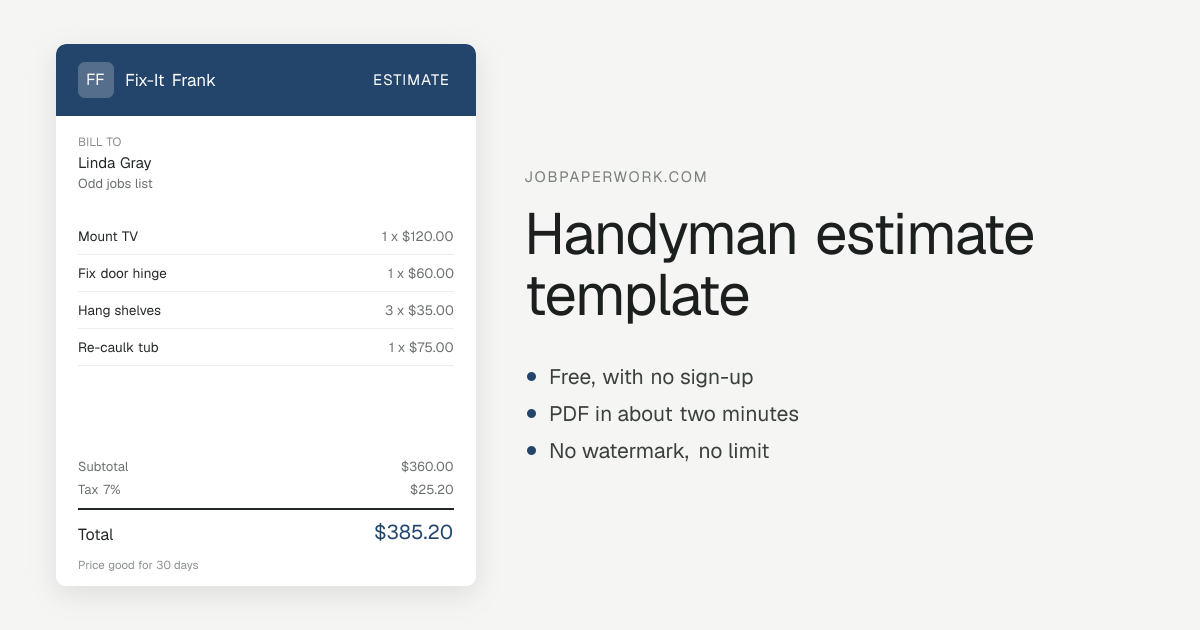
The sample line items and example prices this sheet opens with are on the handyman invoice template — the same table, which is about the trade rather than about this paper, so it lives in one place rather than on all six. Working out the price itself? The markup calculator turns your cost and markup into the figure to put on the estimate, and shows the margin it leaves.
What you get
A PDF, and a link your customer can open in any browser. Word and Excel versions are not available yet — if a spreadsheet is what you need, this is not yet the tool for it, and saying so is cheaper for both of us than you finding out after typing everything in.
Pick how it looks
Six looks, from a plain classic sheet through a bold top band to a shop ticket, and your initials go on automatically until you upload a logo. See all six.
How to send it
Most customers want the paper on their phone, so the estimate goes out by WhatsApp, text or email, or as a link that needs no app and no account on their side. Or download the PDF to print it or keep it for your own records.
Questions
Should I price each job separately or give one figure?
Separately, always. A list of eleven priced jobs lets the customer drop three and still book you; one figure for all eleven invites them to think about the total and do nothing. It also makes the next list easier, because they now know what things cost.
What about jobs that turn out bigger than they looked?
Mark those on the estimate as priced on sight, and say what would change them. A faucet that needs the whole valve replacing, a shelf going into crumbling plaster — common enough that naming the possibility costs nothing and prevents the entire conversation.