

What goes on a flooring invoice
Flooring is priced per square foot across three separate things — material, underlay and labor — and customers almost always compare quotes on the material price alone. Showing all three is how you explain the difference.
- Material by square foot, with the product and grade named
- Underlayment or moisture barrier, by square foot
- Install labor, by square foot or by the room
- Removal and disposal of the old floor
- Subfloor prep or levelling, which is the usual surprise
- Trim, thresholds and transitions, by the piece
Sample line items and example prices
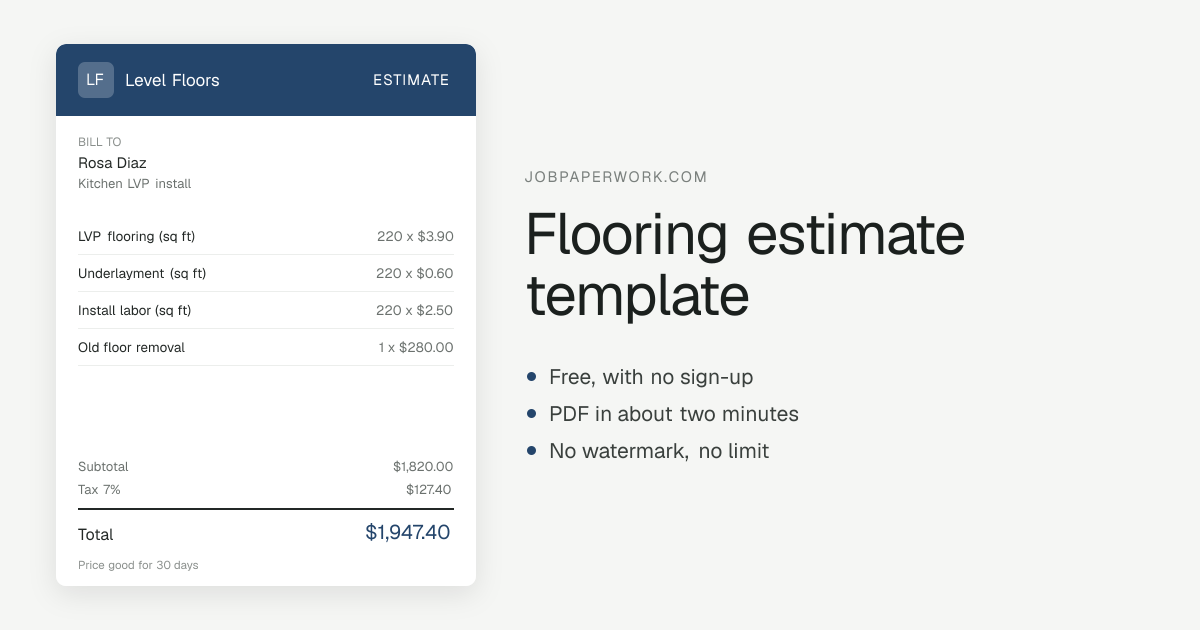
These are the sample lines and example prices this invoice opens with. They are starting points, not a survey of what anybody charges and not a recommendation — adjust every item to match your work, your rates and your customer before you create the PDF.
| Job | Usual quantity | Opens at |
|---|---|---|
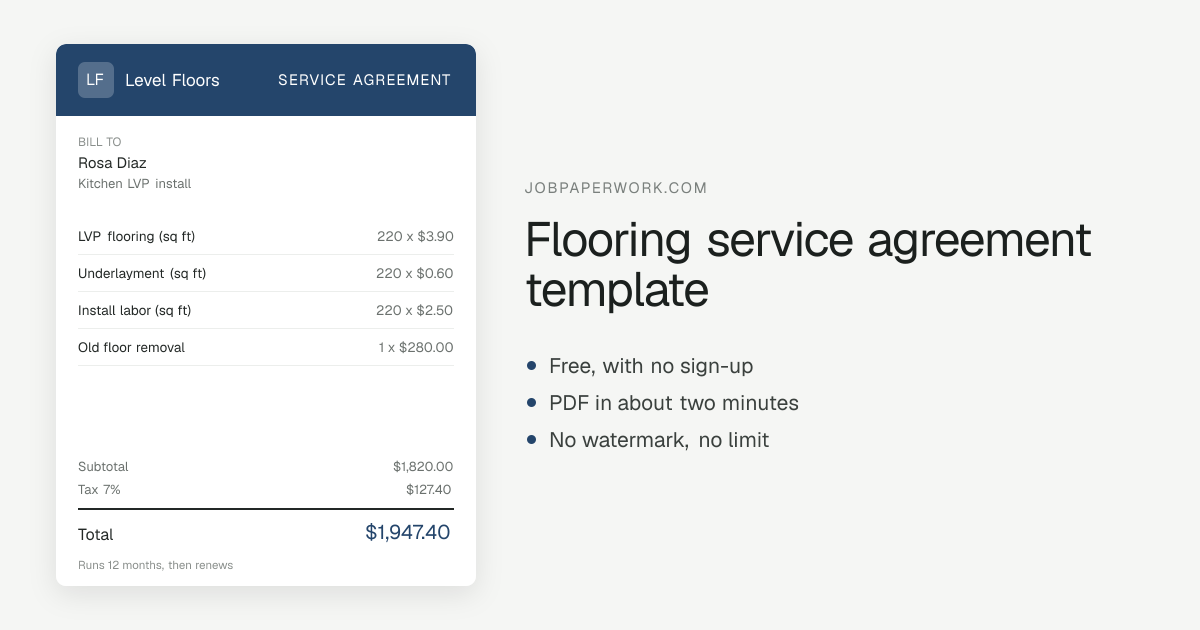
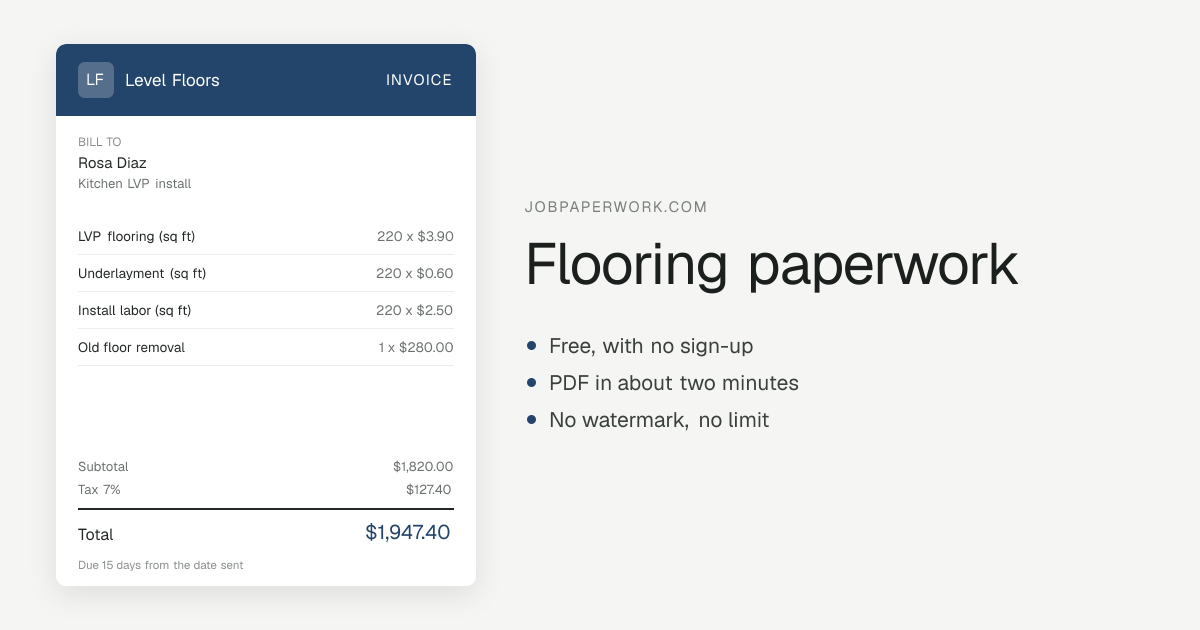
| LVP flooring (sq ft) | 220 | $3.90 |
| Underlayment (sq ft) | 220 | $0.60 |
| Install labor (sq ft) | 220 | $2.50 |
| Old floor removal | 1 | $280.00 |
Add, delete or rename any line. The math, the tax and any discount are worked out as you type. Setting the terms? The invoice due date calculator turns Net 15, 30 or 60 into the exact date to put on the invoice.
One flooring invoice template: free, editable, printable and yours
Free flooring invoice template
Free means the whole thing: no sign-up to start, no watermark on the PDF, no limit on how many flooring invoices you make, and no card asked for at any point. An account is optional, and only does one job — keeping your papers in step between a phone and a computer.
Editable flooring invoice template
It opens with 4 jobs a flooring business usually bills — lvp flooring (sq ft), underlayment (sq ft), install labor (sq ft) — already priced, so most of the typing is done. Every line can be renamed, repriced or deleted, new ones added, and the subtotal, tax and any discount recalculate as you type.
Printable flooring invoice template
Print it straight from the browser and only the invoice prints — no menus, no buttons — on whatever paper your printer holds. Or save it as a PDF to email, text or keep, and the customer’s copy is the same sheet you saw on screen.
Custom flooring invoice template
Your business name, phone and address go at the top, with your logo if you upload one or your initials if you do not. Six looks to choose from, 5 accent colors, and your own payment terms in the footer — a flooring invoice that looks like it came from your business, not from a website.
Every flooring paper, as it comes out
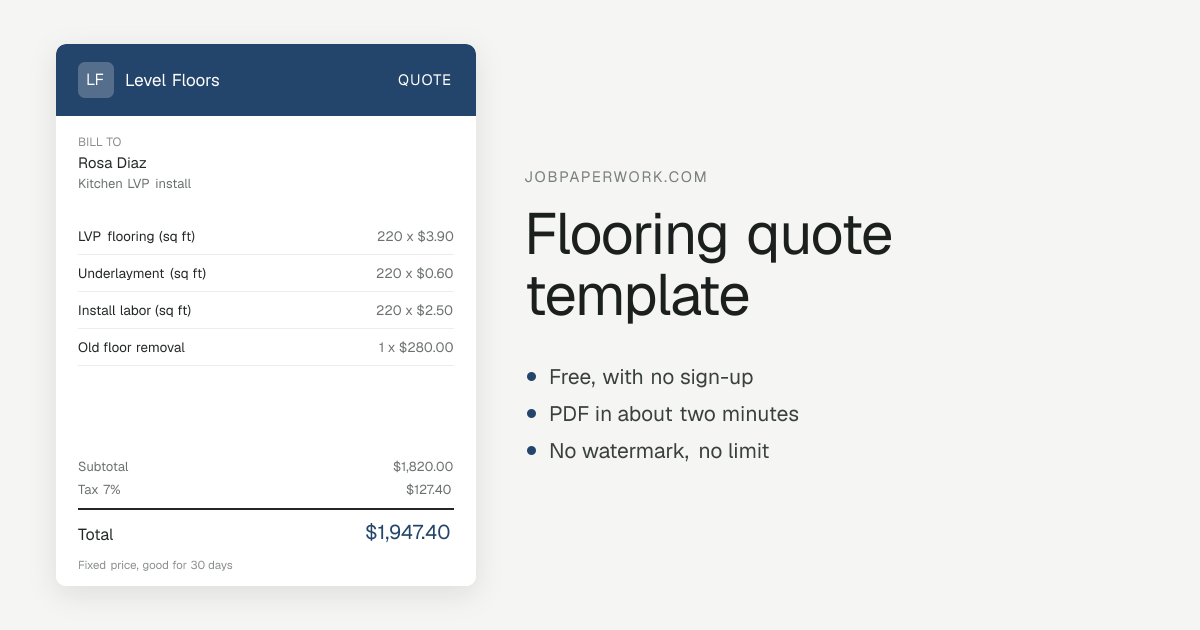
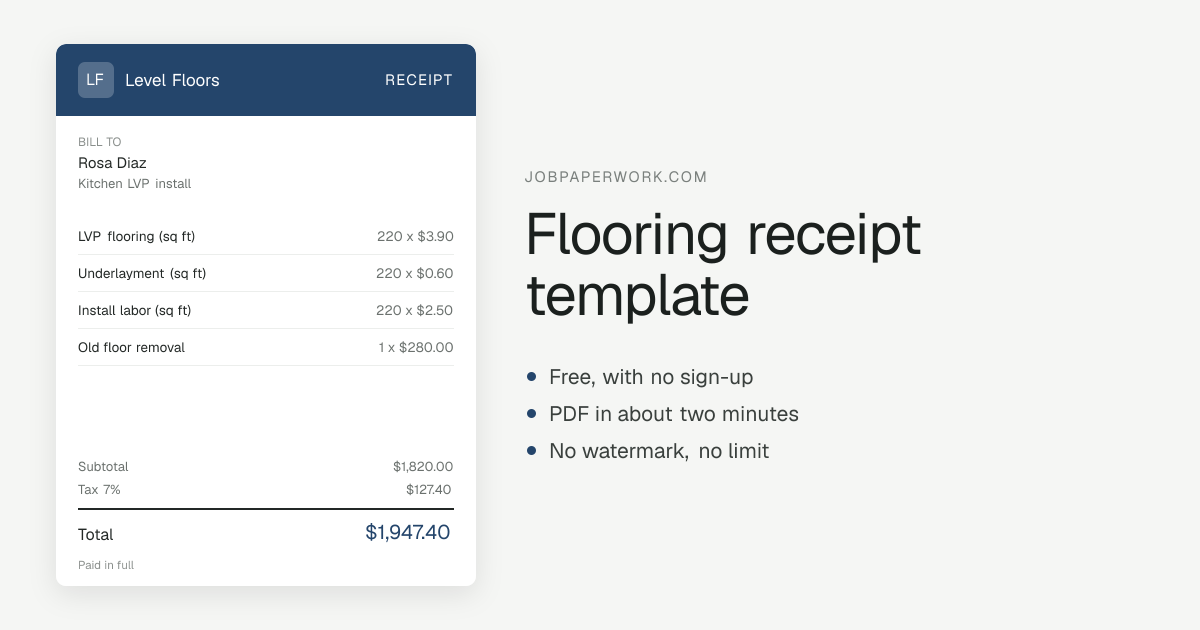
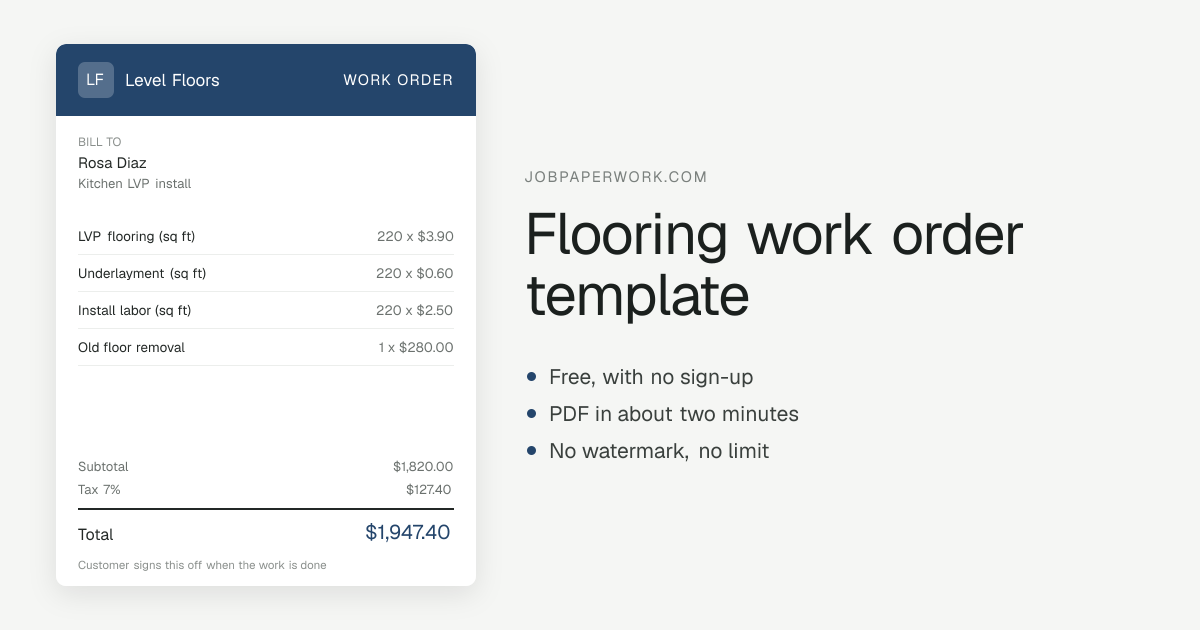
The same jobs and the same look carry across all six papers, so one flooring job can move from estimate to invoice to receipt without retyping.
What you get
A PDF, and a link your customer can open in any browser. Word and Excel versions are not available yet — if a spreadsheet is what you need, this is not yet the tool for it, and saying so is cheaper for both of us than you finding out after typing everything in.
Pick how it looks
Six looks, from a plain classic sheet through a bold top band to a shop ticket, and your initials go on automatically until you upload a logo. See all six.
How to send it
Most customers want the paper on their phone, so the invoice goes out by WhatsApp, text or email, or as a link that needs no app and no account on their side. Or download the PDF to print it or keep it for your own records.
Questions
Why should subfloor prep be its own line?
Because nobody can see it until the old floor is up, and it is the cost that turns a quote into a complaint. Flag it as possible on the estimate, then bill it as its own line if it was needed.
Should I include waste in the square footage?
Price the material with your waste factor in, but show the room area the customer can measure and say the line covers offcuts. Charging for 240 square feet of a 220 square foot room without a word is how disputes start.
When do I invoice on a flooring job?
A deposit covering the material at order, since it is cut and bought for one room, and the balance on completion. If the subfloor turns out to need work, price it and get it agreed before you lay anything on top of it.
Do I charge extra for moving furniture out of the room before I lay the floor?
Many installers do, either as a flat fee per room or by the hour, and some include light furniture and charge only for pianos, gun safes, beds and loaded bookcases. Whichever you choose, put it on the estimate and then as its own line on the invoice, such as "Furniture move-out and reset, 3 rooms". A crew standing around waiting for a room to be cleared is the cost you otherwise absorb.
How should transitions, thresholds and baseboard show up on a flooring invoice?
By the piece or by the linear foot, kept apart from the per-square-foot install line. Name each one: "T-molding, bedroom to hall, 2 pcs", "Reducer at slider door", "Quarter round, 84 linear ft, painted". Customers forget that every doorway and floor-height change needs trim, and an itemized list shows where the money went instead of leaving it buried in a bigger labor number.
Should tear-out and haul-away of the old carpet or tile be a separate charge?
Yes. Removal is real labor, and tile set in a mortar bed or glued-down vinyl takes far longer than carpet and pad. Bill it per square foot or per room as "Remove and dispose existing ceramic tile", with dumpster or dump fees on a line of their own. If the customer pulls the old floor themselves, note that on the invoice so nobody later assumes you skipped a step.
How do I price stairs on a hardwood, vinyl plank or carpet install?
Per step, not per square foot, because each tread, riser and stair nose is cut and fitted by hand. List it as "Stairs, 13 treads and risers, with matching nosing" and price landings separately. Open-sided stairs, returns and curved steps take longer again, so they are worth naming on their own line. Square footage alone badly understates what a staircase costs to do well.
Do I charge sales tax on the flooring material, the install labor, or both?
It depends on the state. In some, an installer who permanently attaches flooring is treated as a contractor who pays sales tax when buying the material and then charges none on the job; in others the material is taxed on the invoice and the labor is not. Showing material and labor on separate lines keeps either option open. Your state department of revenue says which rule applies to you.
What goes on the invoice when the homeowner bought the flooring and I only install it?
A labor-only invoice that says so: "Install customer-supplied luxury vinyl plank, 410 sq ft". Add a line noting that material quantity, quality and defects are the customer's responsibility, and say what happens if they run short mid-job, such as a return-trip charge. Many installers also charge a higher labor rate on supplied material, since there is no material margin on the job.