

What goes on a painting invoice
Painting is quoted by the room or the surface and billed the same way. Prep is the part customers forget they agreed to, so it earns its own line rather than disappearing into the labor.
- Each room or surface on its own line
- Prep work — patching, sanding, masking — priced separately
- The number of coats, because two is not the price of one
- Paint by brand, finish and quantity, and who supplied it
- Trim, doors and ceilings, which price differently from walls
- Moving or covering furniture, if that was part of it
Sample line items and example prices
These are the sample lines and example prices this invoice opens with. They are starting points, not a survey of what anybody charges and not a recommendation — adjust every item to match your work, your rates and your customer before you create the PDF.
| Job | Usual quantity | Opens at |
|---|---|---|
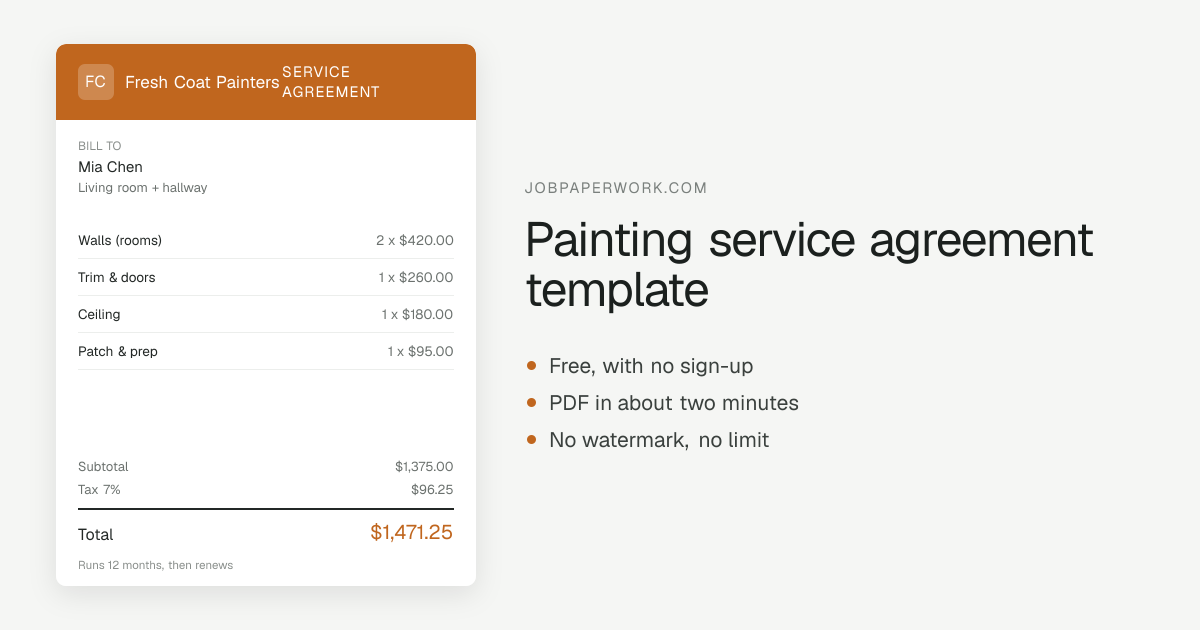
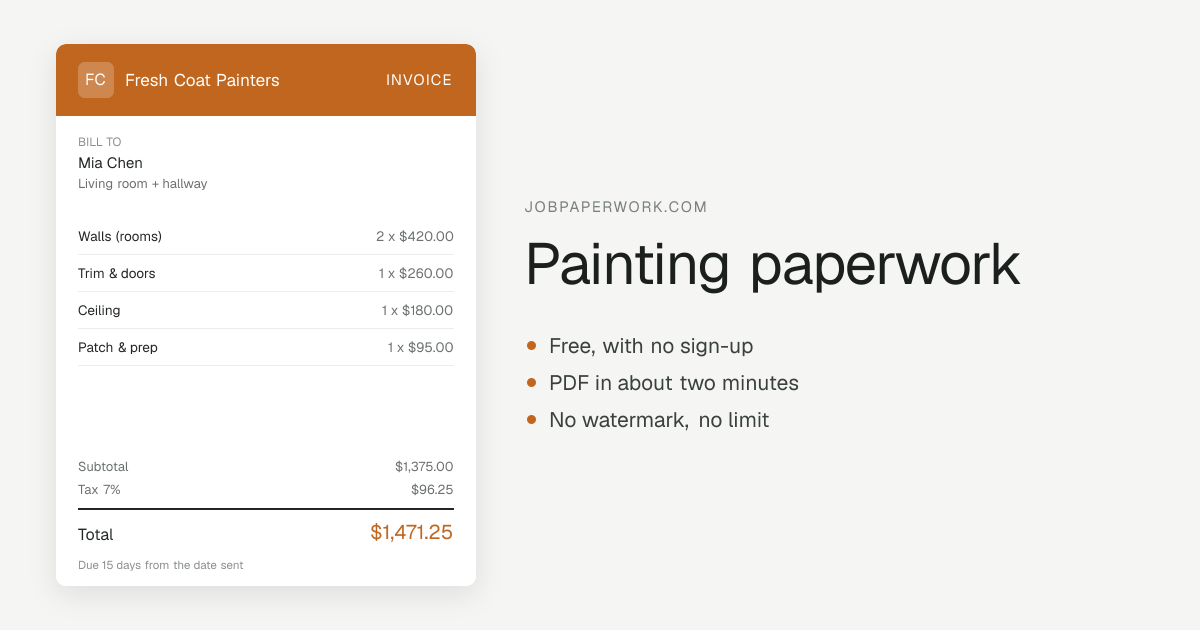
| Walls (rooms) | 2 | $420.00 |
| Trim & doors | 1 | $260.00 |
| Ceiling | 1 | $180.00 |
| Patch & prep | 1 | $95.00 |
Add, delete or rename any line. The math, the tax and any discount are worked out as you type. Setting the terms? The invoice due date calculator turns Net 15, 30 or 60 into the exact date to put on the invoice.
One painting invoice template: free, editable, printable and yours
Free painting invoice template
Free means the whole thing: no sign-up to start, no watermark on the PDF, no limit on how many painting invoices you make, and no card asked for at any point. An account is optional, and only does one job — keeping your papers in step between a phone and a computer.
Editable painting invoice template
It opens with 4 jobs a painting business usually bills — walls (rooms), trim & doors, ceiling — already priced, so most of the typing is done. Every line can be renamed, repriced or deleted, new ones added, and the subtotal, tax and any discount recalculate as you type.
Printable painting invoice template
Print it straight from the browser and only the invoice prints — no menus, no buttons — on whatever paper your printer holds. Or save it as a PDF to email, text or keep, and the customer’s copy is the same sheet you saw on screen.
Custom painting invoice template
Your business name, phone and address go at the top, with your logo if you upload one or your initials if you do not. Six looks to choose from, 5 accent colors, and your own payment terms in the footer — a painting invoice that looks like it came from your business, not from a website.
Every painting paper, as it comes out
The same jobs and the same look carry across all six papers, so one painting job can move from estimate to invoice to receipt without retyping.
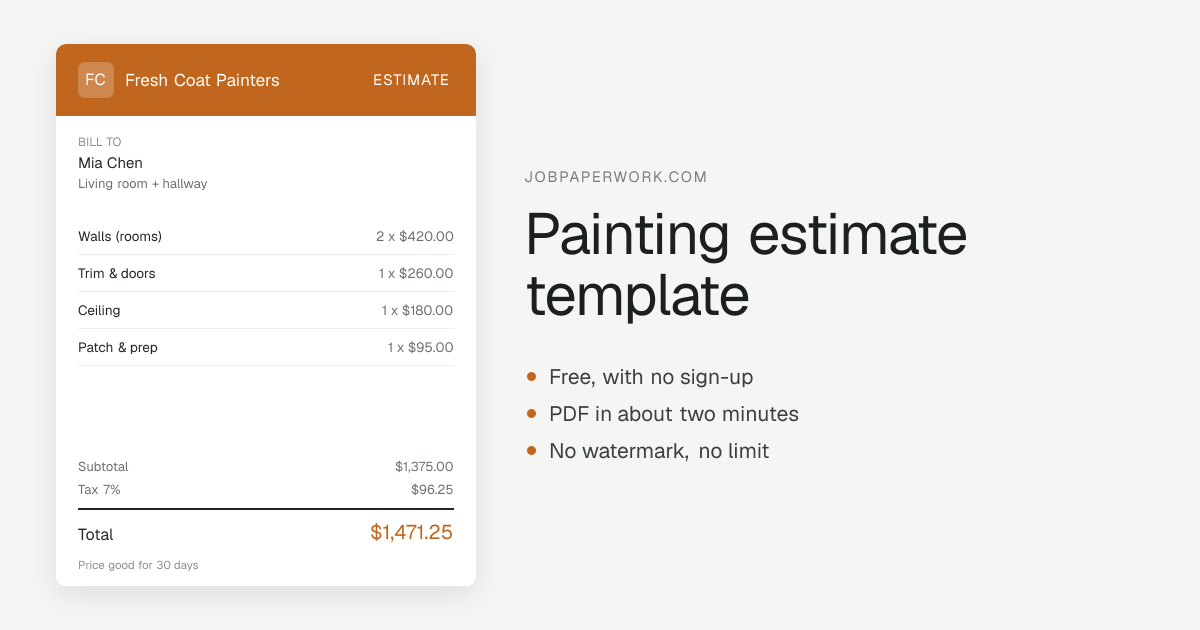
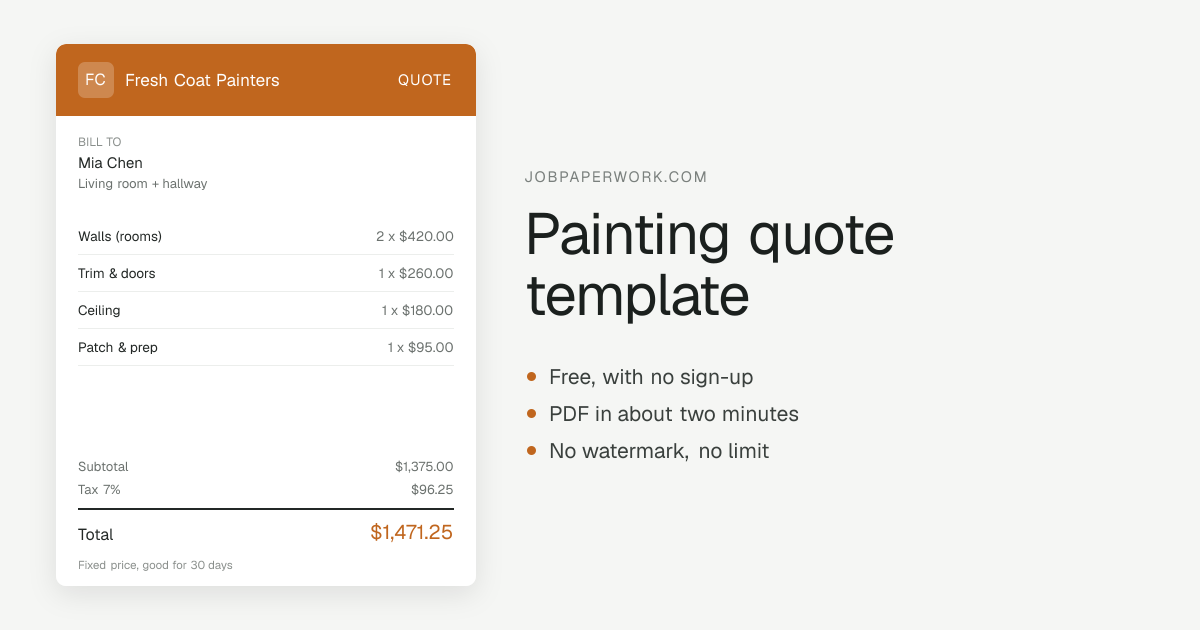
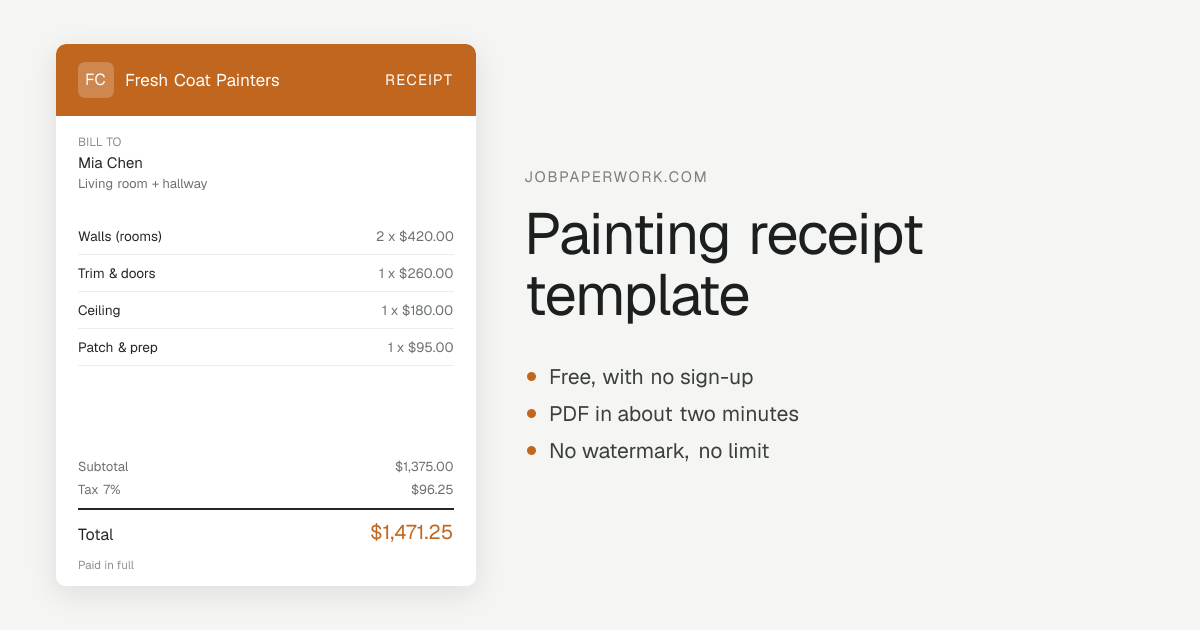
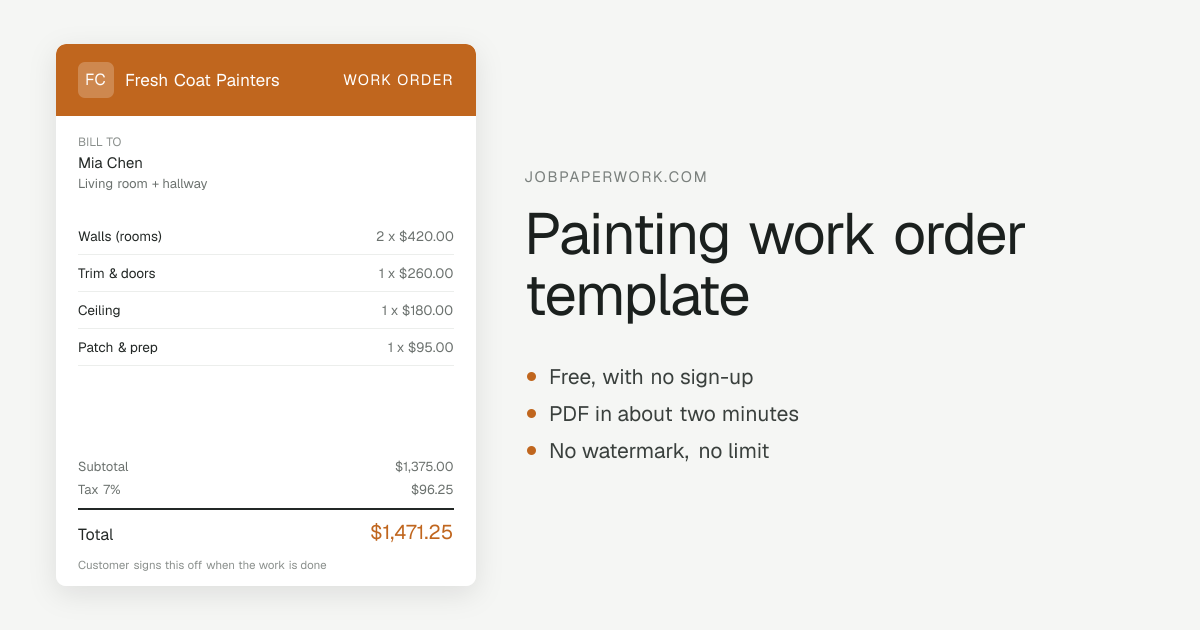
What you get
A PDF, and a link your customer can open in any browser. Word and Excel versions are not available yet — if a spreadsheet is what you need, this is not yet the tool for it, and saying so is cheaper for both of us than you finding out after typing everything in.
Pick how it looks
Six looks, from a plain classic sheet through a bold top band to a shop ticket, and your initials go on automatically until you upload a logo. See all six.
How to send it
Most customers want the paper on their phone, so the invoice goes out by WhatsApp, text or email, or as a link that needs no app and no account on their side. Or download the PDF to print it or keep it for your own records.
Questions
Should prep work have its own line?
Yes. It is often a third of the hours and none of what the customer sees, so the line that names it is the only thing standing between you and “why did one room cost that much to paint”.
Do I charge for the paint or include it?
Either, as long as the invoice says which. If you supplied it, list the brand and finish — it protects you when the customer wants a touch-up to match two years later.
When should I invoice a painting job?
On completion for a single room, in stages for a whole house — deposit, then on finishing each floor or area. Waiting until every last piece of trim is done on a three-week job is three weeks of your money paying for their paint.
How do I charge when the customer changes the color after we start?
Treat it as a change order: a dated line for the new color, the extra coat or primer it needs, and the paint already tinted for the first choice. Tinted paint is usually not returnable, so it belongs on the invoice either way. Get the change approved in writing or by text before you open the new cans; the record matters when the final total is higher than the estimate.
How do I bill going from a dark color to a light one?
Add a line for the primer coat, or for the extra finish coat, rather than raising the per-room price. Going from a deep red or navy to off-white usually needs a tinted primer and two topcoats, where a similar color needs two coats alone. Naming the reason on the invoice — “tinted primer for dark-to-light coverage” — explains why this room cost more than the one next to it.
What paperwork do I need for painting a house built before 1978?
Disturbing paint in pre-1978 homes generally falls under the EPA’s Renovation, Repair and Painting rule, which covers firm certification, lead-safe work practices and giving the owner the Renovate Right pamphlet. Many painters put the firm certification number on the invoice and bill lead-safe containment as its own line. Some states run their own program, so check with the EPA or your state.
How do I invoice wood rot found while prepping the exterior?
As its own dated line, separate from the painting, with what was replaced — fascia, trim boards, a window sill — by linear foot or piece. Photograph it before and after and get approval before cutting it out, since it was not in the original price. If you send it to a carpenter, show the sub’s work as its own line too, so the customer can see what was repair and what was paint.
How should I price cabinet painting on the invoice?
Most painters price cabinets per door and drawer front, with the boxes and face frames as a separate line by linear foot or as a flat amount. Add lines for removing and reinstalling hardware, degreasing, sanding or deglossing, and primer. Note whether the doors were sprayed off-site. Listing the door count matters: it is the number the customer can check by opening the kitchen.
Do I charge more for high ceilings and stairwells?
Usually, yes. A stairwell or a vaulted ceiling needs ladders, planks or scaffolding and takes longer per square foot, so price it as a separate line rather than inside the room rate. If you rent scaffolding or a lift, show the rental as its own line with the days. Customers accept an equipment line far more easily than an unexplained jump in the price of one room.