

What goes on a painting estimate
Most of a paint job is work the customer cannot see at the end. Filling, sanding, caulking and masking are where the hours go on anything older than new build, and an estimate that buries them in a total reads as a lot of money for a tin of paint. Separate them and the price explains itself.
- Each room, or each elevation outside, on its own line
- Prep priced separately — patching, sanding, caulking, masking
- The number of coats, and over primer or over the existing color
- Paint by brand, finish and quantity, and whether you or the customer is buying it
- Trim, doors, ceilings and radiators called out rather than assumed
- What is not included: furniture moving, wallpaper stripping, substrate repairs
- How long the price stands, and a line to sign to go ahead
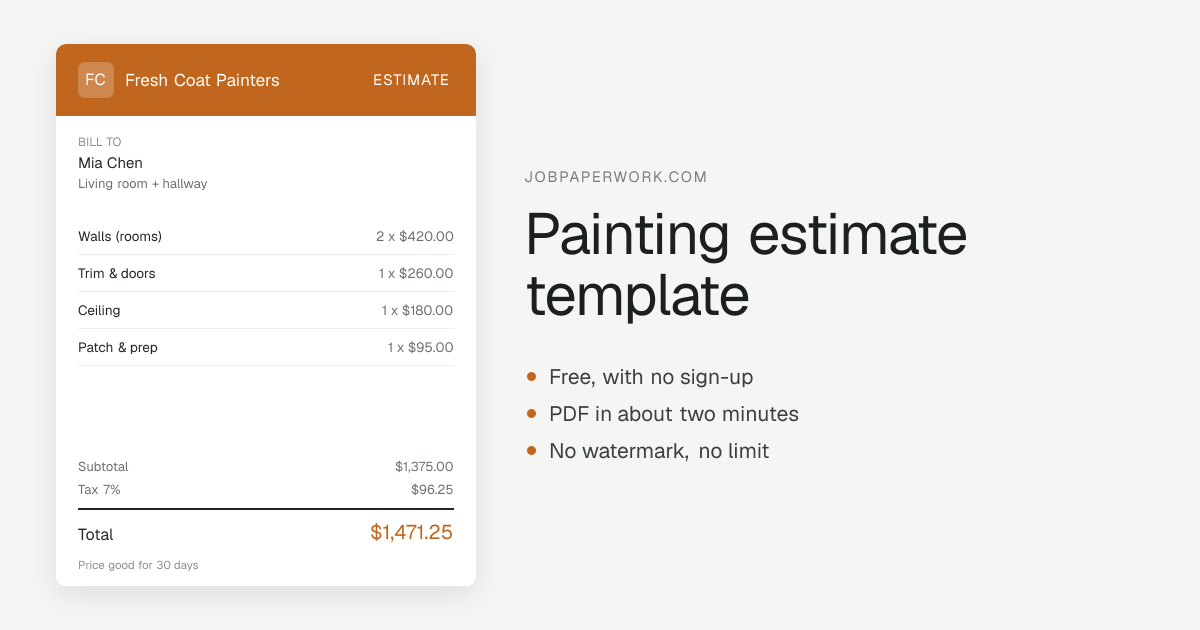
The sample line items and example prices this sheet opens with are on the painting invoice template — the same table, which is about the trade rather than about this paper, so it lives in one place rather than on all six. Working out the price itself? The markup calculator turns your cost and markup into the figure to put on the estimate, and shows the margin it leaves.
Surface area, prep and coats — where the number comes from
A painting estimate is priced on area and condition, not on the number of rooms, and the estimate should show it: the wall count or square footage, the number of coats, and the prep each surface needs. Two “three-bedroom house” jobs can differ by half again once one needs filling, sanding and a primer coat and the other does not, and the estimate is where that difference is explained rather than discovered on the final invoice.
- Interior and exterior priced separately, never blended into one figure
- Prep listed, not assumed — fill, sand, prime, mask
- The number of coats, and the extra coat a strong color change needs
- Trim, doors, ceilings and feature walls as their own lines
- Paint grade, and whether you supply it or the customer does
What will move the price, said up front
Say whether the price includes paint and at what grade, because “customer to supply” and “trade-grade paint included” are different jobs at different numbers. Then name the things that will move the figure — repairs found once the old coat is stripped, an extra coat over a dark color, access that needs scaffolding or a tower — so an overrun is a line you flagged rather than a surprise the customer feels ambushed by.
What you get
A PDF, and a link your customer can open in any browser. Word and Excel versions are not available yet — if a spreadsheet is what you need, this is not yet the tool for it, and saying so is cheaper for both of us than you finding out after typing everything in.
Pick how it looks
Six looks, from a plain classic sheet through a bold top band to a shop ticket, and your initials go on automatically until you upload a logo. See all six.
How to send it
Most customers want the paper on their phone, so the estimate goes out by WhatsApp, text or email, or as a link that needs no app and no account on their side. Or download the PDF to print it or keep it for your own records.
Questions
Do I price painting by the room or by the square foot?
By the room for interiors, because that is the unit the customer thinks in and the unit they will want to drop one of. Square footage is how you work the number out; it does not have to be how you present it. Exteriors are the other way round — elevations and square footage, because nobody agrees on what counts as a room outside.
Should prep be its own line?
Always, and it is the line that saves the job. Patching, sanding, caulking and masking are most of the hours on an older house and none of the thing the customer can see at the end. Buried in a total it looks like you charged a lot for paint; on its own line it is the work it actually is.
How do I handle the number of coats?
Say it on the estimate — two coats over primer, or one over an existing color — because it is the single easiest thing to be accused of having skipped. If a dark color is going light, say that it needs three and that the price assumes it.