

How to ask for a deposit on a job
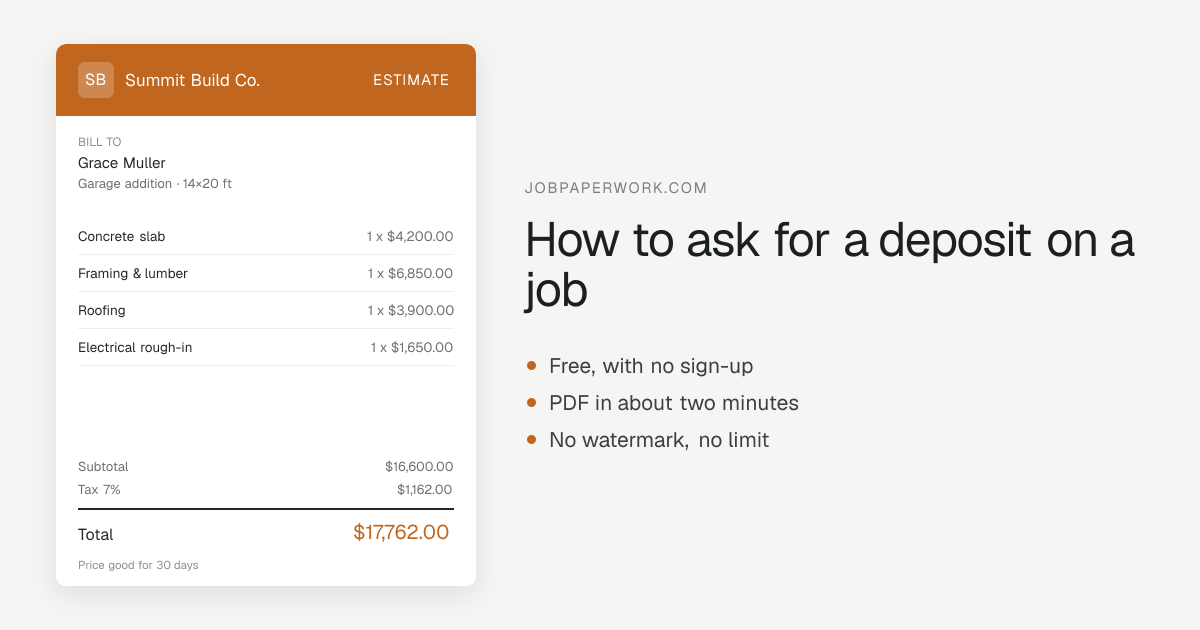
Put the deposit on the estimate as a line the customer reads and signs, not first on the invoice. Ask for enough to cover the materials you will buy for that job, say what it covers and whether it is refundable, and show it deducted from the full price on the final invoice.
Asking for money before you have done anything feels like the hardest conversation in the trade. It stops being a conversation at all the moment you stop asking and start printing it — on the estimate, as a line, alongside everything else they are agreeing to.
When a deposit is normal, and when it is not
A deposit is expected on anything where you buy materials for one customer: custom carpentry, flooring cut to a room, a special-order part, a building job. The material is worthless to you if they change their mind, and both of you know it.
It is unusual on a call-out repair, on small handyman work, or on anything you will finish the same day. Asking for one there reads as distrust rather than as normal practice, and you will lose jobs over it.
How much
Enough to cover what you are about to spend, which is the honest answer and also the easiest one to defend. If the materials are a third of the job, a third is not a number you plucked out of the air.
On larger construction work, a deposit plus stage payments beats a big single deposit. It is less money at risk for the customer, more predictable cash flow for you, and it gives them a smaller figure to approve each time.
Put it on the estimate, never first on the invoice
This is the whole trick. A deposit that appears as a line on the estimate is something the customer reads, considers and signs. A deposit first mentioned when you turn up is a request, and a request can be declined.
Same words, same number, completely different conversation — because one of them is part of what they already agreed to.
Say what it is for and whether it comes back
One line: what the deposit covers, and whether it is refundable if they cancel. Customers accept non-refundable deposits on custom work readily when the reason is written down, and resent them bitterly when they are not.
If it is refundable up to a point — before materials are ordered, say — then write that point down. Vagueness here always resolves in favor of whoever is angrier.
Show it on the final invoice, deducted
When the job is done, the invoice shows the full price, the deposit already paid as a deducted line, and the balance underneath. Never quietly invoice only the balance: the customer loses the record of what the job actually cost, which is exactly what they need if they claim it back or sell the house.
When the job changes after the deposit
A deposit was agreed against a scope. If the scope grows, the deposit does not automatically stretch to cover the new materials, and the moment to say so is when the change is agreed rather than when the final invoice lands.
Price the change on its own line, say whether it needs a further payment up front, and get both approved together. A customer who has already paid one deposit almost never objects to a second one on work they asked for — what they object to is finding out afterwards that you covered it yourself and are now asking.
If they say no
Some will. On custom work it is worth holding the line, because the risk is real and the deposit is the only thing covering it. A middle path that often works: a smaller deposit covering materials only, with the labor billed on completion.
A customer who refuses any deposit at all on a job that needs one is telling you something useful about how the final invoice is going to go.
Questions
Should I give a receipt for a deposit?
Yes, immediately, marked as a deposit against the job with the balance still owing shown underneath. It is the customer’s proof they paid and your proof of what it was for.
Is a signed estimate enough to hold them to the deposit?
It is far better than nothing and it is what most trades rely on, because it shows they saw the term and agreed to it. What it is worth if it ever goes further than a conversation depends on your state and the size of the job.
Can I ask for the whole amount up front?
On a small supply-only job, sometimes. On anything with labor in it, rarely — it removes the customer’s only leverage, and most will refuse. Stage payments get you most of the same protection without the resistance.