

What goes on a construction estimate
An estimate on a build is a document about uncertainty, and pretending otherwise is what turns one into an argument. Price what you can see, name what you cannot, and make the stages separable — a customer who can drop one stage will usually drop one rather than walk away from the lot.
- The date, and the date the price stops being good
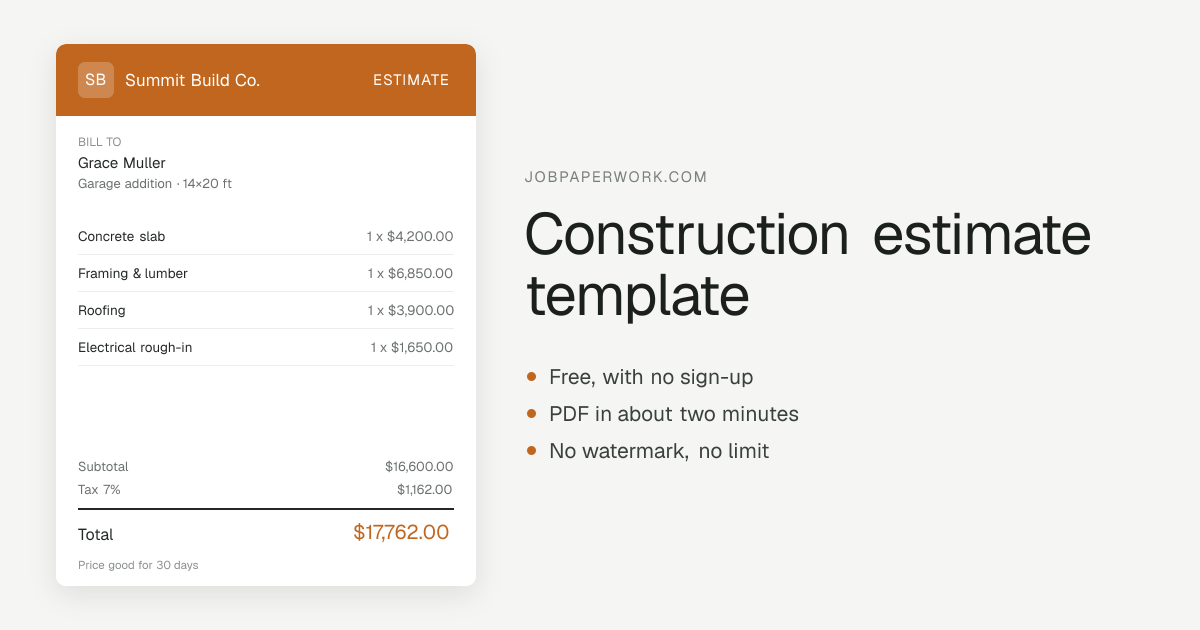
- Each stage of the build on its own line — slab, framing, roofing, rough-in
- Materials shown apart from labor, so either can be queried without the other
- Exclusions, named: ground conditions, what is behind the wall, what the inspector adds
- Allowances for anything specified later — fixtures, finishes, appliances
- The payment schedule, and what triggers each stage payment
- A signature line, because an accepted estimate is what starts the job
The sample line items and example prices this sheet opens with are on the construction invoice template — the same table, which is about the trade rather than about this paper, so it lives in one place rather than on all six. Working out the price itself? The markup calculator turns your cost and markup into the figure to put on the estimate, and shows the margin it leaves.
An estimate is not a quote — say so on the paper
On a construction job the difference between an estimate and a quote is money, so the paper should state plainly that this is an approximate figure that may move, not a fixed price. Break it down by stage, so a customer can see where the number comes from and so one element can be changed or dropped without re-pricing the whole build.
Name what you have had to assume
The honest construction estimate names its assumptions — ground conditions, the state of what is hidden behind a wall, materials at today’s price — because those are exactly what turn an estimate into a larger invoice. A customer who was told the assumptions up front accepts the revision; one who was not, disputes it.
What you get
A PDF, and a link your customer can open in any browser. Word and Excel versions are not available yet — if a spreadsheet is what you need, this is not yet the tool for it, and saying so is cheaper for both of us than you finding out after typing everything in.
Pick how it looks
Six looks, from a plain classic sheet through a bold top band to a shop ticket, and your initials go on automatically until you upload a logo. See all six.
How to send it
Most customers want the paper on their phone, so the estimate goes out by WhatsApp, text or email, or as a link that needs no app and no account on their side. Or download the PDF to print it or keep it for your own records.
Questions
How detailed should a construction estimate be?
Detailed enough that each stage can be priced, queried or dropped on its own — slab, framing, roofing, rough-in. One figure for the whole job gives the customer nothing to agree to but the total, and nothing to compare against the next quote.
What should it say about things you cannot see yet?
Name them as exclusions, with your assumption written down: ground conditions, what is behind the wall, what the inspector will ask for. An estimate that says nothing about the unknowns gets read as a promise about them.
Should the estimate include a payment schedule?
Yes — deposit, stage payments and balance, with what triggers each. The schedule is as much a part of what the customer is agreeing to as the price, and settling it at signature is far easier than raising it halfway up a wall.