

What goes on a carpentry invoice
Custom carpentry is priced on materials, shop time and install time, and those three move independently. An invoice showing all three is what lets a customer understand why the oak version cost what it did.
- The piece or job, described well enough to identify it later
- Lumber and sheet stock, by species and quantity
- Hardware — hinges, drawer slides, fasteners — on its own line
- Shop or build hours, separately from install hours
- Finishing: sanding, staining, sealing
- Delivery and install, including anything that needed two people
Sample line items and example prices
These are the sample lines and example prices this invoice opens with. They are starting points, not a survey of what anybody charges and not a recommendation — adjust every item to match your work, your rates and your customer before you create the PDF.
| Job | Usual quantity | Opens at |
|---|---|---|
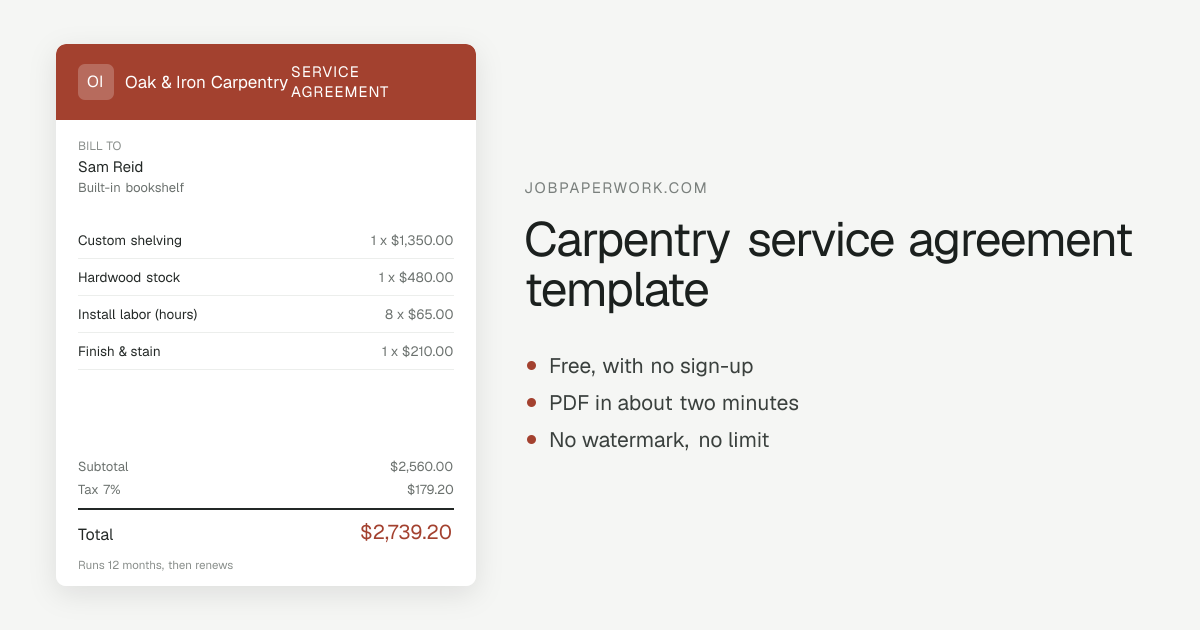
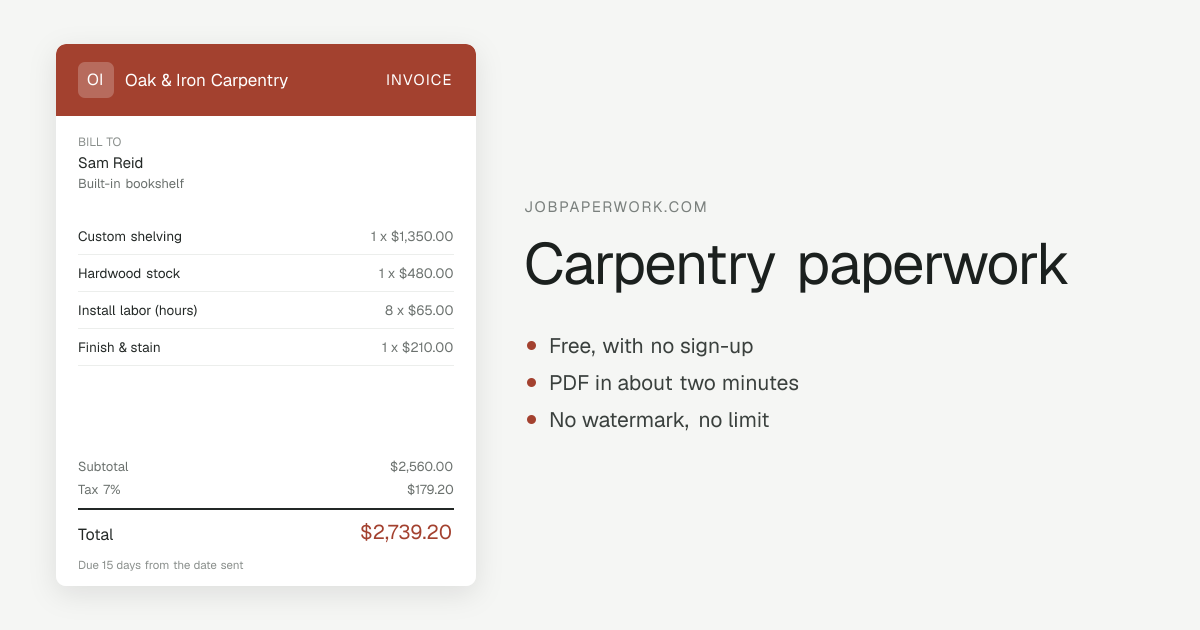
| Custom shelving | 1 | $1,350.00 |
| Hardwood stock | 1 | $480.00 |
| Install labor (hours) | 8 | $65.00 |
| Finish & stain | 1 | $210.00 |
Add, delete or rename any line. The math, the tax and any discount are worked out as you type. Setting the terms? The invoice due date calculator turns Net 15, 30 or 60 into the exact date to put on the invoice.
One carpentry invoice template: free, editable, printable and yours
Free carpentry invoice template
Free means the whole thing: no sign-up to start, no watermark on the PDF, no limit on how many carpentry invoices you make, and no card asked for at any point. An account is optional, and only does one job — keeping your papers in step between a phone and a computer.
Editable carpentry invoice template
It opens with 4 jobs a carpentry business usually bills — custom shelving, hardwood stock, install labor (hours) — already priced, so most of the typing is done. Every line can be renamed, repriced or deleted, new ones added, and the subtotal, tax and any discount recalculate as you type.
Printable carpentry invoice template
Print it straight from the browser and only the invoice prints — no menus, no buttons — on whatever paper your printer holds. Or save it as a PDF to email, text or keep, and the customer’s copy is the same sheet you saw on screen.
Custom carpentry invoice template
Your business name, phone and address go at the top, with your logo if you upload one or your initials if you do not. Six looks to choose from, 5 accent colors, and your own payment terms in the footer — a carpentry invoice that looks like it came from your business, not from a website.
Every carpentry paper, as it comes out
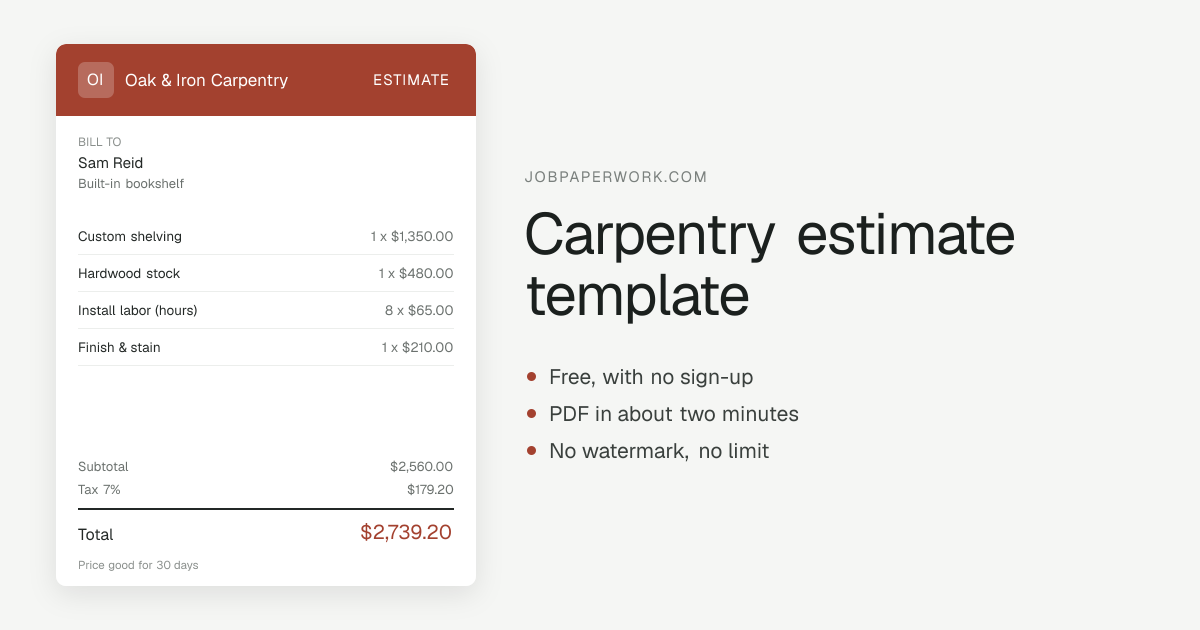
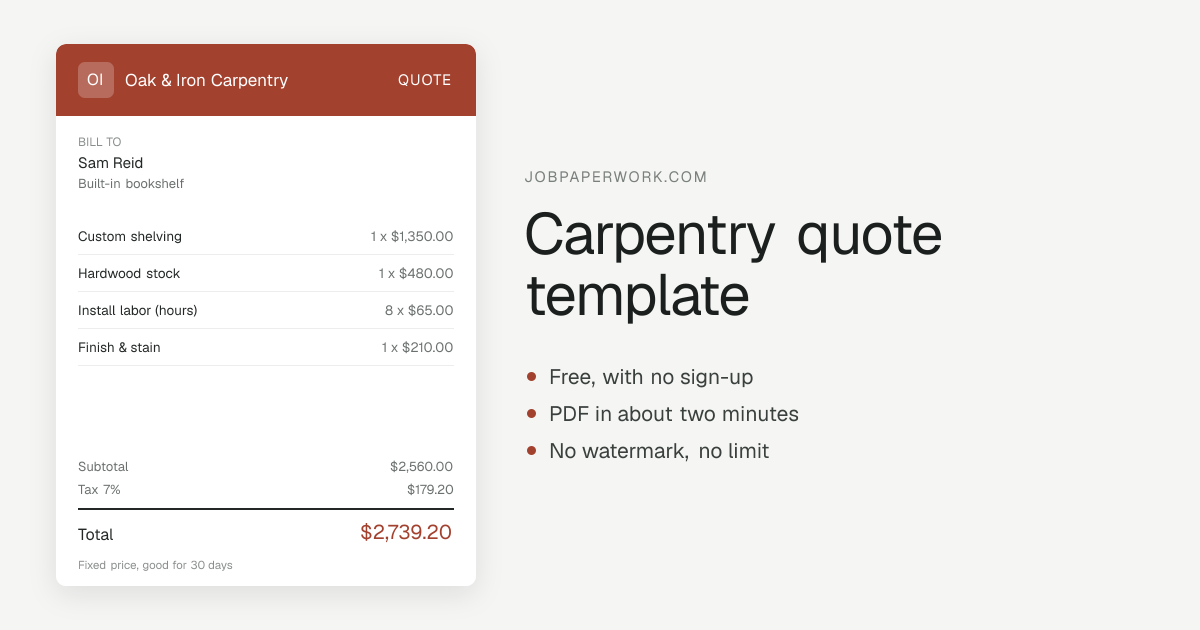
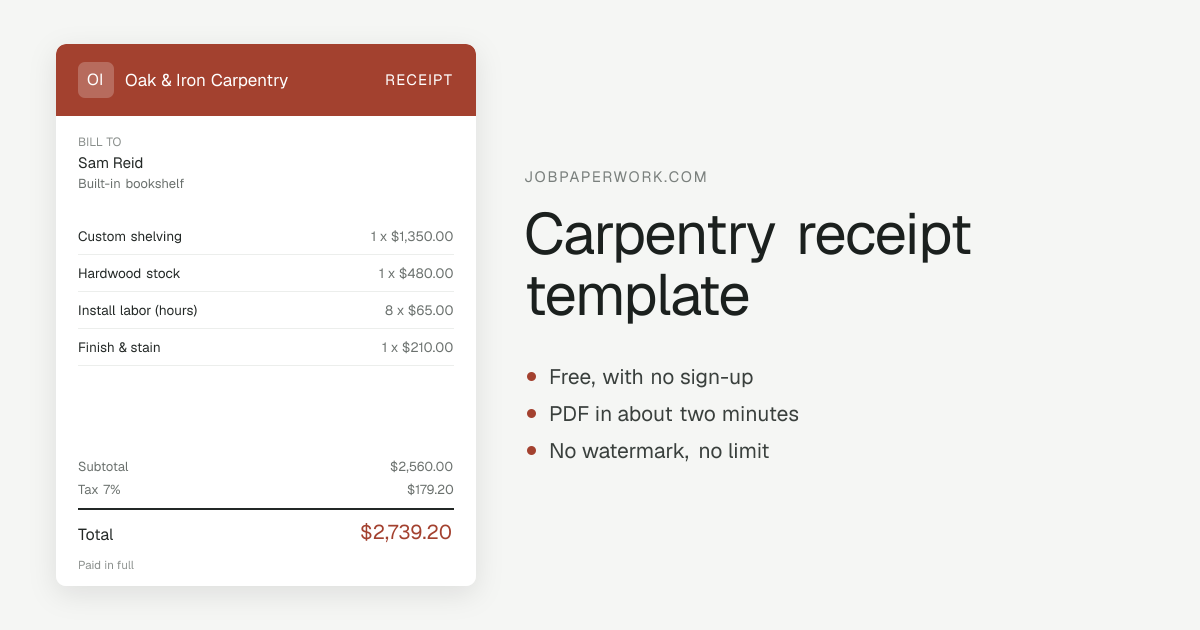
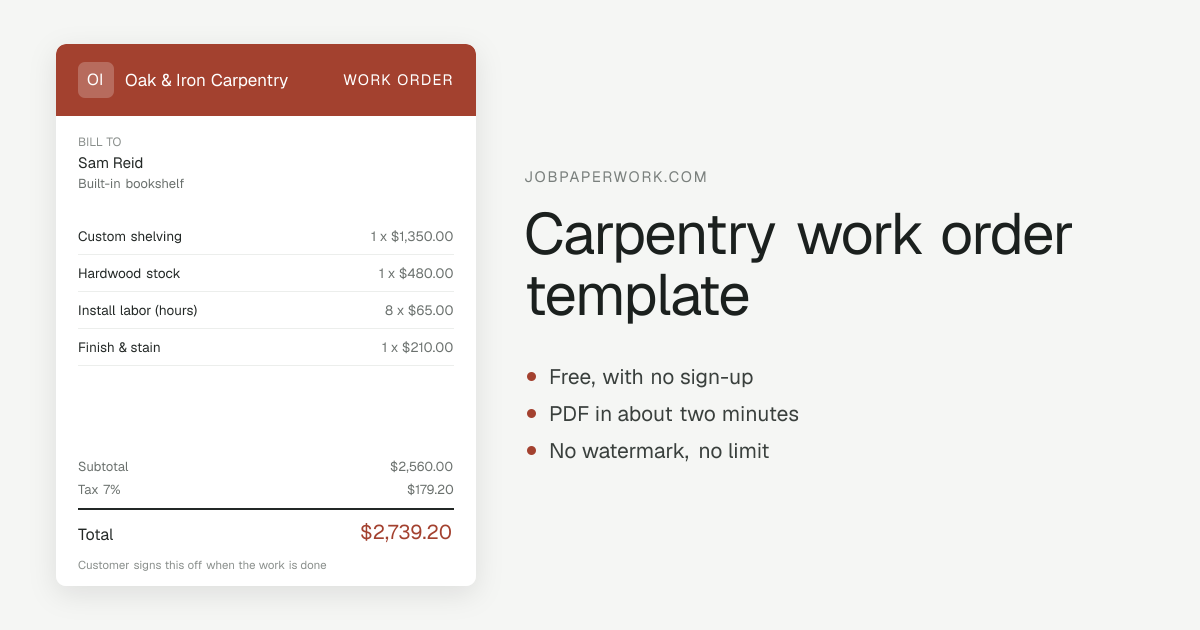
The same jobs and the same look carry across all six papers, so one carpentry job can move from estimate to invoice to receipt without retyping.
What you get
A PDF, and a link your customer can open in any browser. Word and Excel versions are not available yet — if a spreadsheet is what you need, this is not yet the tool for it, and saying so is cheaper for both of us than you finding out after typing everything in.
Pick how it looks
Six looks, from a plain classic sheet through a bold top band to a shop ticket, and your initials go on automatically until you upload a logo. See all six.
How to send it
Most customers want the paper on their phone, so the invoice goes out by WhatsApp, text or email, or as a link that needs no app and no account on their side. Or download the PDF to print it or keep it for your own records.
Questions
How do I price custom work the customer has never bought before?
Break it into materials, build hours and install hours, and show all three. A single number invites haggling; three numbers invite a conversation about which part to change.
Should I take a deposit on a custom build?
On anything where the materials are bought for one customer, yes — the lumber is no use to you if they change their mind. Put the deposit on the estimate as its own line so they approve it when they sign.
What if the customer changes their mind mid-build?
Stop, price the change as its own line, and get it approved before cutting anything else. Lumber already cut to the old design is not returnable, which is exactly why the deposit and the signed estimate exist.
Should I mark up the lumber and hardware I buy for a carpentry job?
Most carpenters do, because picking boards, hauling them and carrying the cost until the customer pays is real work. Show each material at the price you charge — species, dimensions and board feet for lumber, brand and model for hinges and drawer slides — and buy a waste allowance into the quantity rather than billing offcuts later. If a customer asks to see receipts, state your markup policy on the estimate so it is not a surprise on the invoice.
How do I bill custom millwork differently from stock trim off the rack?
Give them separate lines. Stock casing and baseboard are priced per linear foot as bought plus install labor. Custom profiles carry costs stock does not: grinding a knife or buying a router bit, a setup charge, and the run itself, usually priced per linear foot with a minimum. Name the profile or drawing number on the invoice, so matching it in another room later is a reorder rather than a fresh setup.
Should shop hours and on-site install hours be billed at different rates?
Many carpenters do, and either way they belong on separate lines. Shop time runs on your own tools under your own roof; install time includes driving, protecting floors, scribing to walls and working around the household, and is often billed higher or with a two-person rate for heavy pieces. Splitting them shows the customer why a built-in costs more than the same cabinet delivered, and shows you which half of the job you underestimated.
Do I bill finishing separately if the customer wants their painter to do it?
Price finishing — sanding, stain, primer, paint or clear coat — as its own line on every estimate so it can be removed cleanly. If the customer takes it out, write "supplied unfinished, sanded to 150 grit" or whatever you actually delivered on the invoice. That line is what you point to when a painter’s finish raises the grain or shows blotching and the question becomes whose work caused it.
Is sales tax different on a freestanding piece versus a built-in I install?
In many states it is. A table or bookcase you build and deliver is often treated as a sale of goods, taxed on the full price, while cabinetry fastened to the house may count as an improvement to real property, where you pay tax on materials and do not charge it on the job. The rules differ widely, so check with your state department of revenue, and describe on the invoice whether the piece was delivered or installed.
Can I charge for design time and drawings on a custom piece the customer might not order?
Yes, and many custom shops do once a project needs more than a sketch: measured drawings, renderings or finish samples take hours. Quote the design fee up front as its own line, and say whether it is credited against the build if they go ahead. Put on the paper who owns the drawings if they take the design to another shop, because that question tends to come up exactly then.