

Do you charge sales tax on labor?
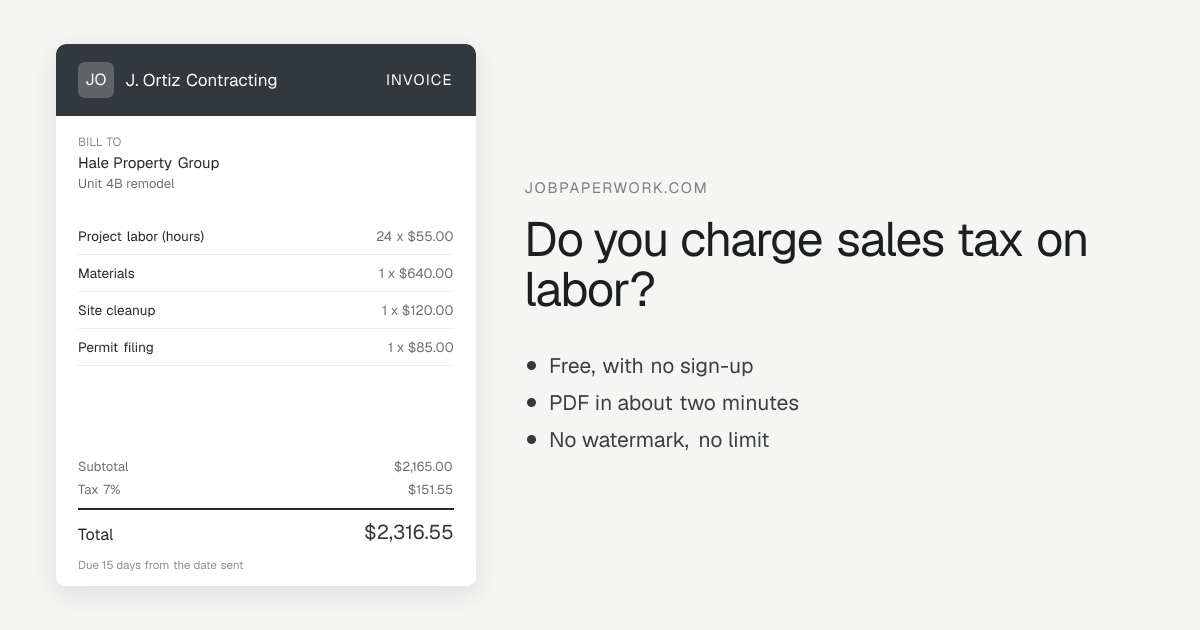
It depends on your state, sometimes your county; there is no national rule. Parts are usually taxable as goods. Labor often turns on whether the job is a repair or an improvement, and whether the work is on a building or a thing. Itemize parts and labor separately, and ask your state department of revenue.
This is the most asked question in trade paperwork and the one with the worst answers online, because people answer it as though there were a national rule. There is not. What there is, is a small set of questions every state asks in some form — and once you know them, the invoice almost writes itself.
Nobody can answer this for you, and be wary of anyone who tries
Sales tax is set state by state, and in plenty of places county by county on top. Two plumbers forty miles apart can both be right and charge differently. Any page that tells you flatly whether to tax labor, without asking where you are or what trade you are in, is guessing with your money.
What follows is how to think about it and where to get the actual answer. It is not tax advice, and your state’s department of revenue is the only source that binds anybody.
Question one: is anything tangible changing hands?
Most states tax tangible goods by default and treat services as the exception. So the parts on your invoice are usually the easy part — they are goods, and they are usually taxable.
Labor is where it gets interesting, because pure labor with no materials often falls outside the net entirely, while the same labor attached to a part may be dragged inside it.
Question two: is it a repair or an improvement?
A great many states draw a line between fixing something that exists and installing something new, and they tax the two differently. Replacing a failed water heater and plumbing in a second bathroom can land on opposite sides of that line even though the same person did both in the same week.
This is the distinction most people miss, and it is why “do you charge tax on labor” has no answer until somebody says which job they mean.
Question three: real property, or personal property?
Work on a building is often treated differently from work on a thing. Fitting a dishwasher into a kitchen and repairing one on a bench can carry different treatment, because one became part of the house and one did not.
Trades that work on both — electricians, carpenters, HVAC — are the ones most likely to need two answers rather than one.
Whatever the answer is, separate parts from labor
This is the practical conclusion, and it holds in every state. If the two are on separate lines, you can apply tax to one, the other, or both, and change it later without reconstructing anything.
If they are combined into one line, some states will tax the whole line — including the labor you might not have owed tax on — simply because you did not show it separately. The lazy invoice is the expensive one.
Where to actually check
Your state department of revenue publishes guidance by industry, and most have a page specifically for contractors and repair trades. That is the document to read, and it is usually clearer than its reputation.
If your work crosses state lines, or you are not sure whether what you do counts as improvement, an hour with an accountant who knows your trade is the cheapest hour you will spend. Getting this wrong compounds quietly across every invoice until somebody notices.
Setting it up once
In JobPaperwork, the tax rate is set once in your business details and applied to the subtotal, and every paper keeps parts and labor on their own lines by default. Change the rate and it follows through to everything you make afterwards — so the decision above is one you make once rather than per invoice.
Official sources
This guide explains how the rules usually work; these are the bodies that actually decide them where you are. Check them before you rely on anything above.
- Find your state department of revenue (Federation of Tax Administrators)
- Sales and use tax, state by state (U.S. Small Business Administration)
Last checked 26 October 2026. This is general information, not tax or legal advice.
Questions
What if I have been doing it wrong?
Talk to an accountant rather than quietly changing it and hoping. States generally care more about being told than about being right first time, and voluntary correction is usually treated very differently from a discrepancy they find themselves.
Do I charge tax on a call-out fee?
It follows the same three questions — it is a service charge, so whether it is taxable usually depends on what the visit was for and how your state treats that work. Put it on its own line and you can apply whichever answer you are given.
My customer says they are tax exempt. What do I do?
Ask for their exemption certificate and keep a copy with the job. Taking somebody’s word for it leaves you, not them, holding the liability — the certificate is the thing that transfers it.