

How to write a plumbing invoice
A plumbing invoice lists your business details, the customer and job address, invoice number and date, the reported fault and what you found, the call-out fee on its own line, labor as hours × rate with any out-of-hours rate separate, each part noting any the customer supplied, tax, total, due date and warranty term.
Most plumbing disputes are not about the work. They are about a number the customer did not expect to see, and almost always one of three: the call-out, the out-of-hours rate, or a fixture they thought was included. Here is the order that heads all three off.
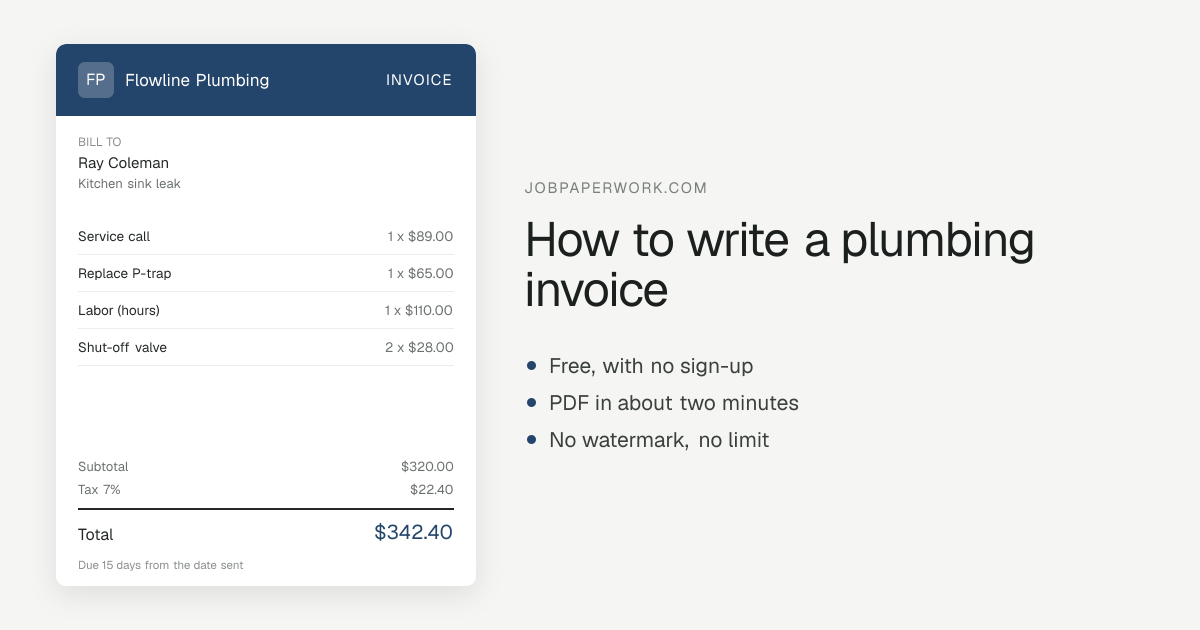
Start with what they rang about, not what you found
Put the reported fault at the top — “kitchen sink leaking” — and what you actually found underneath it. On a job where the two differ, that gap is the whole justification for the bill, and writing it down at the time is far easier than reconstructing it six weeks later when somebody queries the total.
It also protects you on the jobs that turn out to be nothing. An invoice that says the reported fault was a leak and the finding was a loose compression nut explains why a ten-minute visit still costs a call-out.
The call-out is its own line, always
Whether your call-out includes the first hour or is charged on top of it, the invoice should show it separately. Rolling it into the labor hides the one number the customer already agreed to on the phone, and makes the labor look higher than it is.
Say which it is before you drive out. A call-out that covers the first hour and one that does not are the same word for two different deals, and the customer will remember whichever is cheaper.
Labor as hours × rate, with the out-of-hours rate visible
Hours multiplied by a rate, not a lump sum. A lump sum invites the question “how long were you actually there”, and you will not enjoy answering it from memory.
If the job ran into an evening, a weekend or a holiday, put the higher rate on its own line rather than quietly using a bigger hourly number. A surcharge the customer can see is a surcharge they argue with once; one they have to work out from the math is one they tell other people about.
Parts and fixtures: supplied, or only fitted
Every part gets its own line with a quantity. The important distinction is whether you supplied the fixture or fitted one the customer bought, because it decides who is responsible when it fails.
If you fitted their part, say so on the invoice. It is one short line, and it is the difference between a warranty conversation and a free return visit.
Keep parts and labor apart for tax
A good many states treat materials and labor differently for sales tax, and some treat a repair differently from an improvement. Separating the two while you are writing the invoice costs nothing; separating them afterwards, across a year of invoices, costs a weekend.
What applies to your trade in your state is a question for your state, not for a template — there is more on how to frame it in the guide on sales tax on labor.
Say what the warranty covers, and for how long
One line. What is covered, and the term. Plumbers who put it on every invoice get noticeably fewer “you were here in March” phone calls, because the customer can check the answer themselves.
Get paid before you pack up
A plumbing job is finished the moment the leak stops, and that is the moment it is worth the most to the person who called you. On domestic work, take payment there and hand over the receipt — chasing a $180 call-out costs more in your time than the call-out was worth.
What it looks like put together
In order, a plumbing invoice that does not get queried reads roughly like this:
- Your business name, phone and logo
- The customer, and the address the work was done at
- Invoice number and date
- Reported fault, and what you found
- Call-out or service fee
- Labor — hours × rate, with any out-of-hours line separate
- Parts and fixtures, one per line, noting any the customer supplied
- Subtotal, tax, total, and the date it is due
- Warranty term, and how you want to be paid
Questions
Should I invoice before or after the work?
After, for a repair — you cannot price what you have not found yet. Send an estimate first on anything larger, and invoice against it when the work is done so the customer is comparing two documents that match.
What if the job needs a part I have to come back with?
Invoice the visit, and put the return trip on the estimate rather than assuming it is free. Two short visits cost you more than one long one, and a customer told that up front almost never objects.
Do I need to itemize if the customer agreed a flat price?
You do not have to, but itemizing a flat-rate job still helps — it shows what the price covered, which is what the customer needs if they claim it back or compare you with somebody else next year.