

Free quote templates for every trade
A quote is a price you are committing to. That is the whole difference between a quote and an estimate, and it is why a quote has to say exactly what it covers — once it is accepted, anything you left out is work you have agreed to do for nothing.
Pick your trade
Each has a page of its own — what goes on a quote in that trade, what that trade bills for, and the questions it actually gets asked. The sheet opens with that trade’s usual jobs and prices already filled in.
What goes on a quote
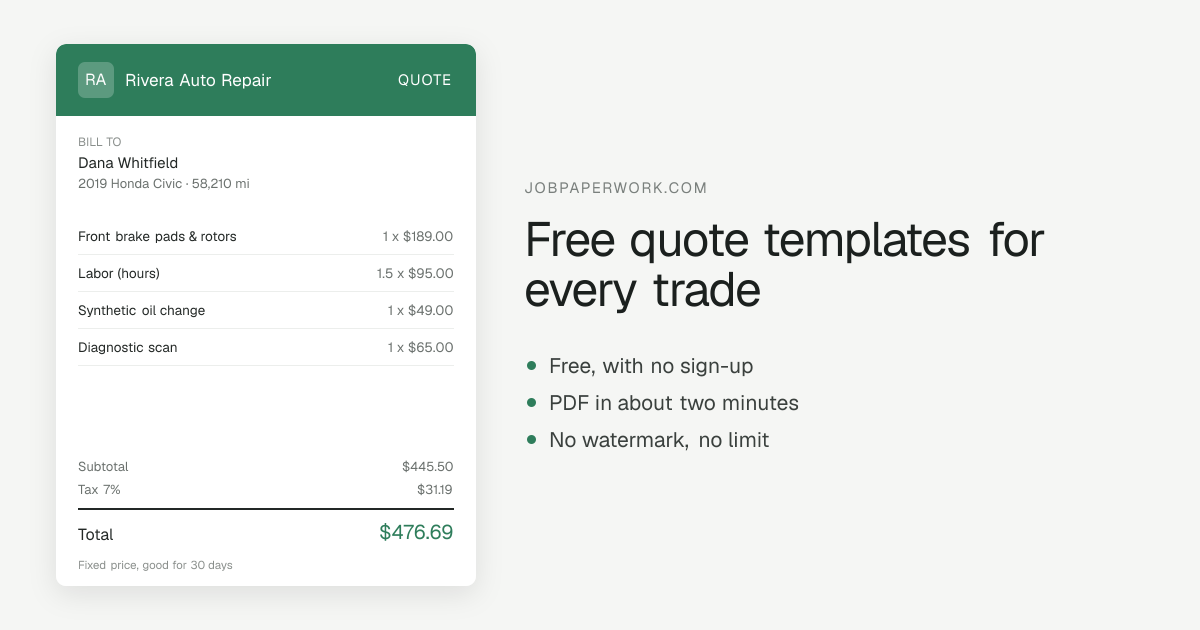
- The date, and how long the price stands
- Every item of work the price includes, written tightly enough to hold
- What is excluded, named rather than implied
- The fixed total, and whether tax is on top of it or inside it
- What happens if the job turns out different — how a variation gets priced
- A line for the customer to sign, because a quote is accepted rather than noted
Settling on the figure? The markup calculator turns what the job costs you and the markup you add into the price to write on the quote — and shows the margin that price actually leaves.
Quote templates by trade
What a quote has to pin down depends on what the price in that trade hangs on. These are five trades whose quotes people search for by name, and what each one’s quote needs to say that the others do not.
Contractor quote: allowances, and what happens when the wall comes open
Most contractor quotes are for work on a house somebody is living in, and two things decide whether the price holds. The first is allowances: the tile, the vanity, the light fittings the homeowner has not chosen yet, each written as a dollar figure with what happens if their pick costs more. The second is what is behind the wall — rot, old wiring, a joist somebody notched. Say the price assumes sound framing and that anything found is a change order at a stated rate. Then the living-around-it terms: working hours, which rooms are closed off, dust protection and daily clean-up. Independent contractor quote template.
Construction quote: price it against a named drawing set and a date
A construction quote is only as fixed as the drawings it was priced from, so name them — the set, the revision and the date. When revision C turns up, the quote says plainly that it was priced on B. Lumber, steel and concrete move fast enough that the validity period matters more here than in any service trade; keep it short and print it. Then the site: ground conditions assumed, access for deliveries and plant, temporary power and water, who carries the permits. On anything billed in stages, attach the schedule of values now, because it is what every progress invoice will be measured against. Construction quote template.
HVAC quote: the equipment by model, and the sizing it is based on
An HVAC quote is compared against the next one box by box, so name the equipment exactly: make, model number, tonnage and efficiency rating, for both the outdoor and indoor unit. Say whether the size came from a load calculation or simply matches the old system, because that is the question a careful buyer asks. Then the parts that decide the real cost: the line set reused or replaced, ductwork changes or none, the electrical disconnect and breaker, the condensate drain, the thermostat, the permit, and hauling the old unit away. Keep the manufacturer’s warranty and your labor warranty as two separate lines, and name any rebate rather than netting it off the price. HVAC quote template.
Electrical quote: a point count by room, and the wall it assumes
An electrical quote is a schedule of points — outlets, switches, fixtures and circuits, counted room by room — and a price per extra point for when the customer changes their mind. Say what construction the price assumes, because fishing cable through open studs and through plaster on lath are not the same day’s work. If the job touches the service or the panel, say that the utility’s disconnect and reconnect run on the utility’s schedule, not yours. Then the permit and inspection, who supplies the fixtures, and who patches the drywall after — the line most often assumed by both sides to be the other’s. Electrical quote template.
Painting quote: prep, coats and product, written down before the brush
Two painting quotes for the same room can be a day apart, and the difference is almost always prep. Write down what yours includes — scraping, sanding, filling, caulking, spot-priming — and what it does not, such as rotten trim, which is better priced per board than absorbed. Then the coats, the product line and sheen, and how many colors, since every extra color adds cutting-in. Say who moves the furniture and covers the floors. On a home built before 1978, the EPA’s lead-safe renovation rule can apply to disturbing old paint, and the quote is the place to say how that work is handled. Painting quote template.
How to send it
Most customers want the paper on their phone, so the quote goes out by WhatsApp, text or email, or as a link they can open without installing anything. You can download the PDF instead if you would rather print it or keep it for your own records.
Pick how it looks
Six looks, from a plain classic sheet to a bold top band or a shop ticket, and your initials or logo are placed automatically. See all six looks.
Questions about quotes
What is the difference between a quote and an estimate?
A quote is a price you are bound to. An estimate is your best guess at a price, and saying so is what lets it move when the job does. If you send a document headed “quote” and then ask for more, the customer is entitled to be annoyed about it — so use the word you mean, and if you are not sure which you mean, it is an estimate.
Is a quote legally binding?
In most of the US a quote the customer has accepted is an offer they have accepted, which is a contract — and that is the point of it. What protects you is not vagueness but precision: say exactly what the price covers, name what it excludes, and say how a variation gets priced. A tight quote is safer than a woolly one.
How long should a quote stay open?
Thirty days is the convention and it is worth printing on the paper. Material prices are the reason — a quote with no expiry is a price you have agreed to hold for as long as the customer feels like thinking about it. If they come back later, requote.
Can I turn a quote into an invoice once the work is done?
Yes, and it is the easiest way to keep the numbers honest: the invoice should match the quote line for line unless something was agreed in between, and anything that did change gets its own line so the difference is visible rather than buried in a total.
What is the difference between a quote and an estimate here?
A quote is a fixed price for the work as described, and the customer signs to accept it. An estimate is your best figure before the work starts and can move if the job does. Both carry a signature line and a date the price holds until.
More on how JobPaperwork works, including what it stores and what it does not do, and the guides for the questions that need more than a paragraph.