

What goes on a mechanic quote
Quotes are rare in a shop, because most of what arrives has to be opened before anybody knows what it needs. Where one fits is the job you can see the whole of beforehand — a clutch, a timing belt on a model you have done twenty of. For those a fixed price wins the work, because what the customer is actually afraid of is the open-ended bill.
- The exact job, named by the part and the operation rather than as “engine work”
- The vehicle and the engine variant, since one model can take two different belts
- Parts and labor as a single fixed figure, with the breakdown underneath if they want it
- What voids the price: a seized bolt, a scored pulley, a leak found behind the cover
- Whether the old parts are returned to them, which some customers do ask for
- The warranty on the work, and how long it runs
- How long the price stands, which matters while parts prices are moving
The sample line items and example prices this sheet opens with are on the mechanic invoice template — the same table, which is about the trade rather than about this paper, so it lives in one place rather than on all six. Working out the price itself? The markup calculator turns your cost and markup into the figure to put on the quote, and shows the margin it leaves.
What you get
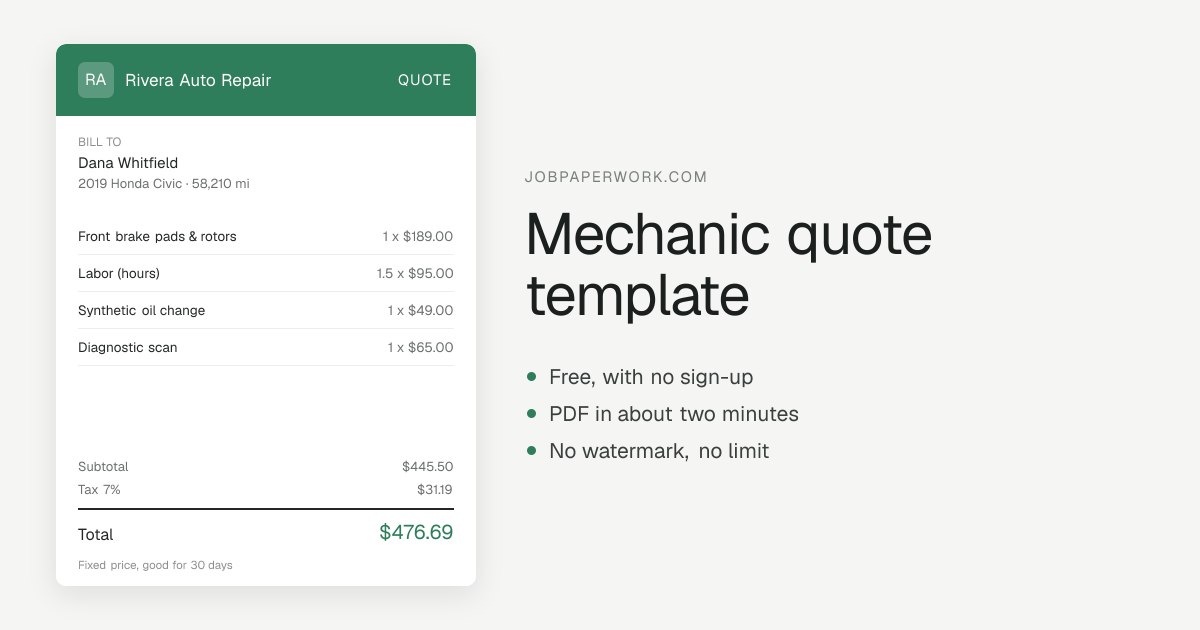
A PDF, and a link your customer can open in any browser. Word and Excel versions are not available yet — if a spreadsheet is what you need, this is not yet the tool for it, and saying so is cheaper for both of us than you finding out after typing everything in.
Pick how it looks
Six looks, from a plain classic sheet through a bold top band to a shop ticket, and your initials go on automatically until you upload a logo. See all six.
How to send it
Most customers want the paper on their phone, so the quote goes out by WhatsApp, text or email, or as a link that needs no app and no account on their side. Or download the PDF to print it or keep it for your own records.
Questions
When should I quote rather than estimate?
When you can see the whole job before you start it. A timing belt on a model you have done twenty of is a quote. Anything that has to come apart before you know what it needs is an estimate, and calling that a quote is a promise you have no way to keep.
What if the job turns out worse once it is apart?
That is what the “what voids this” line is for — a seized bolt, a scored pulley, a leak behind the cover. Written down, a nasty surprise is a conversation you already set up. Left out, the fixed price covers it, because that is what fixed means.