

What goes on a handyman invoice
A handyman invoice is usually a list of small unrelated jobs, and that is exactly how it should read. One line per task with its own price is what stops the customer asking what the lump sum was for.
- Each task on its own line, described the way the customer asked for it
- Either a per-task price or hours × rate — but consistent across the invoice
- A minimum call-out, if you have one
- Materials you supplied, with quantities
- Anything you looked at and did not do, and why
- Any task that needs a licensed trade, flagged as such
Sample line items and example prices
These are the sample lines and example prices this invoice opens with. They are starting points, not a survey of what anybody charges and not a recommendation — adjust every item to match your work, your rates and your customer before you create the PDF.
| Job | Usual quantity | Opens at |
|---|---|---|
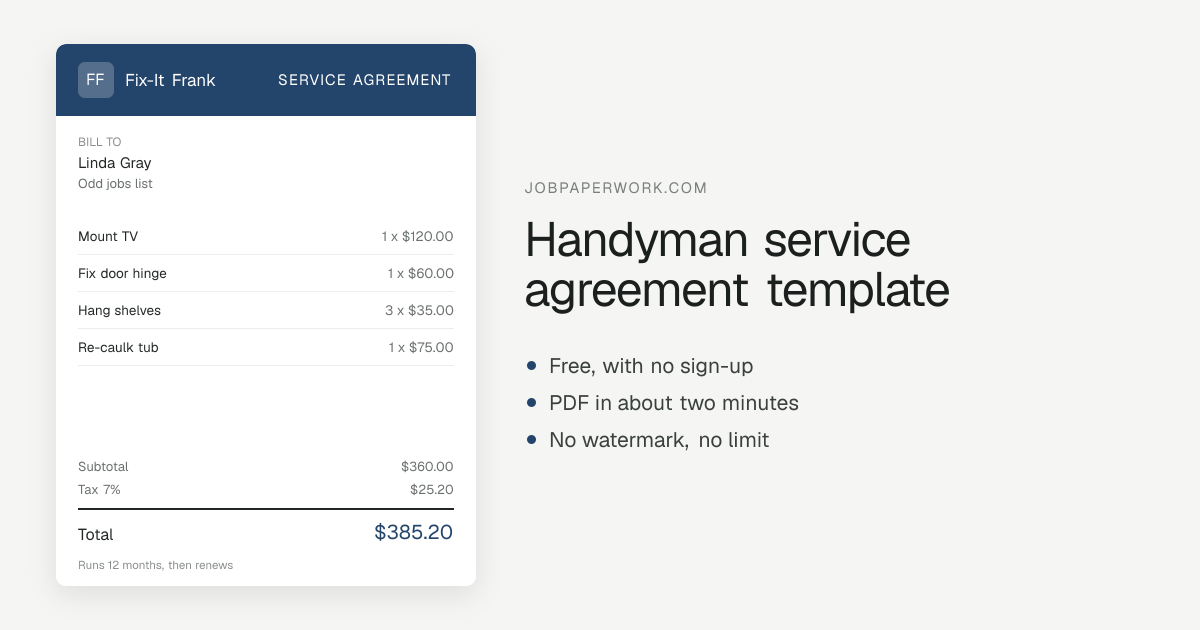
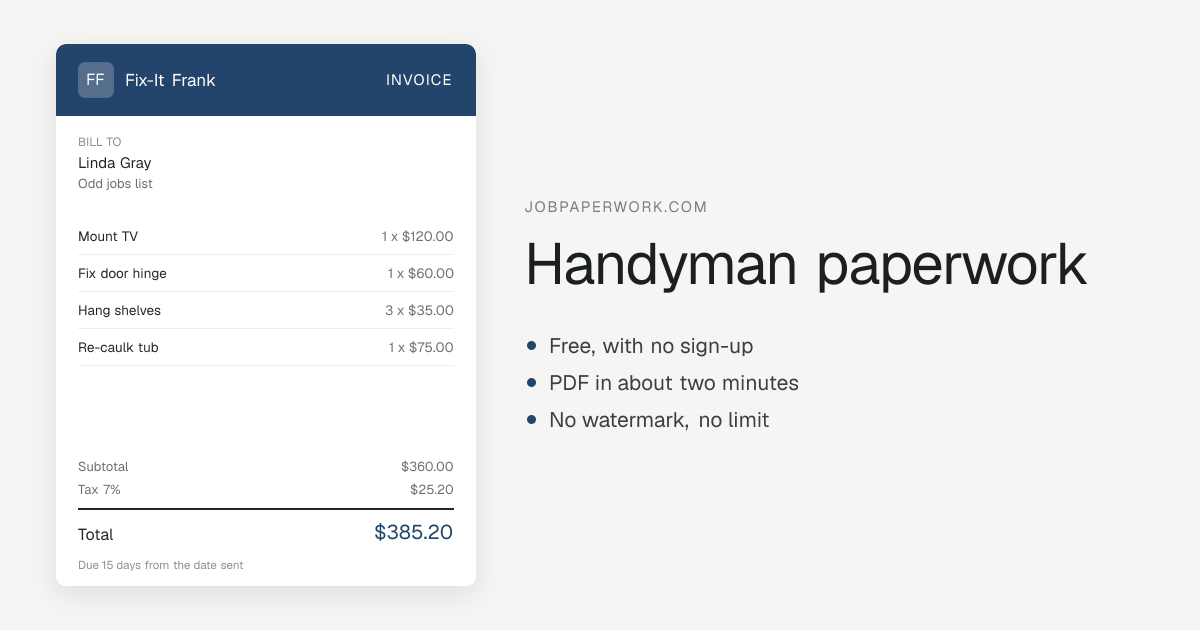
| Mount TV | 1 | $120.00 |
| Fix door hinge | 1 | $60.00 |
| Hang shelves | 3 | $35.00 |
| Re-caulk tub | 1 | $75.00 |
Add, delete or rename any line. The math, the tax and any discount are worked out as you type. Setting the terms? The invoice due date calculator turns Net 15, 30 or 60 into the exact date to put on the invoice.
Several small jobs on one visit
The handyman invoice is unusual in that one visit is often five unrelated jobs — a door rehung, a shelf put up, a faucet washer, two pictures, a smoke alarm — and the customer wants to see each of them, not a single “4 hours labor”. List the tasks, then the labor and the materials, so the person paying can tie the money to the things that are now fixed.
The starting point for a trade we do not list
If your trade is not one of the twenty here, the handyman invoice is the one to start from: it already assumes mixed small jobs, labor and materials, and a call-out, which is the shape most trade invoices share. Rename the lines to your work and it becomes your trade’s invoice.
One handyman invoice template: free, editable, printable and yours
Free handyman invoice template
Free means the whole thing: no sign-up to start, no watermark on the PDF, no limit on how many handyman invoices you make, and no card asked for at any point. An account is optional, and only does one job — keeping your papers in step between a phone and a computer.
Editable handyman invoice template
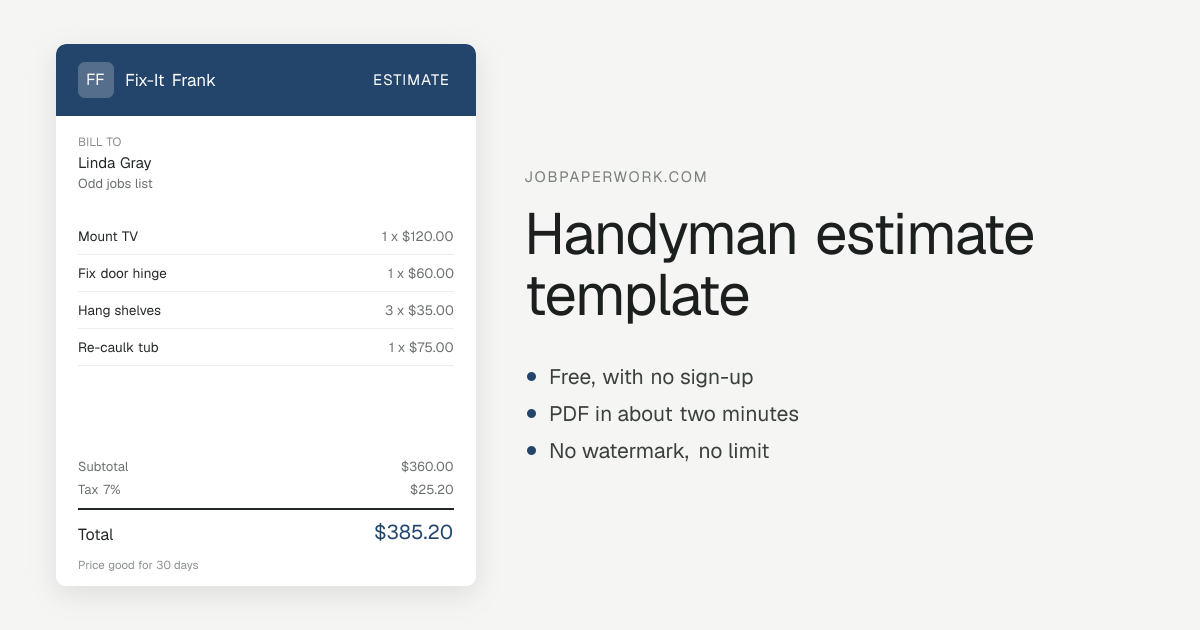
It opens with 4 jobs a handyman business usually bills — mount tv, fix door hinge, hang shelves — already priced, so most of the typing is done. Every line can be renamed, repriced or deleted, new ones added, and the subtotal, tax and any discount recalculate as you type.
Printable handyman invoice template
Print it straight from the browser and only the invoice prints — no menus, no buttons — on whatever paper your printer holds. Or save it as a PDF to email, text or keep, and the customer’s copy is the same sheet you saw on screen.
Custom handyman invoice template
Your business name, phone and address go at the top, with your logo if you upload one or your initials if you do not. Six looks to choose from, 5 accent colors, and your own payment terms in the footer — a handyman invoice that looks like it came from your business, not from a website.
Every handyman paper, as it comes out
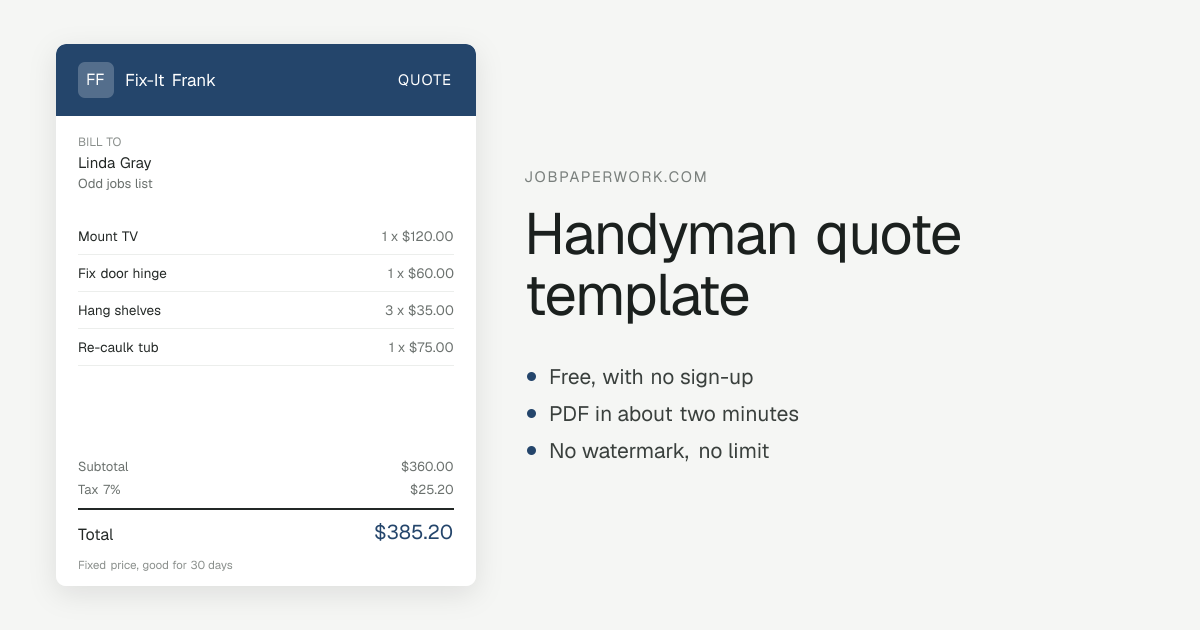
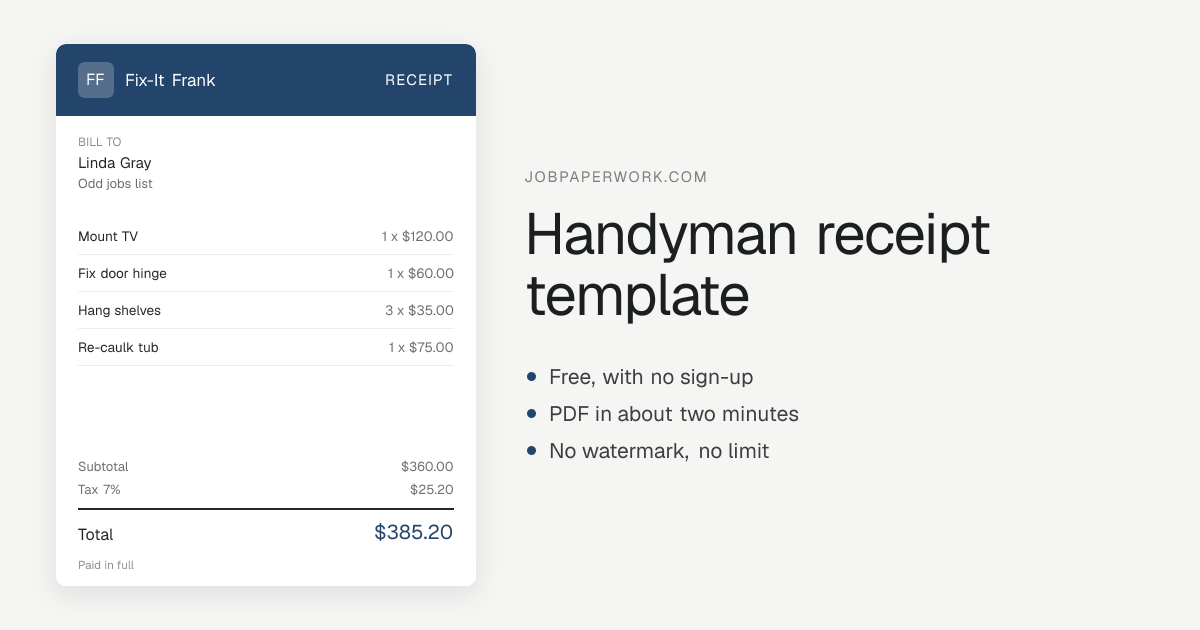
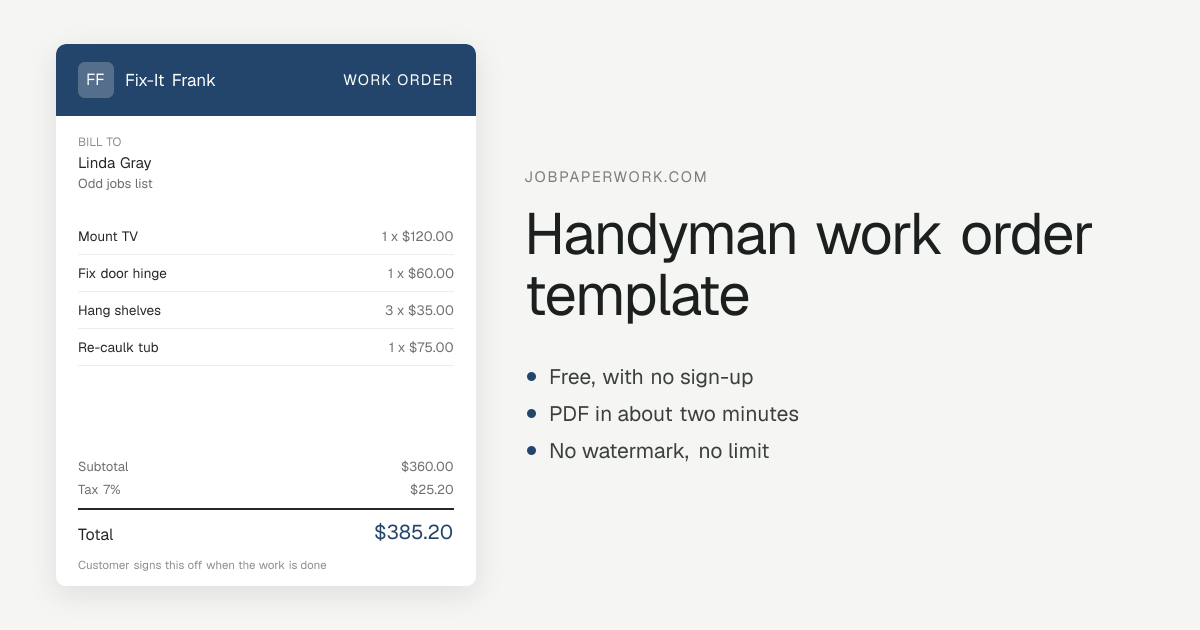
The same jobs and the same look carry across all six papers, so one handyman job can move from estimate to invoice to receipt without retyping.
What you get
A PDF, and a link your customer can open in any browser. Word and Excel versions are not available yet — if a spreadsheet is what you need, this is not yet the tool for it, and saying so is cheaper for both of us than you finding out after typing everything in.
Pick how it looks
Six looks, from a plain classic sheet through a bold top band to a shop ticket, and your initials go on automatically until you upload a logo. See all six.
How to send it
Most customers want the paper on their phone, so the invoice goes out by WhatsApp, text or email, or as a link that needs no app and no account on their side. Or download the PDF to print it or keep it for your own records.
Questions
Should I charge per job or by the hour?
Per job for anything you have done a hundred times, by the hour for anything unpredictable. Mixing both on one invoice is fine as long as each line says which it is.
What if a job turns out to need a licensed electrician or plumber?
Stop, and put it on the invoice as a line at zero saying what you found and that it needs a licensed trade. It costs you nothing and it is the line that protects you later.
Should I get paid at the end of each visit?
For a list of small jobs, yes — on the day, before you leave. The amounts are too small to chase and the customer is standing right there. Hand over the receipt and the job is closed.
Does my minimum charge apply per task or per visit?
Per visit is the usual handyman practice, and the invoice should say so: "Minimum service charge, covers up to one hour of labor" as one line, then each task listed beneath it. That lets a customer fill the minimum with three small jobs instead of feeling charged three times. Past the minimum, bill time in stated increments — quarter or half hours — so the total is easy to check.
How do I bill a trip to the hardware store in the middle of a job?
Decide in advance and say it on the estimate. Common approaches are billing the run at your hourly rate, charging a flat materials-pickup fee, or folding it into a materials markup. On the invoice, list the parts bought with quantities and a line such as "Materials run — 40 min" so the customer sees why the clock kept running while you were gone. Keep the store receipt in case they ask.
The customer keeps adding "while you’re here" jobs. How do I put those on the invoice?
Add each one as its own line, labeled as added on the day, with the time or price it took. A quick verbal "sure" turns into a dispute when the total is higher than the list they booked, so read the new line and its price back before you start it. If an add-on will not fit in the time booked, write it up as a separate estimate for the next visit.
Is there a dollar limit on handyman jobs before I need a contractor license?
Many states set one, and some cities and counties add their own rules; the threshold, and whether it counts labor alone or labor plus materials, varies. Check with your state contractor licensing board. On the paperwork, price the job as it really is: splitting one project across several invoices to stay under a limit is the kind of thing licensing boards look for, and it can leave you unable to collect.
Should I charge for hauling away the old toilet, vanity or debris?
Yes, as its own line, because dump fees and the trip cost you something. Describe what went — "Removed and disposed of old vanity and faucet" — and charge a flat disposal fee or the transfer station charge plus your time. Some items, like appliances with refrigerant, paint or batteries, have special disposal rules locally, so check with your city or county before you agree to take them.
What do I put on the invoice when the customer bought the faucet or light fixture themselves?
Bill installation labor only and note it plainly: "Customer-supplied fixture — labor only." Add that your warranty covers the installation, not the product. That line matters when a big-box faucet leaks from its own cartridge six months later. If the part is wrong or missing pieces and you have to come back, say on the estimate that a return trip is billed at your minimum.