

What makes a trade invoice collectable
A trade invoice is collectable when it is billed to the party who agreed to pay, itemizes the work so anybody can reproduce the total, shows when the work was done, issued and due, and is backed by proof the customer authorized and accepted the work, such as a signed estimate or work order.
Almost every unpaid trade invoice that goes nowhere fails for the same handful of reasons, and none of them is the amount. It is billed to the wrong party, or it describes work nobody can tie to an authorization, or there is no record that the customer ever said go ahead. Those are all things you settle while you are still on good terms, which is the only time they are easy to settle.
The invoice is one document in a chain
A disputed invoice is almost never won on the invoice. It is won on the documents either side of it: the estimate or quote that set the price, the authorization that said go ahead, the work order that recorded what was actually done, and the sign-off at the end. The invoice is the demand; those are the evidence.
That is also why the chain is worth keeping even on small jobs. A customer querying a four-hundred-dollar bill is not usually disputing the work — they are disputing that they agreed to it, and the only answer to that is a piece of paper with a date on it.
Who, exactly, is being billed
This is the commonest fatal defect and the easiest to avoid. If the work was agreed with a company, the invoice goes to the company by its registered name, not to the person who rang you. If it was agreed with an individual, it goes to them. Billing the wrong one of those is how an otherwise straightforward debt stops being enforceable against anybody.
On rented property it is worth being explicit about which of three possible payers you are invoicing — the tenant, the landlord, or the managing agent. All three may have been in the conversation; only one of them agreed to pay.
What the work was, in enough detail to be checked
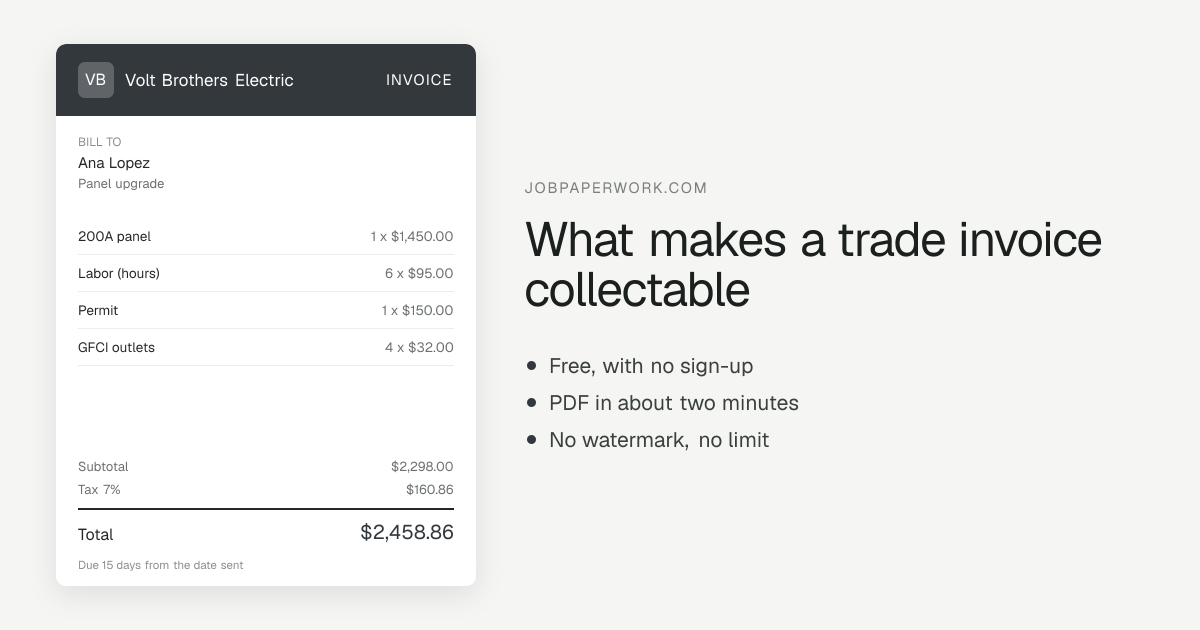
A line reading “labor — $680” is not a description, and it is the line a customer points at when they want to pay less. Each job, part and material on its own line, with the quantity and the rate, means the total can be reproduced by anybody holding the paper.
Keeping labor separate from parts matters for a second reason as well: tax often treats the two differently, and a customer putting the cost through a business or claiming on a warranty will be asked to show which was which.
The arithmetic has to be reproducible
Every figure should be arrived at rather than asserted. Quantity times rate, subtotal, any discount shown as what it was, tax shown as a rate against a base, and the total. If somebody cannot get from your lines to your total with a calculator, the total is the thing they will argue with.
Dates, terms, and when the clock starts
An invoice wants three dates on it: when the work was done, when the invoice was issued, and when payment falls due. They are frequently different, and the gap between the first and the second is the one a late payer will use.
Payment terms should say the number of days and what happens afterwards. Where you intend to charge interest or a late fee on overdue accounts, that has to have been agreed beforehand rather than appearing for the first time on the invoice — what is allowed, and at what rate, is set by your state.
Proof the work was authorized
Being able to show the customer agreed to the work is worth more than everything else on this page put together. A signed estimate is the strongest version. A signed work order is next. A text message saying “yes, go ahead” is weaker but real, and far better than a recollection.
Where the job grew after it started, the same applies to the extra: a note made the same day, with the time and the name of who authorized it, is evidence. A note written when the invoice is queried is a position.
Proof it was accepted
A sign-off at completion closes the other half. It does not have to be elaborate — a line on the work order saying the work was done as listed, dated and signed, is enough to move a later complaint from “you never did it” to “I am not happy with it”, which is a far better conversation to be having.
On work where nobody is present at the end, photographs with dates do a similar job.
What your state adds to this
Everything above is general and applies more or less everywhere. On top of it, states add their own requirements, and these are the ones worth checking for the states you work in rather than taking on trust from anybody, including this page.
- Whether your contractor or trade license number has to appear on invoices and contracts
- Whether written estimates are required before work begins, and by how much the final bill may exceed one
- Mechanics lien rights: whether a preliminary notice is needed, and the deadline for filing
- The limitation period — how long an unpaid invoice stays enforceable
- Whether interest or a late fee on overdue accounts is permitted, and at what rate
- Home improvement contract rules, which in several states are stricter than ordinary commercial ones
None of this is legal advice
This is what is usual, written down so you know what to ask about. What is actually required where you work is decided by your state, and the sums involved in a disputed trade invoice are often small enough that an hour of a lawyer’s time is genuinely the cheaper option. Your state contractor licensing board is the free first stop, and most of them publish exactly what has to be on the paperwork.
Questions
Does an invoice have to be signed to be enforceable?
No. An invoice is a demand for payment rather than a contract, and it does not need a signature to be valid. What benefits from a signature is the document behind it — the estimate, quote or work order that shows the customer agreed to the work and the price.
How long do I have to chase an unpaid invoice?
It depends on your state and on whether the agreement was written or verbal, and the two are often different lengths. The practical answer is that the gap matters more than the deadline: an invoice chased at thirty days is usually paid, and one first raised at eighteen months has lost its evidence as well as its goodwill.
Does a verbal agreement count?
Often yes, and it is still the worst way to work. A verbal agreement can be perfectly enforceable and is simply much harder to prove, which puts the whole thing on whose memory is better. A text message confirming what was agreed takes thirty seconds and converts a verbal agreement into a written one.
What is the single commonest reason a trade invoice fails?
Being addressed to the wrong party. Work agreed with a company and invoiced to the person who rang you — or the reverse — is a debt that may not be enforceable against either of them. It takes one question at the start and it is the question most often skipped.