

What goes on a mechanic invoice
A mechanic’s invoice has to survive two readers: the customer at the counter, and whoever handles the warranty claim months later. That means parts and labor listed separately, the vehicle identified, and the work described in plain words rather than job codes.
- Parts, each on its own line, with part numbers where a warranty claim may follow
- Labor as hours × your shop rate, not a lump sum
- The diagnostic fee, and whether it comes off the bill if the work goes ahead
- Shop supplies and waste disposal, if you charge for them
- Any core charge, and what the customer gets back when the old part is returned
- The vehicle — make, model, plate and mileage — so the invoice matches the job
Sample line items and example prices
These are the sample lines and example prices this invoice opens with. They are starting points, not a survey of what anybody charges and not a recommendation — adjust every item to match your work, your rates and your customer before you create the PDF.
| Job | Usual quantity | Opens at |
|---|---|---|
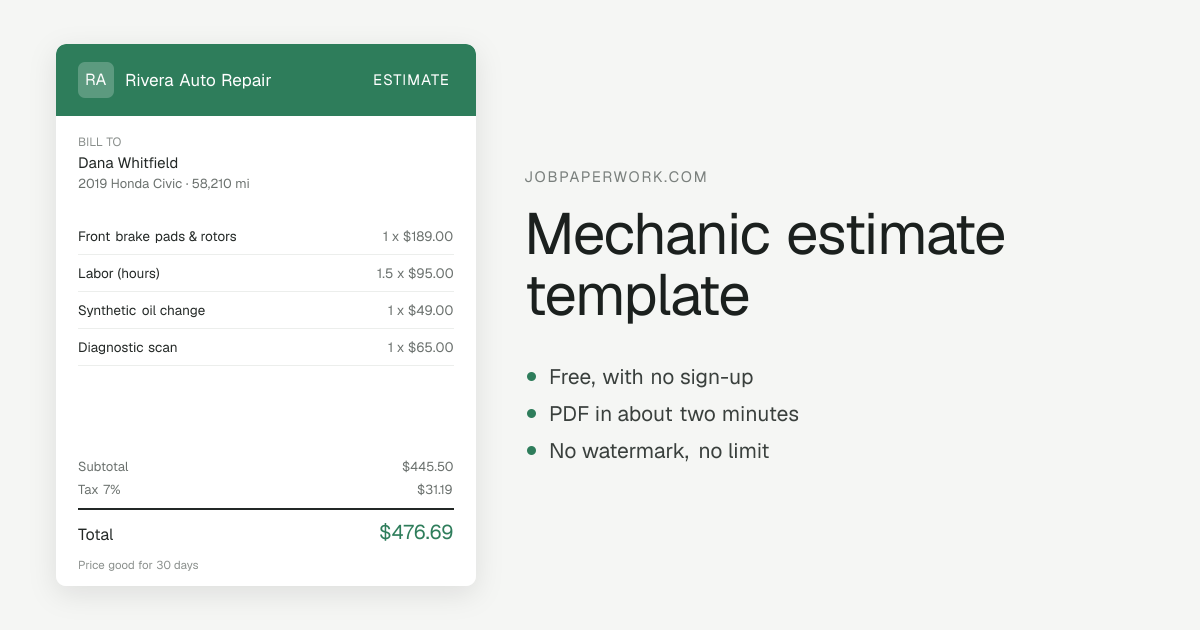
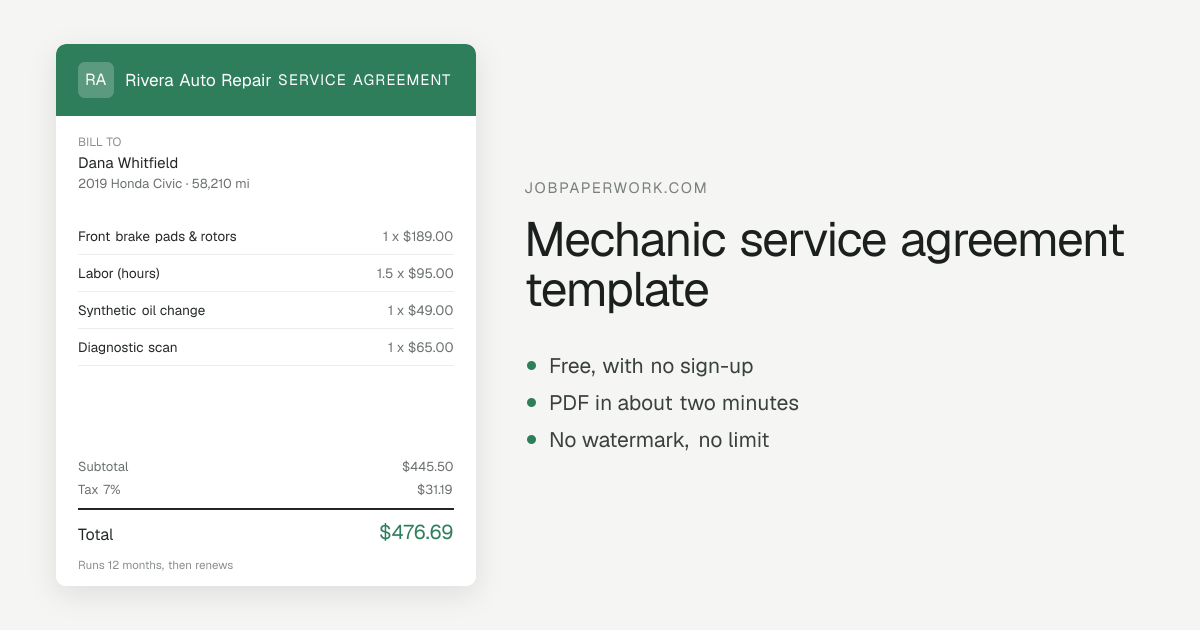
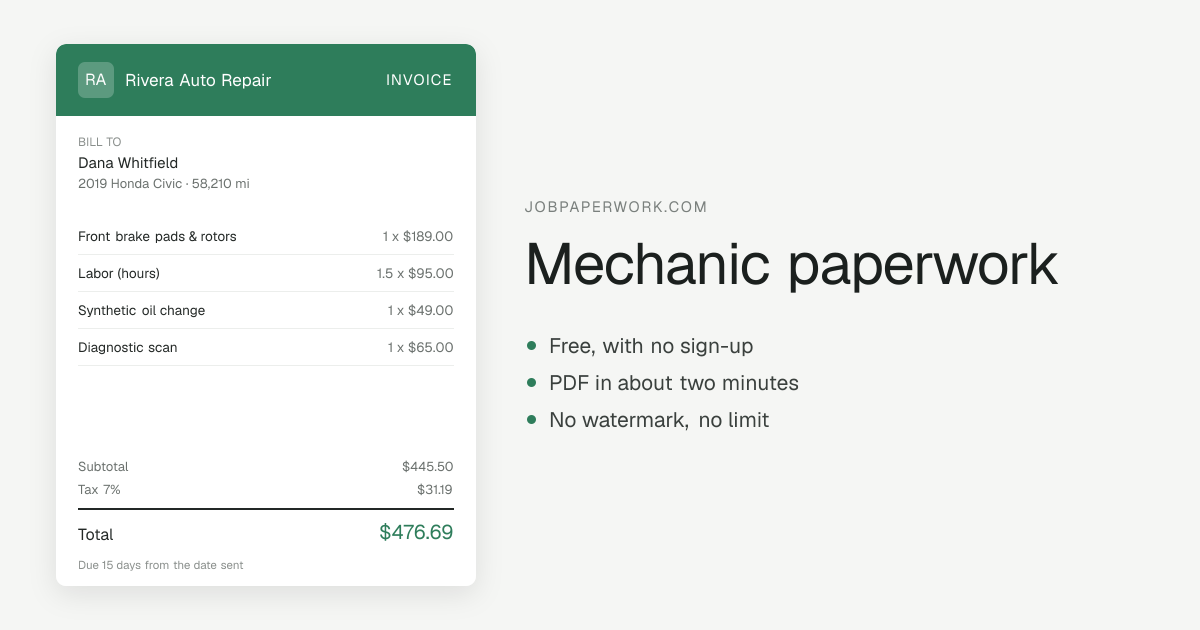
| Front brake pads & rotors | 1 | $189.00 |
| Labor (hours) | 1.5 | $95.00 |
| Synthetic oil change | 1 | $49.00 |
| Diagnostic scan | 1 | $65.00 |
Add, delete or rename any line. The math, the tax and any discount are worked out as you type. Setting the terms? The invoice due date calculator turns Net 15, 30 or 60 into the exact date to put on the invoice.
Parts, labor and the warranty trail
A mechanic’s invoice is read twice: once at the counter, and again months later when a part fails and somebody wants the warranty honored. The version that survives the second reading has the part number on the line, the vehicle’s mileage at the time of the work, and the labor described in words rather than a job code — so the claim can be matched to the repair without a phone call.
Keep core charges and betterment visible. If an old part goes back for a core refund, say what comes back and when; if a repair improved the vehicle beyond the original fault — a new timing kit that went in with the water pump — the customer accepts the figure more readily when they can see why it came to more than the estimate.
One mechanic invoice template: free, editable, printable and yours
Free mechanic invoice template
Free means the whole thing: no sign-up to start, no watermark on the PDF, no limit on how many mechanic invoices you make, and no card asked for at any point. An account is optional, and only does one job — keeping your papers in step between a phone and a computer.
Editable mechanic invoice template
It opens with 4 jobs a mechanic business usually bills — front brake pads & rotors, labor (hours), synthetic oil change — already priced, so most of the typing is done. Every line can be renamed, repriced or deleted, new ones added, and the subtotal, tax and any discount recalculate as you type.
Printable mechanic invoice template
Print it straight from the browser and only the invoice prints — no menus, no buttons — on whatever paper your printer holds. Or save it as a PDF to email, text or keep, and the customer’s copy is the same sheet you saw on screen.
Custom mechanic invoice template
Your business name, phone and address go at the top, with your logo if you upload one or your initials if you do not. Six looks to choose from, 5 accent colors, and your own payment terms in the footer — a mechanic invoice that looks like it came from your business, not from a website.
Every mechanic paper, as it comes out
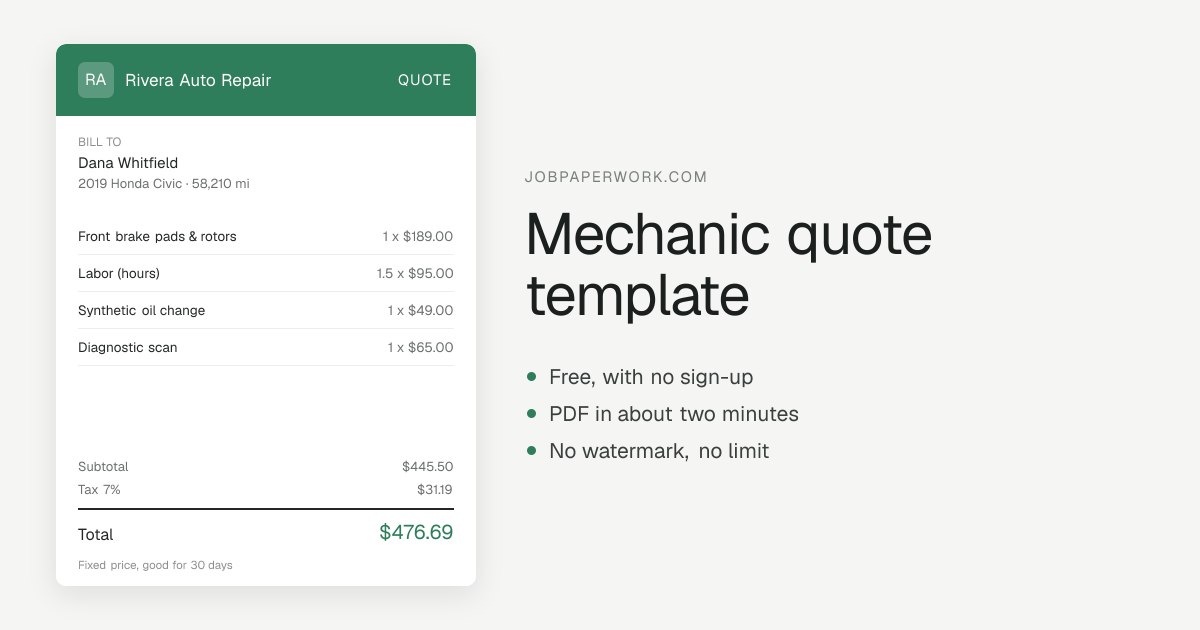
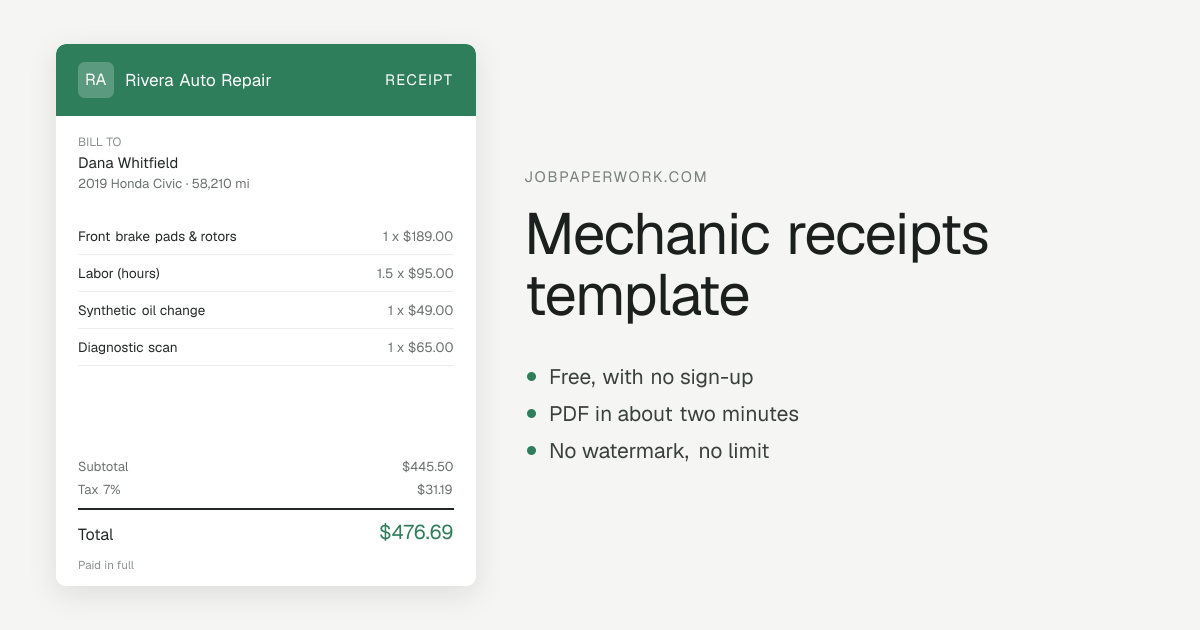
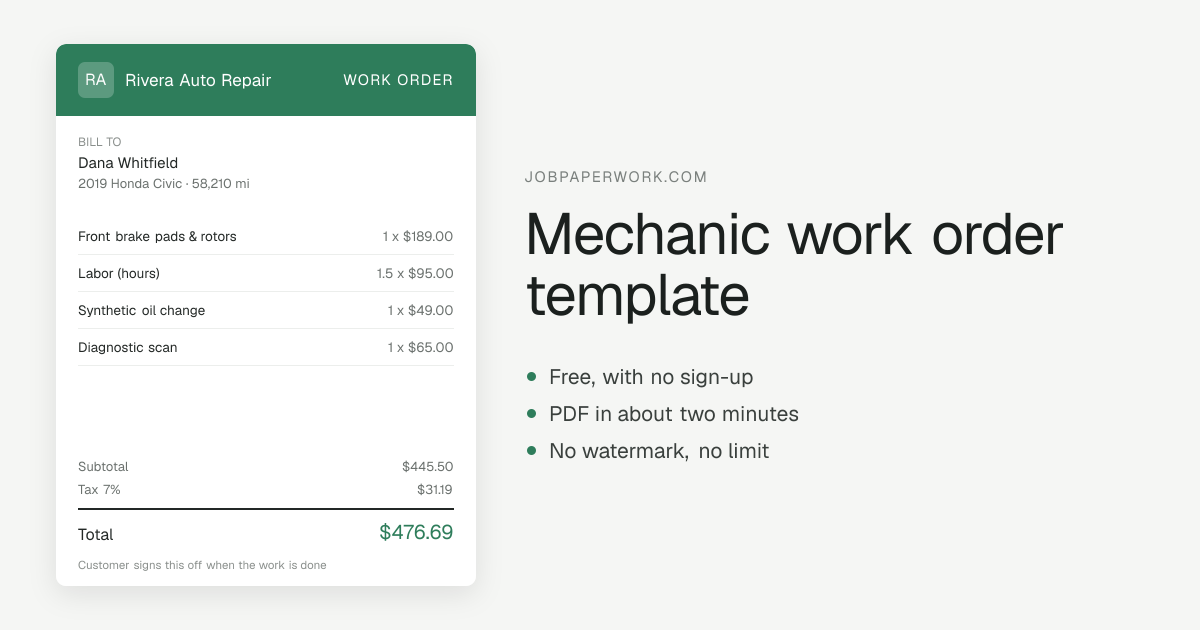
The same jobs and the same look carry across all six papers, so one mechanic job can move from estimate to invoice to receipt without retyping.
What you get
A PDF, and a link your customer can open in any browser. Word and Excel versions are not available yet — if a spreadsheet is what you need, this is not yet the tool for it, and saying so is cheaper for both of us than you finding out after typing everything in.
Pick how it looks
Six looks, from a plain classic sheet through a bold top band to a shop ticket, and your initials go on automatically until you upload a logo. See all six.
How to send it
Most customers want the paper on their phone, so the invoice goes out by WhatsApp, text or email, or as a link that needs no app and no account on their side. Or download the PDF to print it or keep it for your own records.
Questions
Should the diagnostic fee come off the repair bill?
Many shops waive it when the customer goes ahead with the work, and say so on the estimate. Whichever you do, put it in writing before you start: it is the most common argument at the counter.
Do I need the VIN on a mechanic invoice, or is the plate enough?
The plate and the mileage are usually enough for the customer. Add the VIN when the work is going to a warranty claim or an insurer, because that is the number they match against.
Can I charge storage if the customer leaves the car?
Plenty of shops do, and many states also allow a lien on an unpaid repair. Both depend on the customer having been told the rate in writing beforehand, so put it on the work order rather than discovering a month later that it mattered.
How do I show a core charge on the invoice, and the credit when the old part comes back?
Put the core charge on its own line directly under the part it belongs to — “Core charge, alternator” — rather than folding it into the part price. If the old part is returned at the time of the repair, show the matching core credit as a negative line. If they keep the old part or bring it back later, say how long they have to return it. Whether sales tax applies to a core charge varies by state, so check with your state’s department of revenue.
Do I bill book time or the hours the job actually took?
Most shops bill flat-rate: the labor-guide time for the job, times the shop rate, however long it really took. Either way, say which on the invoice — “Labor per published labor guide, 2.4 hrs” or “Actual time, 2.4 hrs” — next to the job description. Customers challenge an hours figure they cannot trace. Some states’ auto-repair rules say how labor has to be described on estimates and invoices, so check with your state’s consumer protection office or automotive repair bureau.
How should I list shop supplies and hazmat disposal fees so customers don’t fight them?
Name them and show them as separate lines: “Shop supplies” for rags, cleaners and small hardware, and “Waste fluid disposal” or “Tire disposal” for what goes to a recycler. A flat amount, or a percentage of labor with a stated cap, both work — what causes the argument is a fee the customer first sees at pickup, so print it on the estimate too. Some states regulate these fees or tax them, so check with your state’s revenue and consumer protection agencies.
What do I write on the invoice when the customer brings their own parts?
List the part as “Customer-supplied: front brake pads” with no price, then your labor as usual. Add plain wording such as “No warranty on customer-supplied parts. Labor to replace a failed customer-supplied part will be charged.” and have the customer sign the repair order before you start. That is the line you point to when the cheap pads squeal in a month. How far a warranty disclaimer holds up depends on state law, so check with your state’s consumer protection office.
How do I bill a sublet like a wheel alignment or machine shop work?
Mark it as a sublet on its own line — “Sublet: four-wheel alignment, [vendor name]” — at the price you are charging, whether that is your cost or cost plus a handling charge. Bill your own labor to remove, deliver or reinstall the part separately. Keep the vendor’s invoice in the job file, and say on yours whose warranty covers the sublet work, because the customer will come back to you, not to the machine shop.
How do I itemize a TPMS sensor replacement and relearn on the invoice?
Each sensor as a part with its part number and wheel position (“TPMS sensor, LF”), the valve service kit as its own line, and the programming or relearn as a labor line. If you found a dead sensor and the customer declined it, write “TPMS sensor RR inoperative — replacement declined” on the invoice. Without that line, the tire-pressure light that stays on after a tire job is blamed on the shop that last touched the wheel.