

What goes on an HVAC quote
A full changeout is a quote because everything is visible before you start: the unit, the run, the supply. What has to be fixed in the price is not the equipment but the conditions — what happens if the ducts turn out undersized, and what you are committing to on performance.
- The complete scope: unit, coil, line set, duct modification, electrical
- Model numbers, so the quote can be compared like for like
- What the system is sized for, and on what basis you sized it
- The fixed price, and the stages it is paid in
- Start date, duration, and how long the property is without heating or cooling
- Warranty: the manufacturer’s, and separately your own on the labor
- What voids it — undersized returns, existing duct condition, access
The sample line items and example prices this sheet opens with are on the HVAC invoice template — the same table, which is about the trade rather than about this paper, so it lives in one place rather than on all six. Working out the price itself? The markup calculator turns your cost and markup into the figure to put on the quote, and shows the margin it leaves.
What you get
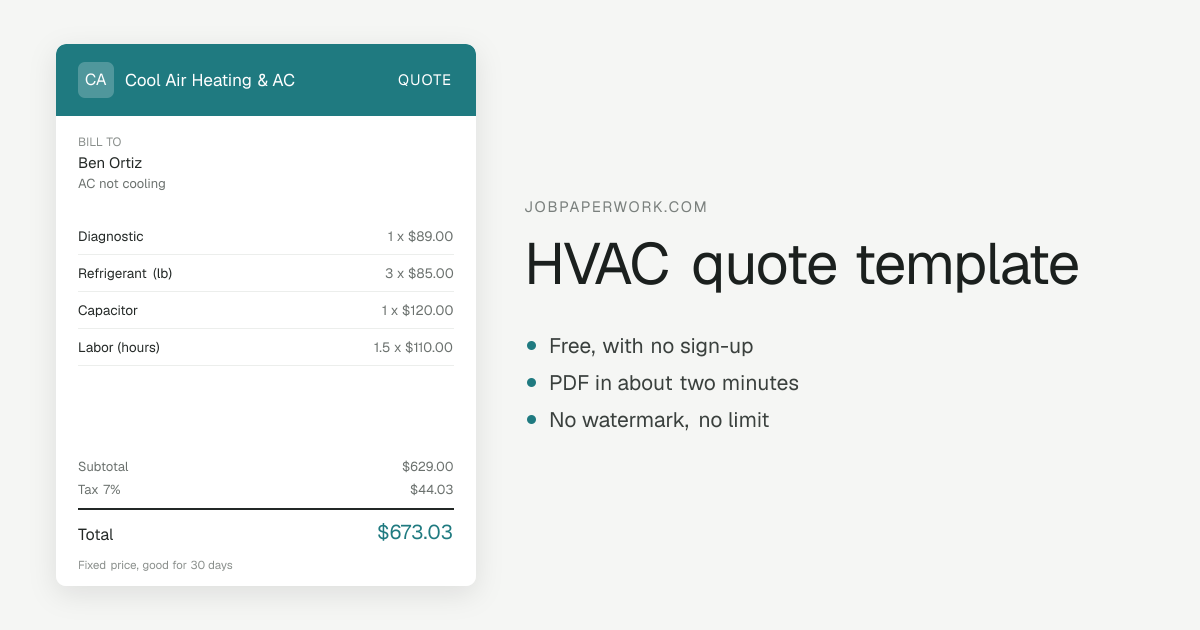
A PDF, and a link your customer can open in any browser. Word and Excel versions are not available yet — if a spreadsheet is what you need, this is not yet the tool for it, and saying so is cheaper for both of us than you finding out after typing everything in.
Pick how it looks
Six looks, from a plain classic sheet through a bold top band to a shop ticket, and your initials go on automatically until you upload a logo. See all six.
How to send it
Most customers want the paper on their phone, so the quote goes out by WhatsApp, text or email, or as a link that needs no app and no account on their side. Or download the PDF to print it or keep it for your own records.
Questions
Should the sizing calculation go on the quote?
At least a reference to it. “Sized on a Manual J, copy on request” costs you one line and separates you from whoever guessed off the badge on the old unit. It also protects you: if somebody later says the system is undersized, you have the basis you used.
What about the existing ductwork?
Say what you assumed and what you will do if it is wrong. Ducts are the commonest cause of a new system underperforming, and the customer will blame the box rather than the pipe. A quote that states the duct condition it assumed is the one that survives the complaint.