

What goes on a roofing invoice
Roofing invoices often go to an insurer as well as a customer, which means the damage, the scope and the materials have to be described well enough that somebody who never saw the roof can follow them.
- The area worked on, in squares or square feet
- Material and grade — shingle type, underlayment, flashing
- Tear-off and disposal, which is its own cost
- Labor, separately from materials
- Anything found once the deck was open, as its own dated line
- The warranty on material and on workmanship, with its term
Sample line items and example prices
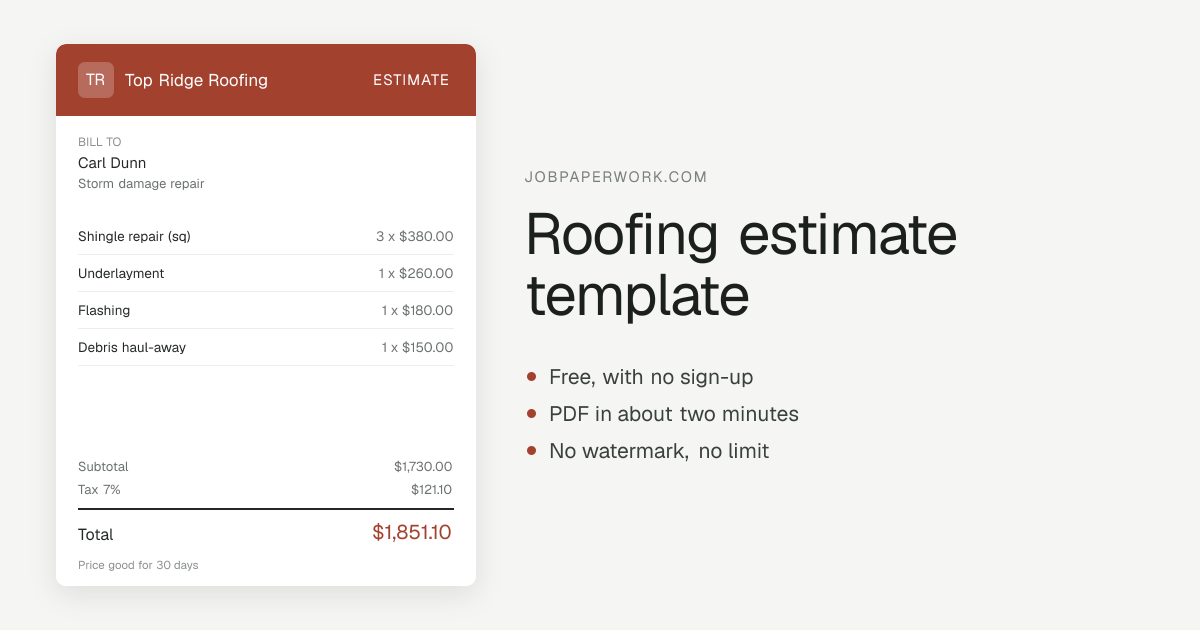
These are the sample lines and example prices this invoice opens with. They are starting points, not a survey of what anybody charges and not a recommendation — adjust every item to match your work, your rates and your customer before you create the PDF.
| Job | Usual quantity | Opens at |
|---|---|---|
| Shingle repair (sq) | 3 | $380.00 |
| Underlayment | 1 | $260.00 |
| Flashing | 1 | $180.00 |
| Debris haul-away | 1 | $150.00 |
Add, delete or rename any line. The math, the tax and any discount are worked out as you type. Setting the terms? The invoice due date calculator turns Net 15, 30 or 60 into the exact date to put on the invoice.
One roofing invoice template: free, editable, printable and yours
Free roofing invoice template
Free means the whole thing: no sign-up to start, no watermark on the PDF, no limit on how many roofing invoices you make, and no card asked for at any point. An account is optional, and only does one job — keeping your papers in step between a phone and a computer.
Editable roofing invoice template
It opens with 4 jobs a roofing business usually bills — shingle repair (sq), underlayment, flashing — already priced, so most of the typing is done. Every line can be renamed, repriced or deleted, new ones added, and the subtotal, tax and any discount recalculate as you type.
Printable roofing invoice template
Print it straight from the browser and only the invoice prints — no menus, no buttons — on whatever paper your printer holds. Or save it as a PDF to email, text or keep, and the customer’s copy is the same sheet you saw on screen.
Custom roofing invoice template
Your business name, phone and address go at the top, with your logo if you upload one or your initials if you do not. Six looks to choose from, 5 accent colors, and your own payment terms in the footer — a roofing invoice that looks like it came from your business, not from a website.
Every roofing paper, as it comes out
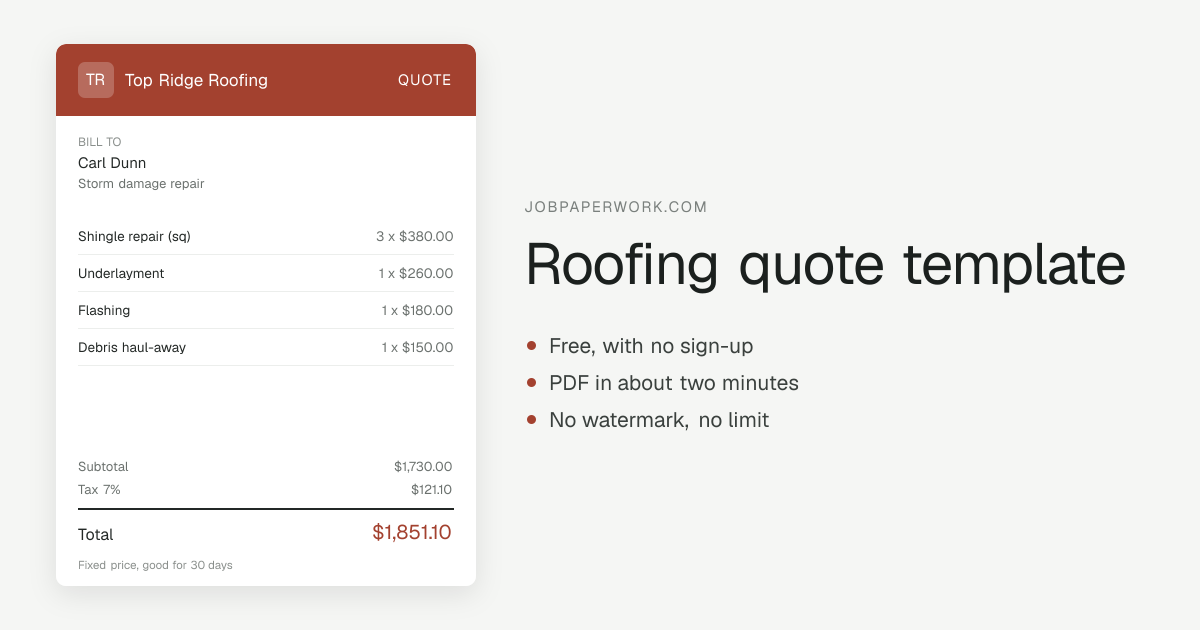
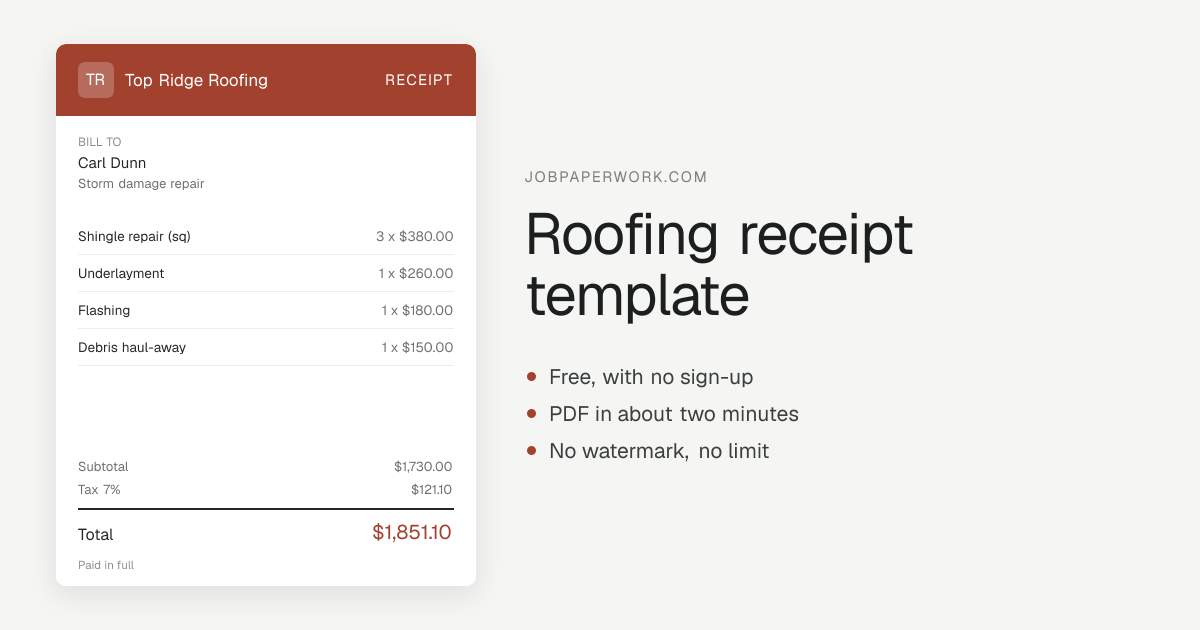
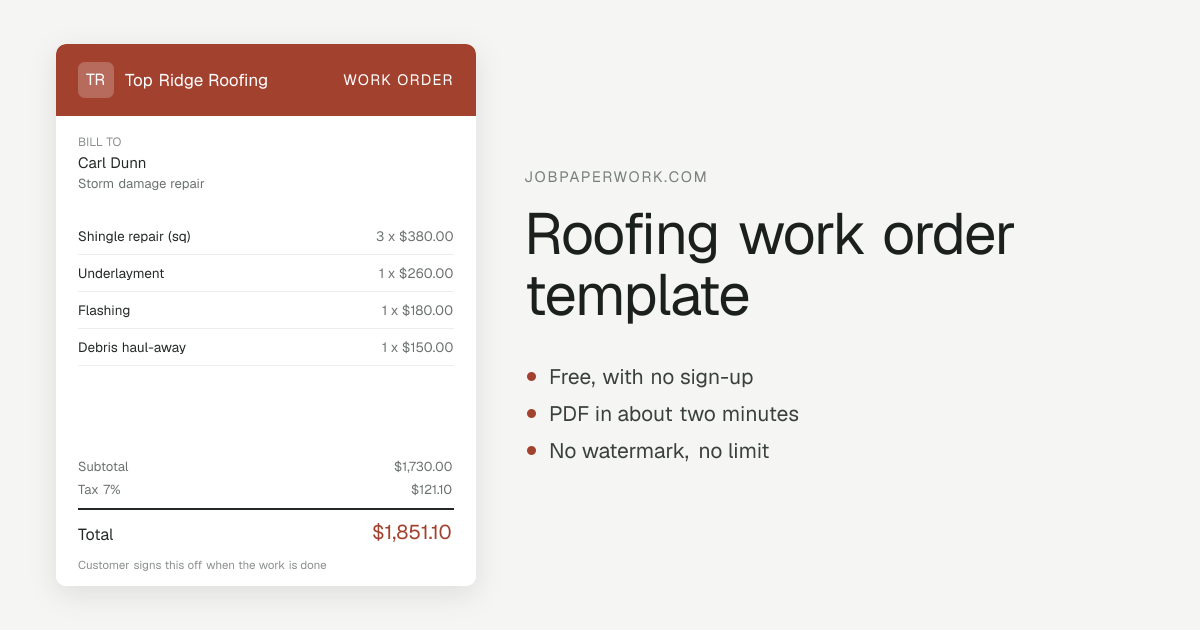
The same jobs and the same look carry across all six papers, so one roofing job can move from estimate to invoice to receipt without retyping.
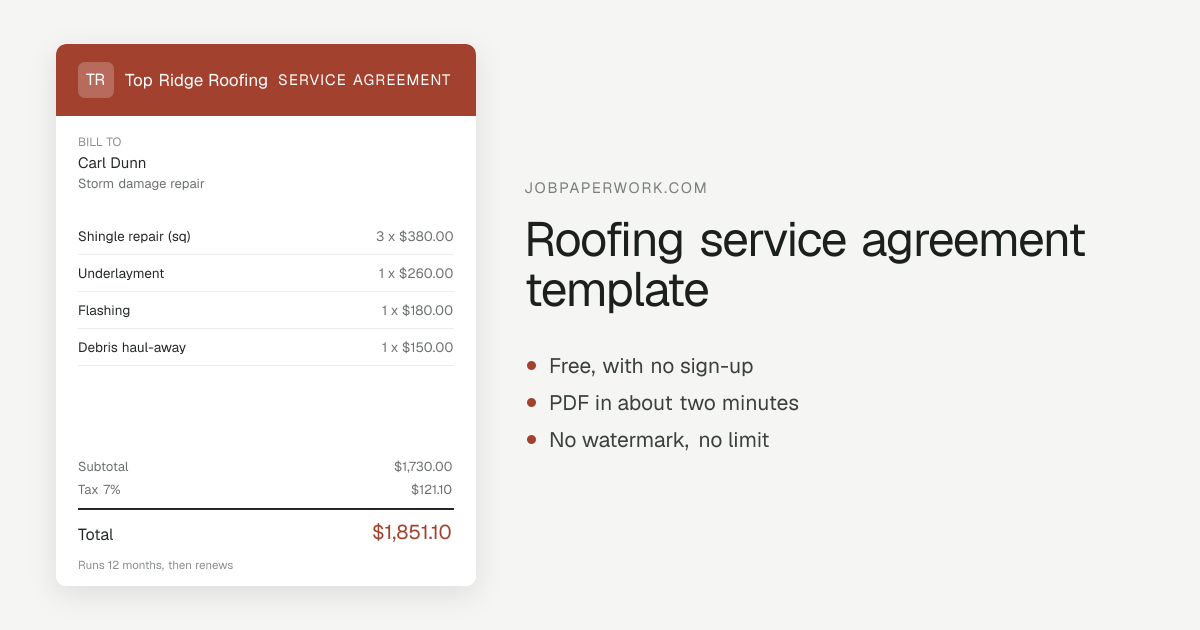
What you get
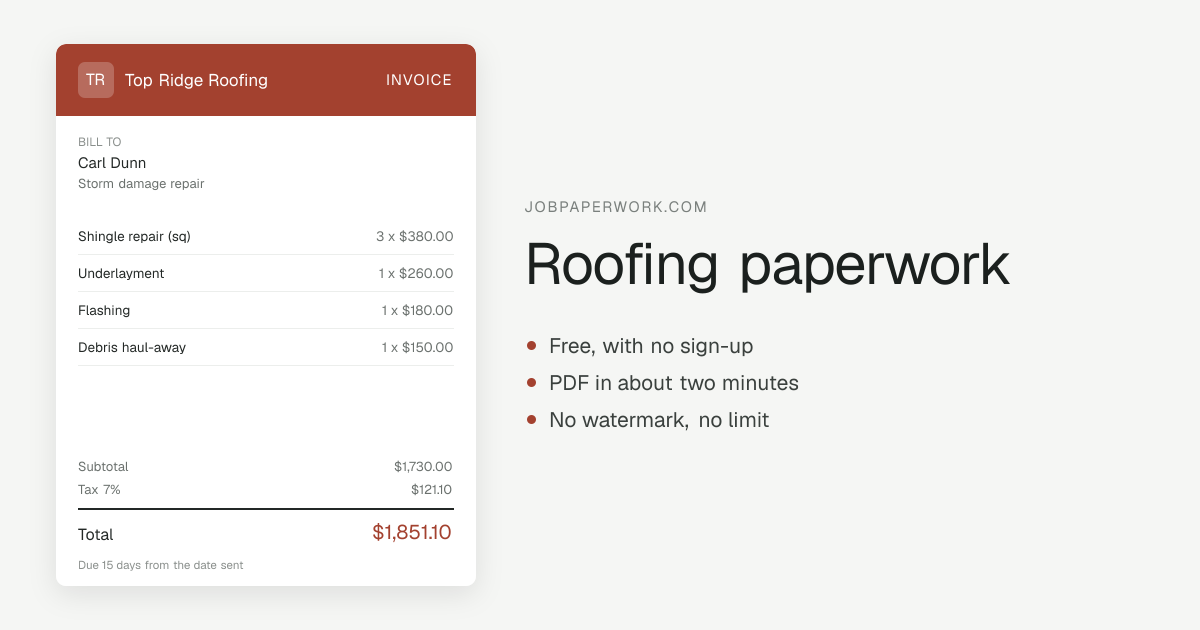
A PDF, and a link your customer can open in any browser. Word and Excel versions are not available yet — if a spreadsheet is what you need, this is not yet the tool for it, and saying so is cheaper for both of us than you finding out after typing everything in.
Pick how it looks
Six looks, from a plain classic sheet through a bold top band to a shop ticket, and your initials go on automatically until you upload a logo. See all six.
How to send it
Most customers want the paper on their phone, so the invoice goes out by WhatsApp, text or email, or as a link that needs no app and no account on their side. Or download the PDF to print it or keep it for your own records.
Questions
How do I invoice for damage I only found after tear-off?
As its own line, dated, noting it was found during tear-off — and photograph it. On an insurance job that line is the difference between being paid for the deck repair and absorbing it.
Should I bill by the square or by the job?
A job price is easier for a customer to say yes to, but show the squares anyway. It is how roofers price, how insurers check, and how the customer compares you with the next quote.
How does getting paid work on an insurance job?
The insurer pays off their own scope, not your quote, so your invoice has to line up with it item by item. Anything found during tear-off needs its own dated line and a photo, or it is a conversation you will lose.
How do I bill replaced plywood sheets on the final invoice?
Bill the actual count — “6 sheets 7/16 OSB replaced at $X per sheet” — against whatever per-sheet price the estimate set. Add the date and a note that the sheets were found during tear-off, and keep the photos. On an insurance job the per-sheet count is what the adjuster pays against; on a retail job it is what the homeowner checks against the number they approved.
How do I charge for an extra layer of shingles coming off?
As an additional-layer line, priced per square, separate from the first layer’s tear-off. The second layer roughly doubles the debris and adds labor and disposal, so state how many layers came off and the squares for each. If the estimate assumed one layer, the extra layer belongs on a dated change line the customer approved, not folded into the total.
How do I write an insurance supplement for items the adjuster missed?
List each missing item as the insurer would — drip edge, starter, ice and water shield, extra layers, code-required upgrades — with quantities, measurements and photos. Many carriers use Xactimate, so matching its line descriptions helps. The supplement goes to the carrier; the homeowner’s invoice should match the approved scope plus any upgrades they paid for themselves, each labeled.
Can I show the homeowner’s deductible on a roofing invoice?
Show it as what it is: the amount the homeowner owes after the insurance payment, not discounted, waived or hidden in a padded line. Many states treat absorbing a deductible as insurance fraud, and some have rules specifically aimed at roofing contractors. Check with your state’s insurance department or contractor licensing board before offering anything that reduces what the homeowner pays.
How do I bill for a steep or two-story roof?
Most roofers add a steep charge per square above a set pitch, and a high or two-story charge for extra setup, staging and harness work. Put the pitch on the invoice — 8/12, 10/12 — and apply the charge to the squares it affects, not the whole roof. Insurers usually pay steep and high charges as their own items too, so separate lines are what gets them approved.
Should drip edge, starter strip and ridge cap be separate lines?
Yes. They are measured in linear feet, not squares, and they are the items most often missed on an insurance scope or dropped from a cheap competing quote. List each with its footage: drip edge along eaves and rakes, starter along eaves, ridge cap along ridges and hips. Do the same for valley metal and step flashing so the customer can see the whole roof system, not just shingles.