

What goes on an HVAC work order
On an install the work order becomes the commissioning record, and it outlives everybody who was there. Model and serial, the charge, and the readings taken at handover are what a tech in five years uses to work out whether anything has changed. Nothing else on the job captures them.
- The property, and where the equipment is
- Model and serial of everything installed, the coil included
- Line set length and size, and the charge — calculated and actual
- Electrical: breaker size, disconnect, and anything upgraded
- Duct modifications made
- Commissioning readings: superheat, subcool, static pressure, temperature split
- Sign-off, and what the customer was shown about running it
The sample line items and example prices this sheet opens with are on the HVAC invoice template — the same table, which is about the trade rather than about this paper, so it lives in one place rather than on all six.
What you get
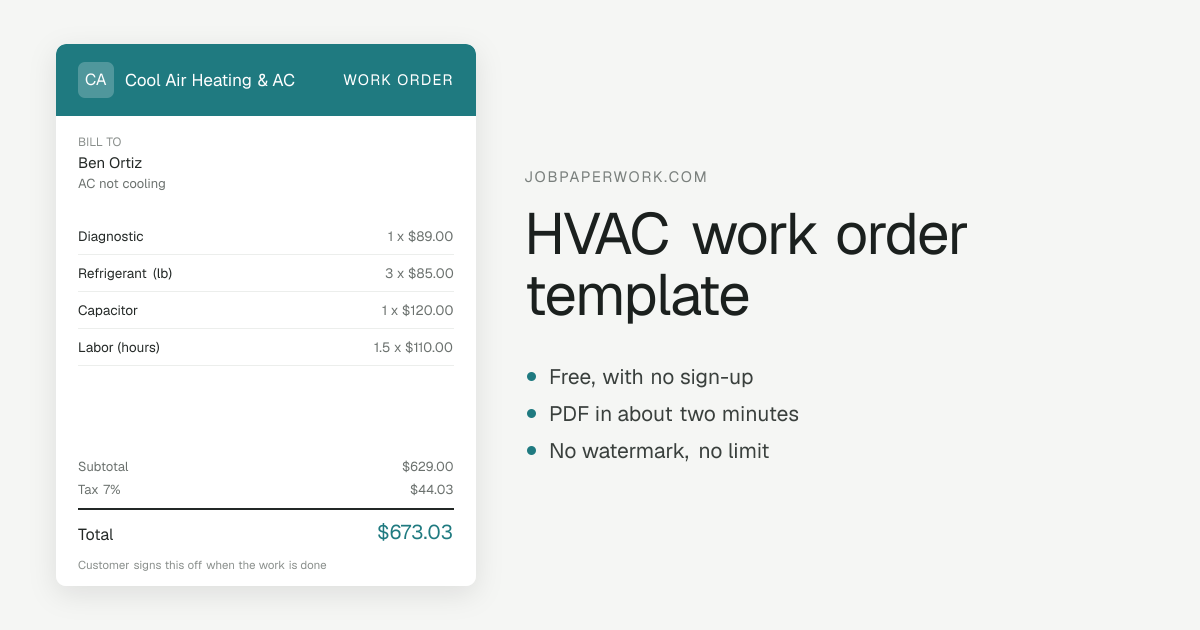
A PDF, and a link your customer can open in any browser. Word and Excel versions are not available yet — if a spreadsheet is what you need, this is not yet the tool for it, and saying so is cheaper for both of us than you finding out after typing everything in.
Pick how it looks
Six looks, from a plain classic sheet through a bold top band to a shop ticket, and your initials go on automatically until you upload a logo. See all six.
How to send it
Most customers want the paper on their phone, so the work order goes out by WhatsApp, text or email, or as a link that needs no app and no account on their side. Or download the PDF to print it or keep it for your own records.
Questions
What readings should go on a commissioning sheet?
Superheat and subcool, static pressure and the temperature split, with the conditions they were taken in. They are the baseline — without them nobody can ever say whether a system underperforming today was ever performing. Take them and write them down even when nobody asks.
Does the customer need a copy?
Give them one and keep one. It is the document that proves the install was commissioned rather than just connected, and on a warranty claim the manufacturer may ask for exactly these numbers.