

What is a purchase order?
A purchase order (PO) is a document the buyer sends the seller to order goods or services, listing what they want, the agreed price and the terms. It comes before the work and, once the seller accepts it, acts as the order both sides work to. The seller’s invoice comes afterward and quotes the PO number.
A purchase order runs in the opposite direction to an invoice: the customer writes it, not you, and it goes out before the work rather than after. For a small trade business POs show up mostly when you take on commercial or government clients, whose accounts departments will not pay an invoice that cannot be matched to one. Knowing how the document works is how you get paid by them without the back-and-forth.
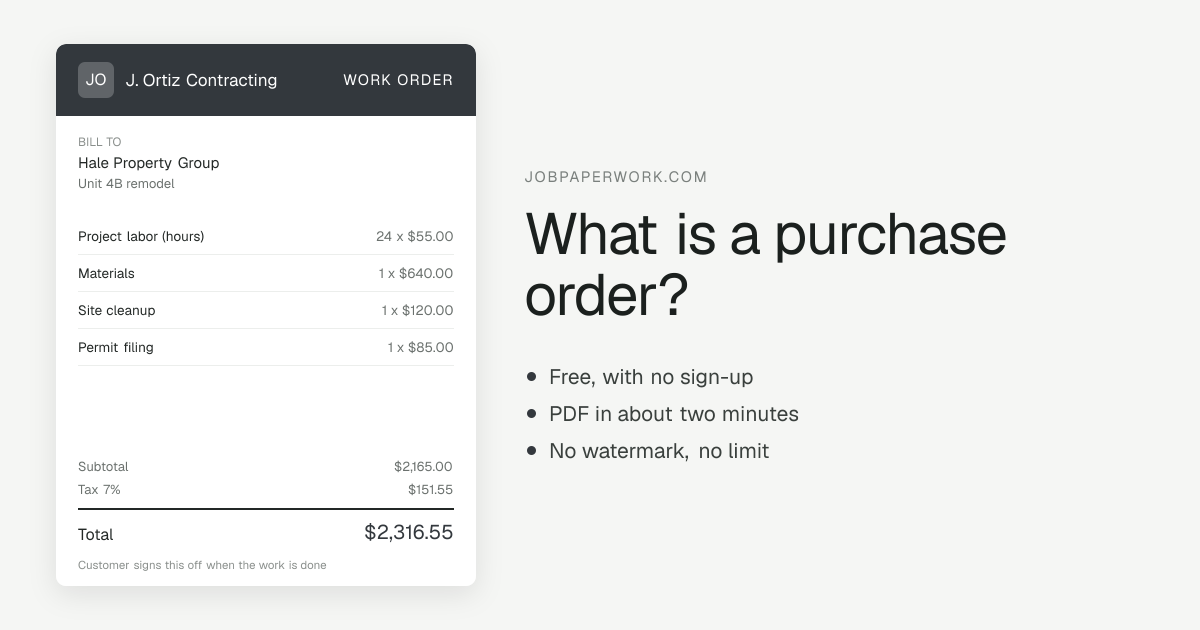
The buyer’s order, in writing
A purchase order is issued by the buyer and sent to the seller to say, formally: I want these things, at this price, on these terms. It lists the goods or services, the quantities, the agreed prices, the delivery or completion date and a unique PO number. Once the seller accepts it, both sides have a shared record of what was ordered before any work or money moves.
That is the opposite of an invoice, which the seller issues after the work to ask for payment. The PO opens the transaction; the invoice closes it.
What the PO number is for
The PO number is the thread that ties the whole transaction together. The buyer puts it on the order, you put it on your invoice, and their accounts department uses it to match the two — along with proof the work was delivered — before they release payment. This is the "three-way match": purchase order, delivery, invoice, all agreeing.
The practical upshot for you: on any job that started with a PO, put that PO number on your invoice. An invoice a commercial client cannot match to a PO is the single most common reason a correct bill sits unpaid for weeks.
What goes on a purchase order
A PO carries much of what an invoice does, but written from the buyer’s side and before the fact:
- A unique PO number
- The buyer’s and the supplier’s details
- The date, and the delivery or completion date wanted
- Each item or service ordered, with quantity and agreed price
- The total, and the payment terms agreed
- Any reference to a quote the order is based on
Purchase order vs invoice
They are two ends of the same deal. The purchase order is the buyer’s commitment to buy, sent first. The invoice is the seller’s request to be paid, sent after the work. The PO says "please supply this"; the invoice says "here is what I supplied, now pay me".
On a clean job the numbers on both documents match, because the invoice bills exactly what the PO ordered. When they do not match, it is usually because the job changed partway through — which is a conversation to have before you invoice, not a surprise to spring in the total.
Purchase order vs work order
These two are easy to confuse because both come before the work. The difference is who they are for. A purchase order goes out to an external supplier or contractor and commits the buyer to pay for what they deliver. A work order is internal — it tells your own crew, or a department, what job to carry out and when.
A single job can involve both: a client sends you a purchase order for the work, and you raise a work order to put your team on it. There is a dedicated work-order page on this site if that is the document you actually need.
Do small trade businesses need them?
For cash-and-domestic work, almost never — you quote and you invoice, and a PO would just be paperwork for its own sake. Where POs become unavoidable is the day you start invoicing businesses, builders, property managers or public bodies, because their internal rules require a PO before anyone is allowed to pay you.
When that day comes, the move is simple: ask for the PO number before you start, and quote it on your invoice. You do not usually have to issue purchase orders yourself unless you are the one hiring subcontractors or ordering materials on account.
Is a purchase order legally binding?
Once the seller accepts it, a purchase order is generally treated as a binding agreement to supply the listed goods or services at the stated price — which is part of why commercial buyers like them. The precise legal weight depends on the terms and on the law where you trade, so a PO on a large job is worth reading as carefully as any contract rather than treating as a formality.
Official sources
This guide explains how the rules usually work; these are the bodies that actually decide them where you are. Check them before you rely on anything above.
Last checked 6 November 2026. This is general information, not tax or legal advice.
Questions
What is the difference between a purchase order and an invoice?
The buyer sends a purchase order first to order the work; the seller sends an invoice afterward to ask for payment. The PO opens the deal, the invoice closes it, and on a clean job the two match.
What is a PO number?
A unique reference the buyer assigns to a purchase order. You quote it on your invoice so the buyer’s accounts team can match the order, the delivery and the bill before paying. Leaving it off is a common cause of late payment.
Is a purchase order legally binding?
Once the seller accepts it, a PO is generally a binding agreement to supply what it lists at the stated price. The exact weight depends on the terms and local law, so read a PO on a big job as carefully as a contract.
Do small businesses need purchase orders?
For domestic work, rarely. They matter once you invoice businesses or public bodies, whose rules require a PO before they can pay you. Ask for the PO number up front and put it on your invoice.
What is the difference between a purchase order and a work order?
A purchase order goes to an outside supplier and commits the buyer to pay. A work order is internal and tells your own crew what job to do. One client job can involve both.