

What goes on a contractor invoice: a checklist
A contractor invoice needs your business details, your license number where your state or trade expects it, the customer and job address, a unique invoice number and date, a plain description of the work, labor and materials on separate lines, subtotal, tax and total, any deposit subtracted, the due date and how to pay.
An invoice that is missing a piece is the one that gets queried, and a queried invoice is one that gets paid late. This is the full list of what belongs on a contractor invoice, what each line is doing there, and which parts are genuinely optional rather than just often skipped.
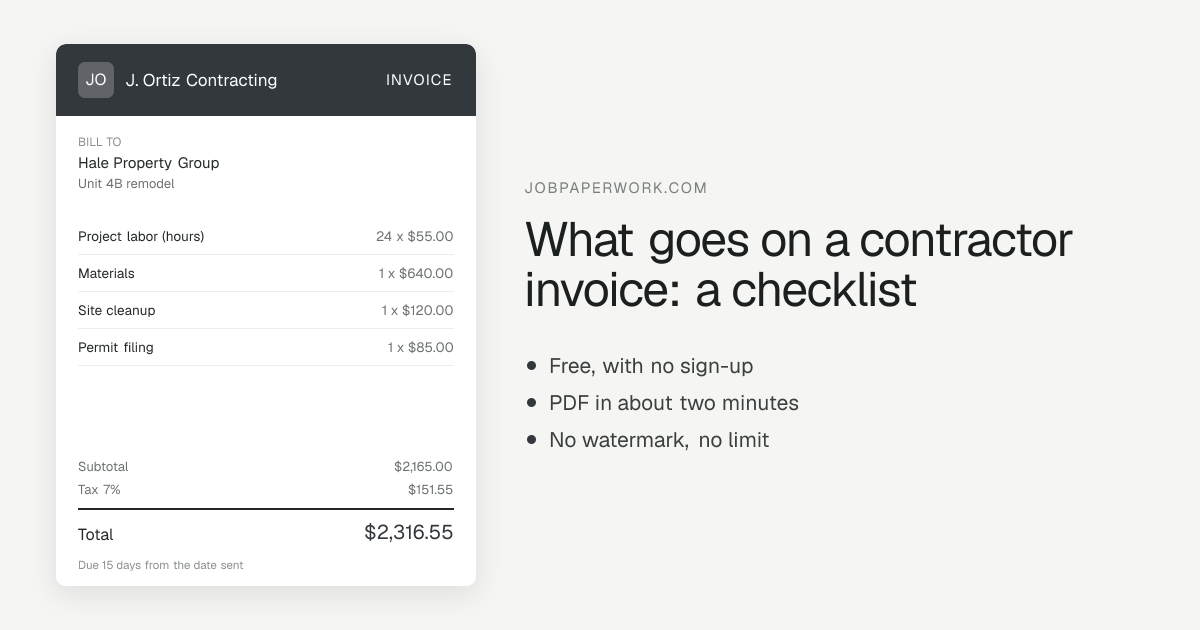
The checklist
Work down this before you send. Most of it is on the sheet already; the point is to notice what is missing rather than to add decoration.
- Your business name, phone number and, if you have one, your logo
- Your license or registration number where your trade or state expects it on the paper
- The customer’s name, and the address the work was actually done at
- A unique invoice number, and the date you are sending it
- What the job was, in plain words a customer would use — not job codes
- Labor on its own lines, as hours × rate rather than one lump sum
- Materials and parts on their own lines, kept separate from labor
- The subtotal, then tax as its own line, then the total
- Any deposit already paid, subtracted to show the balance now due
- The due date, and how you want to be paid
Why labor and materials go on separate lines
This is the line most often collapsed into one, and it is the one most worth keeping apart. Many states tax materials and labor differently, so a combined line can drag tax onto labor you might not have owed it on. Separate lines also let a customer see what they are paying for, which is the single biggest reason an invoice gets paid without a phone call.
Deposit and balance
If you took a deposit, the final invoice should show the full price, then the deposit as a credit, then the balance. Hiding the deposit by only billing the balance leaves the customer’s records and yours disagreeing, which is exactly the kind of small gap that turns into a dispute months later.
What is optional, and what only some trades need
Purchase-order numbers, retainage, and progress-billing stages belong on the invoices that use them and nowhere else — adding fields a job did not have is noise. Likewise a license number is required on the paper in some states and trades and not others. There is no universal list of legally required fields, so treat the trade-specific ones as "include where it applies to you", and confirm the required ones with your state or licensing board rather than copying another contractor’s invoice.
Doing it here
The contractor invoice template opens with labor and materials already on separate lines, a tax line, and a total that recalculates as you type. Add your license number and payment terms once in your business details and they carry onto every invoice after.
Questions
Do I legally have to put my license number on an invoice?
In some states and trades, yes; in others it is optional. It is set by your state and licensing board, not by a national rule, so check theirs. Where it is required, putting it on every invoice is the simplest way never to forget.
What is the difference between this and a construction progress invoice?
A progress invoice bills a stage of a larger job against an agreed schedule of values, so it adds the stage, the percent complete and what has been billed before. This checklist is the base every invoice needs; progress billing is that base plus the stage lines.
Should I include payment terms like Net 15 or Net 30?
Yes — put the due date on the invoice and the terms in your business details so they appear every time. A due date the customer can see is paid sooner than "due on receipt" with no date attached.