

What is an invoice?
An invoice is a document a seller gives a buyer that lists what was supplied, how much is owed and when payment is due. It is a demand for payment and a record of the sale — not a receipt, which proves money was already paid, and not a quote, which is only a price offered before the work.
Everybody in the trades sends invoices, and almost nobody was taught what one actually is. The word carries more weight than it looks: an invoice is the thing that turns finished work into money owed, and it is the record you reach for when a payment is late or the tax year ends. Here is what it is, what has to be on it, and how it differs from the three documents people mix it up with.
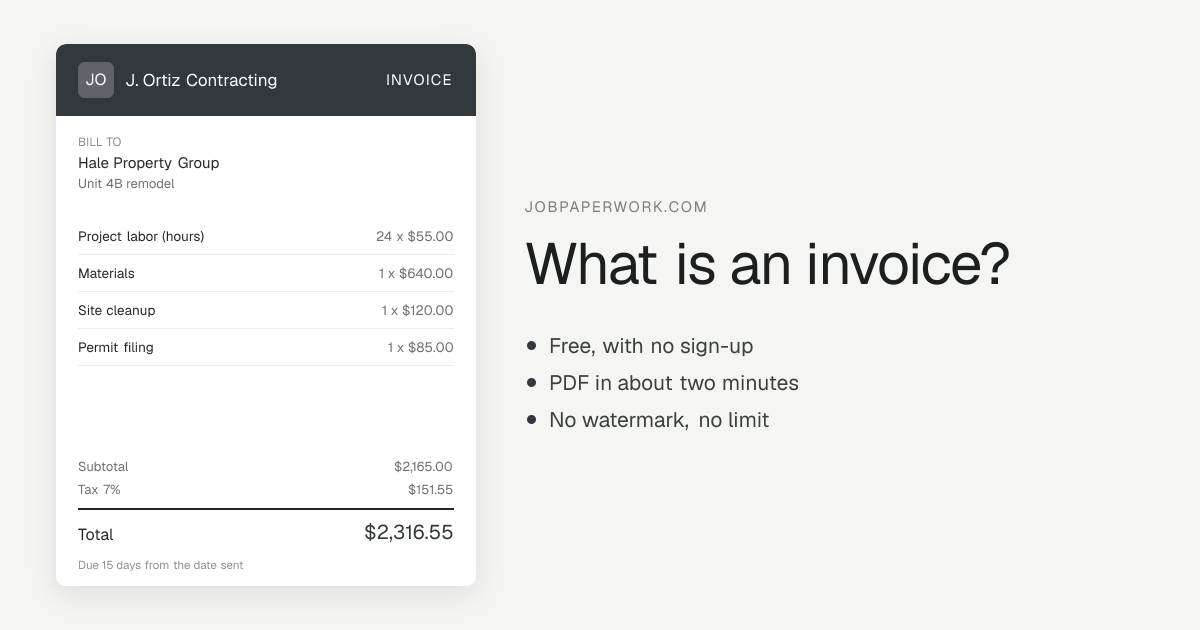
An invoice is a request for payment, with a record attached
At its simplest, an invoice is a written request that says: here is what I did, here is what it costs, here is how and by when to pay me. It is issued by the person who did the work — you — and sent to the person who has to pay it, after the work is done or the goods are delivered.
That "after" matters. An invoice is raised once there is something real to charge for, which is what separates it from an estimate or a quote. It also doubles as a record: the same piece of paper that asks for the money is the one your accountant and the tax office will want to see later, which is why the details on it are not optional.
What every invoice has to show
A few things appear on an invoice because without them it cannot do its job — the buyer cannot pay it, or you cannot prove it later. Leave one off and you have a nice-looking document that still causes a phone call.
- The word "Invoice", so it is not mistaken for a quote or a statement
- Your business name, address and contact details, and your logo if you have one
- The customer’s name and the address the work was done at
- A unique invoice number, and the date you issued it
- A line for each item of work or material, with a quantity and a price
- The subtotal, any tax, and the total due
- The payment due date and how you want to be paid
The invoice number is not decoration
Every invoice carries a number that belongs to it and no other. It is how you and the customer refer to one specific bill out of the hundreds you will send, how a payment gets matched to the work it paid for, and the first thing an accountant looks for when the books do not balance.
The rule is only that numbers are unique and run in a sequence with no gaps — there is more on how to set that up in the guide on invoice numbering. A gap looks, to anyone auditing you, like an invoice you deleted.
Invoice, quote, bill and receipt — four different jobs
These four words get used as if they mean the same thing, and they do not. A quote (or estimate) comes first and offers a price before any work happens. An invoice comes after the work and asks for the money. A receipt comes last and proves the money was paid. "Bill" is just the everyday word a customer uses for the invoice they have to pay.
The practical consequence: never hand over a receipt before you have been paid, and never let an invoice read like a quote the customer can still negotiate. Each document marks a different point in the job, and sending the wrong one blurs where you are.
Payment terms: the part that decides when you get paid
An invoice without a due date is an invoice that gets paid whenever the customer feels like it. The terms — "due on receipt", "net 7", "net 30" — are the clock, and they only start if they are written on the page.
On domestic trade work, shorter is almost always better: most of this market is paid on the day or within a week, and a thirty-day term borrowed from corporate billing just means waiting a month for a two-hour job. Put the date in plain form — "due by 20 November" — rather than leaving the customer to count days from terms they skimmed.
Do you legally have to give one?
For a registered business selling to another business, an invoice is usually expected and sometimes required for tax purposes. For a sole trader doing domestic work the rules are looser, but the record-keeping reason stands whatever the law says: the tax office expects you to be able to show what you earned, and an invoice is the cleanest way to do it.
What counts as a valid invoice for tax — and whether you must show a tax number on it — depends on where you are registered and whether you charge sales tax or VAT. That is a question for your tax authority, linked below, not for a template.
For a tradesperson, the invoice is the business
In a trade, the invoice is not back-office paperwork — it is the last thing you do on every job and the only thing standing between finished work and money in the account. The ones that get paid without a chase are specific (what, where, how much), carry a clear number and date, and name a due date the customer cannot pretend they missed.
You do not need accounting software to send one. A free invoice for your trade, with the usual lines and prices already filled in, takes about two minutes and sends from your phone as a PDF — which is what this site is for.
Official sources
This guide explains how the rules usually work; these are the bodies that actually decide them where you are. Check them before you rely on anything above.
Last checked 6 November 2026. This is general information, not tax or legal advice.
Questions
Is an invoice the same as a receipt?
No. An invoice asks for payment and is sent before the customer pays; a receipt confirms payment and is given after. The same job usually produces both — an invoice when the work is done, a receipt once the money arrives.
Is an invoice the same as a bill?
“Bill” is the word the customer uses for the invoice they have to pay. They are the same document seen from two sides: you send an invoice, they receive what they call a bill.
Do I legally have to give a customer an invoice?
Between registered businesses an invoice is usually expected and may be required for tax. For domestic work the rules are looser, but you still need a record of what you earned, so sending one is the simplest way to stay on the right side of the tax office. Check your own tax authority for what a valid invoice must show.
What is the difference between an invoice and a proforma invoice?
A proforma invoice is a preview sent before the work or before payment — it is not a demand for payment and does not go in your books as a sale. A normal invoice is the real thing, issued after the work, that the customer owes against.
How long should I keep invoices?
Most tax authorities expect business records to be kept for several years — commonly around six, but it varies — so keep both the invoices you send and the ones you pay. A digital copy is fine. Your tax authority sets the exact period.