

What goes on a carpentry estimate
Custom work is estimated because the hours only become real once the first one is made. What you can price exactly is the lumber; what you cannot is the fitting, into a house where nothing is square. An estimate that says which parts are firm and which are your best reading of a wonky wall is the one that survives.
- The piece, with dimensions and where it is going
- Lumber by species, grade and board foot — the part that is genuinely fixed
- Hardware: hinges, drawer slides, handles, by make, and who is choosing them
- Shop hours and fitting hours shown separately; they carry different risk
- The finish: sanded, oiled, stained or sprayed, and how many coats
- What the price assumes about the opening — square, plumb, level
- Delivery and fitting access, which on a built-in is a real constraint
The sample line items and example prices this sheet opens with are on the carpentry invoice template — the same table, which is about the trade rather than about this paper, so it lives in one place rather than on all six. Working out the price itself? The markup calculator turns your cost and markup into the figure to put on the estimate, and shows the margin it leaves.
What you get
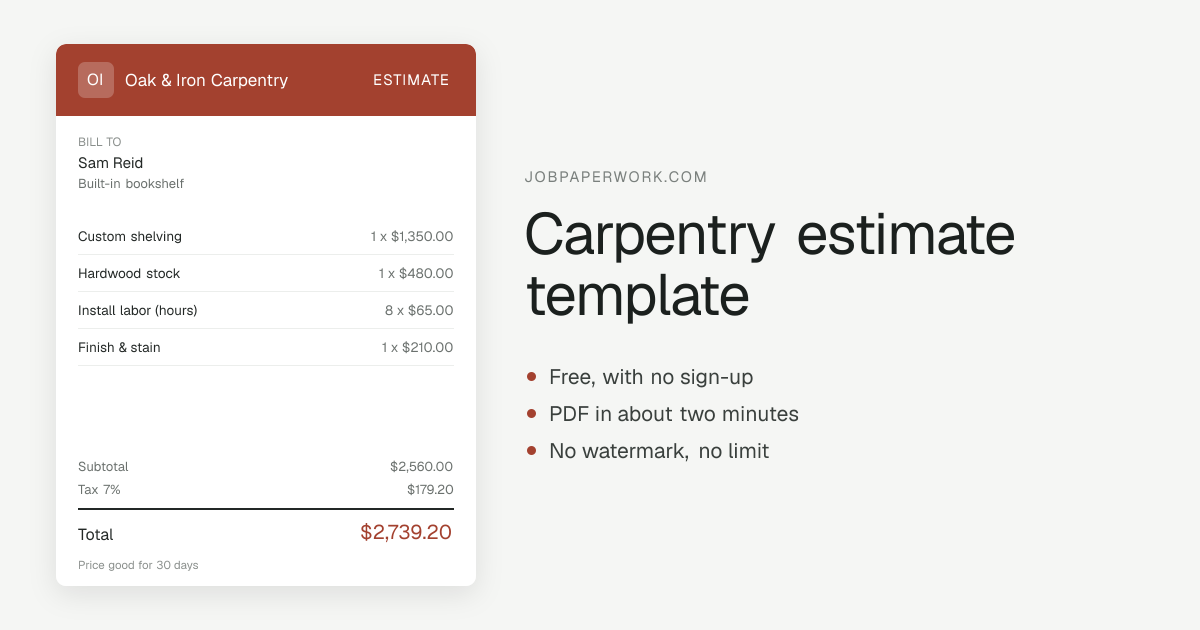
A PDF, and a link your customer can open in any browser. Word and Excel versions are not available yet — if a spreadsheet is what you need, this is not yet the tool for it, and saying so is cheaper for both of us than you finding out after typing everything in.
Pick how it looks
Six looks, from a plain classic sheet through a bold top band to a shop ticket, and your initials go on automatically until you upload a logo. See all six.
How to send it
Most customers want the paper on their phone, so the estimate goes out by WhatsApp, text or email, or as a link that needs no app and no account on their side. Or download the PDF to print it or keep it for your own records.
Questions
How do I estimate hours on a piece I have never made?
Break it into operations you have done before — carcass, doors, drawers, fitting, finish — and price those. The piece is new; the operations rarely are. Then add the fitting contingency as its own line, because fitting is where an unfamiliar piece actually costs you.
What do I say about a wall that is not square?
That the price assumes the opening is within a stated tolerance, and name the rate for scribing beyond it. Almost no wall in an older house is square, and a built-in scribed to an inch-and-a-quarter run-out is hours of work nobody budgeted for.