

What goes on an independent contractor estimate
An independent contractor’s estimate is a scope document that happens to carry a number. The client is buying your time, and the thing that destroys the margin is never the work itself — it is work that arrives after the price was agreed. A second round of revisions, a stakeholder nobody mentioned, a weekly call. What the estimate excludes is worth more to you than what it includes.
- The deliverables, named specifically enough that each can be ticked off
- The hours or days behind the figure, and the rate
- What is excluded, written as a list rather than left to be inferred
- How many rounds of revision or review the price covers
- What the client has to supply, and by when, for the estimate to still hold
- The rate for anything outside the scope
- How long the estimate stands, and your payment terms
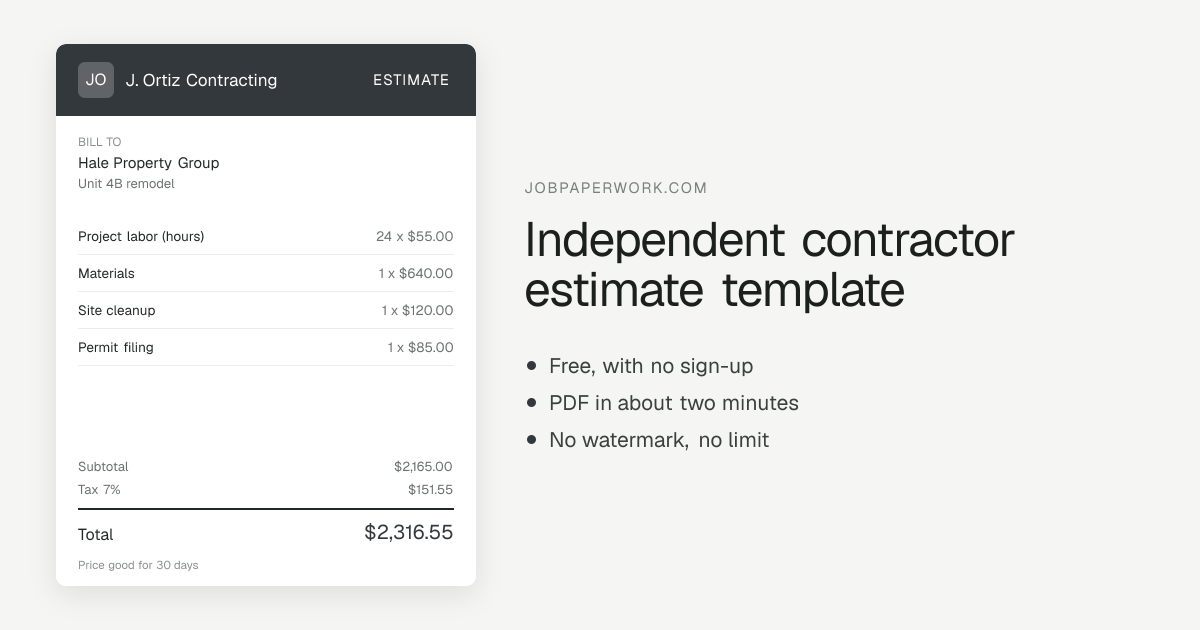
The sample line items and example prices this sheet opens with are on the independent contractor invoice template — the same table, which is about the trade rather than about this paper, so it lives in one place rather than on all six. Working out the price itself? The markup calculator turns your cost and markup into the figure to put on the estimate, and shows the margin it leaves.
What you get
A PDF, and a link your customer can open in any browser. Word and Excel versions are not available yet — if a spreadsheet is what you need, this is not yet the tool for it, and saying so is cheaper for both of us than you finding out after typing everything in.
Pick how it looks
Six looks, from a plain classic sheet through a bold top band to a shop ticket, and your initials go on automatically until you upload a logo. See all six.
How to send it
Most customers want the paper on their phone, so the estimate goes out by WhatsApp, text or email, or as a link that needs no app and no account on their side. Or download the PDF to print it or keep it for your own records.
Questions
Should I show my hourly rate on an estimate?
Show the rate and the total. A client comparing contractors needs the rate to make sense of the total, and a total with no rate behind it reads as a guess. The exception is where your rate is well above market and your speed is the reason — there, lead with the fixed price.
How do I stop scope creep without being difficult about it?
Name the boundary on the estimate instead of defending it later. Two rounds of revision, one weekly check-in, these deliverables and not those. Written in advance it is a term; raised halfway through it is a complaint, and the same sentence lands completely differently.