

What goes on a carpentry work order
Site carpentry runs on a sheet, because the work depends entirely on what is already there and what is already there was built by somebody else. Second fix in particular is a list of small jobs across a whole building, and the list is the only thing stopping one of them being missed.
- The property and the areas, floor by floor on a bigger job
- The items to be fitted, with quantities — doors, casing, baseboard, hardware
- What is already on site and what you are bringing
- What other trades need to have finished first
- Patching and repair, and who is doing it
- Tolerances: what counts as acceptable where the building is out
- Sign-off per area, and the snag list
The sample line items and example prices this sheet opens with are on the carpentry invoice template — the same table, which is about the trade rather than about this paper, so it lives in one place rather than on all six.
What you get
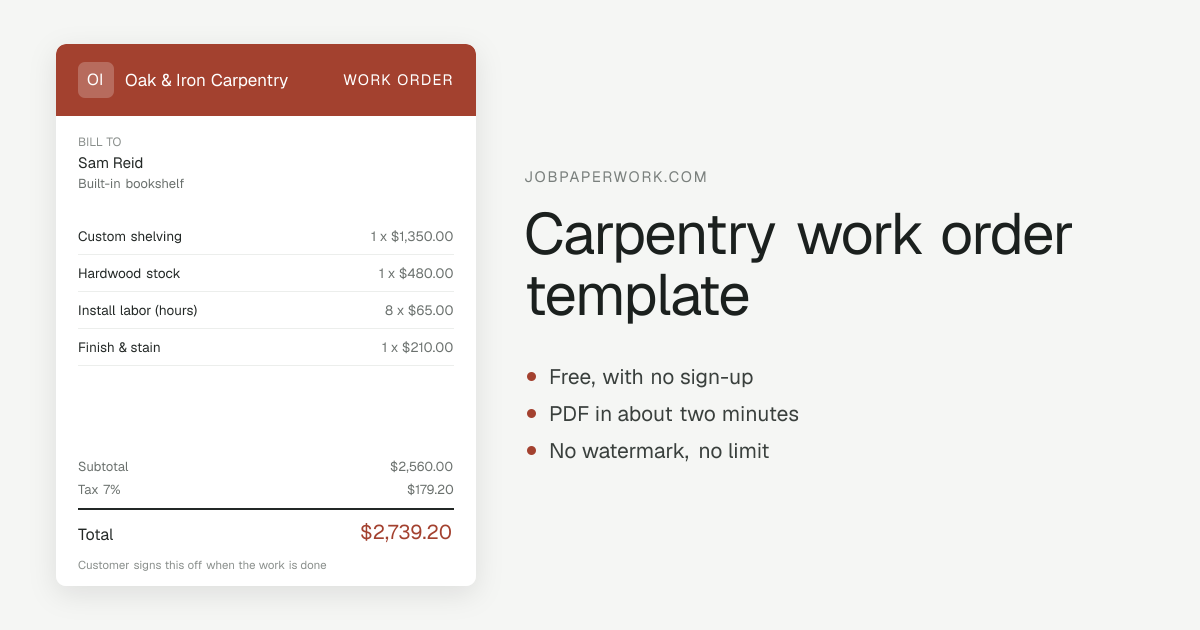
A PDF, and a link your customer can open in any browser. Word and Excel versions are not available yet — if a spreadsheet is what you need, this is not yet the tool for it, and saying so is cheaper for both of us than you finding out after typing everything in.
Pick how it looks
Six looks, from a plain classic sheet through a bold top band to a shop ticket, and your initials go on automatically until you upload a logo. See all six.
How to send it
Most customers want the paper on their phone, so the work order goes out by WhatsApp, text or email, or as a link that needs no app and no account on their side. Or download the PDF to print it or keep it for your own records.
Questions
Why does second fix need a work order?
Because it is forty small jobs across a building and nothing else holds them. A door hung, a set of door casing, a run of baseboard, a handle — individually trivial and collectively a week, and the item that gets missed is always the one nobody wrote down.
What should it say about other trades?
What has to be finished before you start, and what happens if it is not. Carpentry is a finish trade: hanging doors into openings that are not yet drywalled or fitting baseboard to an unleveled floor is work you will be asked to do twice, and the sheet is where you say so first.