

What goes on a plumbing estimate
Plumbing is estimated through a wall. You can price the fitting, the fixture and the hours; what you cannot price is what the last person did behind the plaster. An estimate that writes its assumption down survives being wrong about it, and one that does not gets read as a promise.
- The call-out or service fee, and whether it comes off the job if the work goes ahead
- Labor as hours × rate, with the after-hours rate shown if it might apply
- Fixtures and parts on their own lines, and who is supplying each
- The assumption the price rests on — pipe run, accessible valve, sound substrate
- What happens to the price if that assumption is wrong, as a rate rather than a shrug
- Patching and repair: tile, drywall and flooring, included or excluded, said either way
- How long the price holds, which matters while copper moves
The sample line items and example prices this sheet opens with are on the plumbing invoice template — the same table, which is about the trade rather than about this paper, so it lives in one place rather than on all six. Working out the price itself? The markup calculator turns your cost and markup into the figure to put on the estimate, and shows the margin it leaves.
Estimating work you cannot fully see
A plumbing estimate often prices work behind a wall or under a floor, so it should separate what is certain from what is likely — the visible job, and the “if the pipe is corroded past the joint” contingency. Saying which is which, and what each would add, is what keeps the final invoice from looking like a bait-and-switch.
Where a job needs parts ordered or a deposit before you start, the estimate is where that is agreed. Note the call-out and whether it is credited against the work, so the customer is not surprised by a charge for the visit that produced the estimate.
What you get
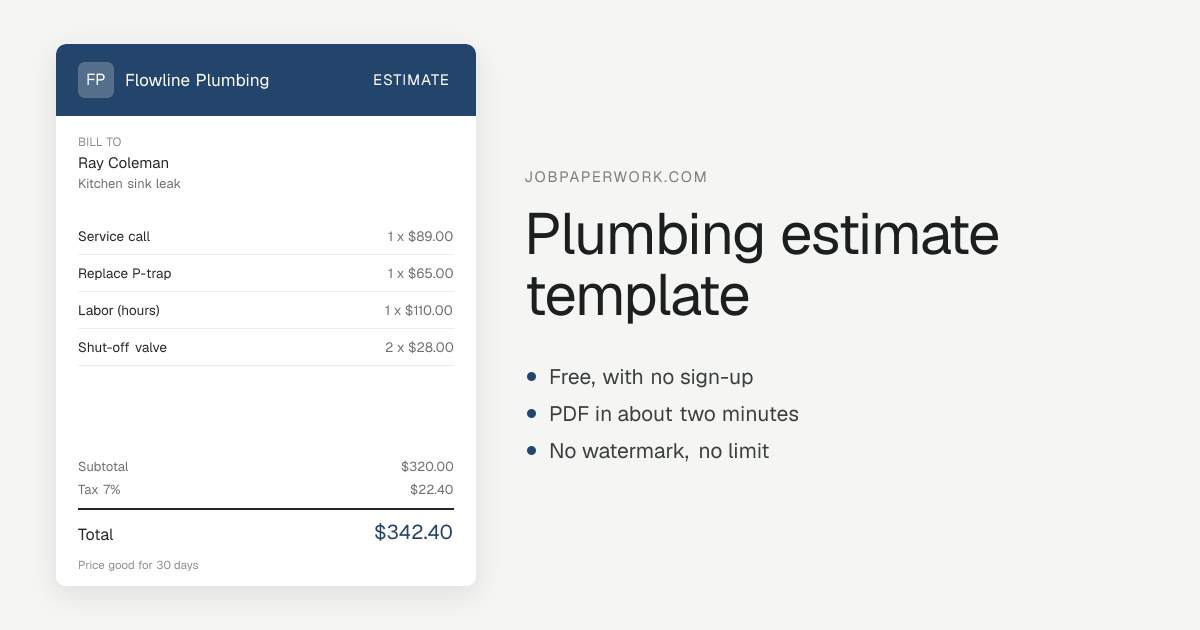
A PDF, and a link your customer can open in any browser. Word and Excel versions are not available yet — if a spreadsheet is what you need, this is not yet the tool for it, and saying so is cheaper for both of us than you finding out after typing everything in.
Pick how it looks
Six looks, from a plain classic sheet through a bold top band to a shop ticket, and your initials go on automatically until you upload a logo. See all six.
How to send it
Most customers want the paper on their phone, so the estimate goes out by WhatsApp, text or email, or as a link that needs no app and no account on their side. Or download the PDF to print it or keep it for your own records.
Questions
Can I estimate a plumbing job I have not opened up yet?
You can estimate what you can see and name what you cannot. Write the estimate against a stated assumption — the pipe is where it should be, the valve is serviceable — and say what happens to the price if it is not. An estimate with the unknown written into it survives being wrong; one without it does not.
Does the estimate have to include the call-out fee?
Show it either way, as its own line. If it comes off the job when the work goes ahead, say so on the estimate — it is one of the most common arguments in the trade and one line settles it before it starts.
How long should a plumbing estimate stand for?
Thirty days is the usual, and copper and fixture prices are the reason to say so rather than leave it open. If the job hangs around for two months the material has moved and you are either absorbing it or having the conversation anyway.