

How to price a handyman job
Estimate the time for each task, add travel and any trip for materials, and multiply by an hourly rate that covers your costs and pay. Add materials at cost plus a markup, set a minimum charge so small visits still pay, and list each task on its own line.
A handyman job is rarely one job. It is a list on the fridge — a sticking door, two shelves, a dripping faucet — and the price has to cover every item on it, the drive there, and the run to the hardware store halfway through. The method below keeps each of those visible.
Hourly, by the task, or by the job
Hourly pricing is the honest default when you cannot see inside the problem: an old house, a repair somebody else started, a door that might be the hinge or might be the frame. The customer pays for the time it really took, and you are not gambling on it.
Flat prices by task — so much to mount a TV, so much to replace a faucet — sell better, because the customer knows the number before you arrive. They only work for tasks you have done often enough to know the time. Larger jobs, like a small deck repair or a run of trim, are usually priced as a whole job from an itemized estimate. Most handymen end up using all three, and the rate underneath them is the same.
Set a minimum, and say what it covers
The ten-minute job is the one that loses money. Loading the van, driving across town, finding parking and driving back takes the same time whether you are there for ten minutes or two hours. A minimum charge — often expressed as the first hour, or a call-out fee — makes the small visit pay for itself.
Say whether the minimum includes the first hour of work or is charged on top of it, and say it before you go. Those are two different deals, and the customer will remember the cheaper one.
What to count as cost
Your hourly rate has to earn more than your wage for the hours on site, because so many of the hours in a handyman’s week are not on site at all. Count:
- Travel time and fuel between jobs, not just the distance on the first one
- Supply runs — the forty minutes at the hardware store when a part is the wrong size
- Consumables: fasteners, sealant, sandpaper, blades and drill bits that never get their own line
- The van, insurance, tools and their replacement, phone and invoicing
- Unpaid time spent quoting, answering messages and chasing payment
A worked example
All numbers here are illustrative, not a market rate. Suppose your all-in rate is $70 an hour and the list is: rehang a sticking door (an hour), mount two shelves (half an hour), and replace a kitchen faucet (an hour). Add half an hour of travel and half an hour for a supply run, and the labor is 3.5 hours × $70 = $245.
The faucet and fasteners cost you $60. Marked up by 20% for the time spent choosing, buying and carrying them, and for the risk of the return trip when a part is wrong, they go on at $72. The estimate totals $317 before any tax.
If the door turns out to be a frame problem rather than a hinge, the estimate already says the door line was priced as a hinge adjustment, and the conversation about the extra hour is short.
Check what the job size allows where you work
Some states limit the size or type of job that can be done without a contractor’s license, often by a dollar threshold, and many restrict electrical, plumbing and gas work to licensed trades whatever the size. The rule is set by your state and sometimes your city, so check theirs before quoting anything that edges into that work. It is better to know before the estimate than to find out from an inspector.
Pricing a task you have not done before
Every handyman meets the job that is not on the menu — an unfamiliar fitting, a repair in a material you rarely work with. Flat-pricing it on a guess puts the whole risk of the guess on you.
There are two honest ways through. Price it by the hour, with an estimate of the likely range and a note that you will check in before going over it. Or break it into the parts you do know — taking the old one out, preparing the surface, fitting the new — and time each, which is usually more accurate than timing the whole thing at once.
Either way, write down afterwards how long it really took. The second time the same task comes up, it can go on the flat-price menu with a number you trust.
Putting the price on the estimate
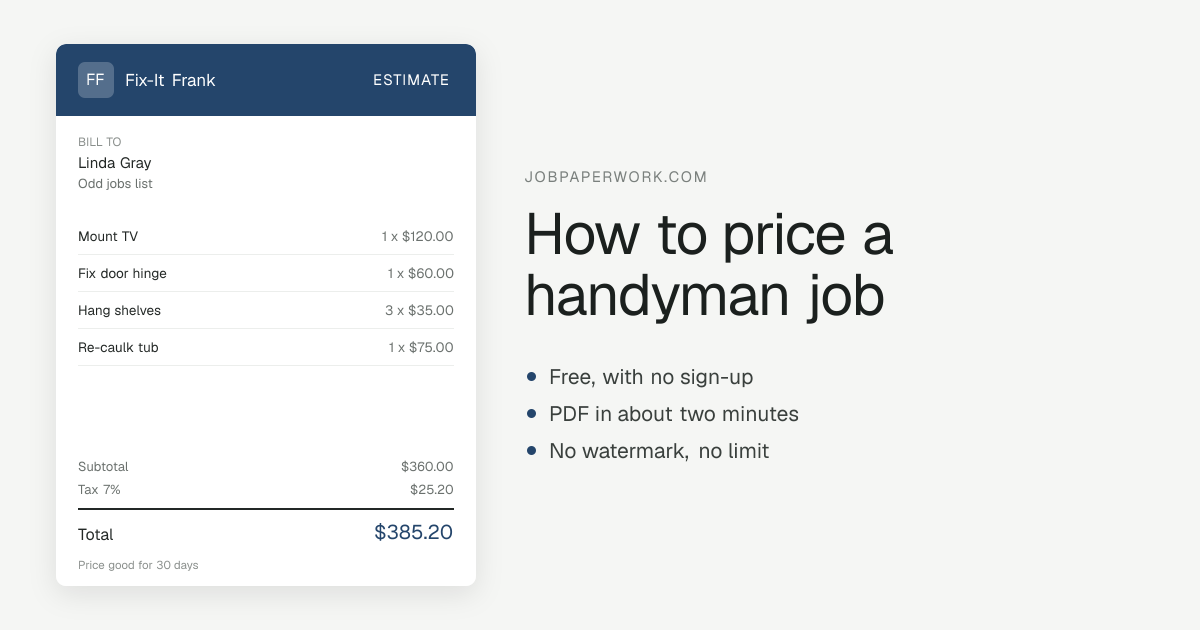
List every task on its own line with its own price, rather than one total for “odd jobs”. A customer who can see the shelves cost $35 can decide to do the shelves themselves and keep the rest; one looking at a single figure just decides it is too much. Put materials on separate lines from labor, say what each task assumes, and add the minimum charge if it applies.
The handyman estimate template opens with typical tasks listed and prices ready to edit, and the markup calculator turns your materials cost into the figure to bill.
Questions
Should I charge for the trip to the hardware store?
Most handymen do, either as time on the job or as a markup on the materials that pays for it. The run takes real time out of your day. Say which way you handle it on the estimate, so the customer is not surprised to see it — or surprised that the parts cost more than the shelf price.
Is it better to charge by the hour or a flat price for small jobs?
A flat price works for tasks you have done enough times to know how long they take, and customers like knowing the number in advance. Where you cannot see the problem until you open it up, hourly is fairer to both of you. Many handymen use flat prices for a short menu of common tasks and hourly for everything else.
What should a handyman minimum charge cover?
At least the cost of getting to the job and back plus a short block of work, so that a ten-minute visit is not done at a loss. Write down whether it includes the first hour or is added on top, and quote it before you go, not on the invoice afterwards.