

What goes on a pest control service agreement
Quarterly cover is the core of the trade. The customer stops thinking about pests, you get a visit in the diary four times a year, and the thing both sides need settled is the one nobody mentions at signing: what happens when something turns up between visits.
- The property, and the areas covered
- Visit frequency, and what each visit includes
- Which species are covered, and which are explicitly not
- Call-outs between visits: included or charged, and at what rate
- Response time for a call-out
- Monitoring left in place, and who is responsible for it
- The price, the term, the renewal and the notice
The sample line items and example prices this sheet opens with are on the pest control invoice template — the same table, which is about the trade rather than about this paper, so it lives in one place rather than on all six.
What you get
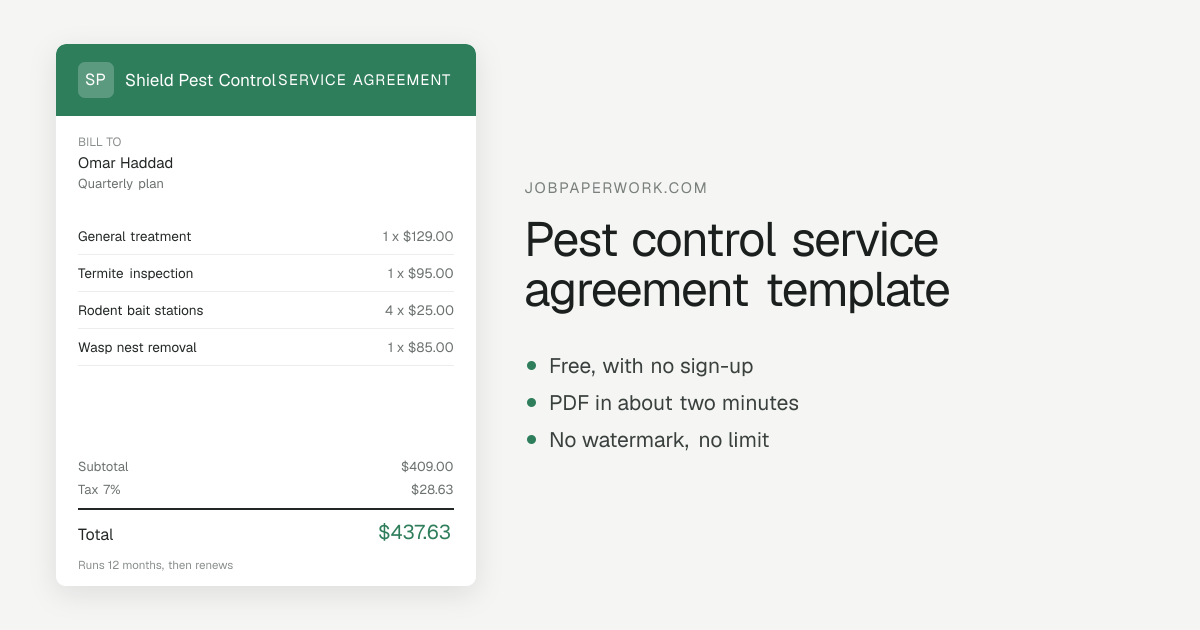
A PDF, and a link your customer can open in any browser. Word and Excel versions are not available yet — if a spreadsheet is what you need, this is not yet the tool for it, and saying so is cheaper for both of us than you finding out after typing everything in.
Pick how it looks
Six looks, from a plain classic sheet through a bold top band to a shop ticket, and your initials go on automatically until you upload a logo. See all six.
How to send it
Most customers want the paper on their phone, so the service agreement goes out by WhatsApp, text or email, or as a link that needs no app and no account on their side. Or download the PDF to print it or keep it for your own records.
Questions
Should call-outs between visits be included?
Include a stated number, or include them for the covered species only. Unlimited call-outs on an open list of species is an agreement that will cost you at the one property with a persistent problem; excluding them entirely makes the cover look worthless the first time something appears.
Which species should an agreement cover?
List them, and list what is excluded. Wasps, squirrels, bedbugs and birds routinely fall outside a general contract, and the moment to settle that is at signing. A customer who assumed everything was covered treats the first exclusion as a refusal.