

What goes on a welding service agreement
Plant, farm and fleet maintenance is where welding becomes repeat work. A machine down in harvest or mid-shift is losing money by the hour, and what the customer is buying is not a rate but the certainty that somebody comes out.
- The site or sites, and the plant covered
- The call-out rate and the hourly rate, fixed for the term
- Response time, and what counts as a breakdown rather than a repair
- Out-of-hours and weekend cover, and what it costs
- Scheduled inspection work, where any is included
- Materials: your stock or theirs, and the markup if yours
- The term, the renewal, and the notice
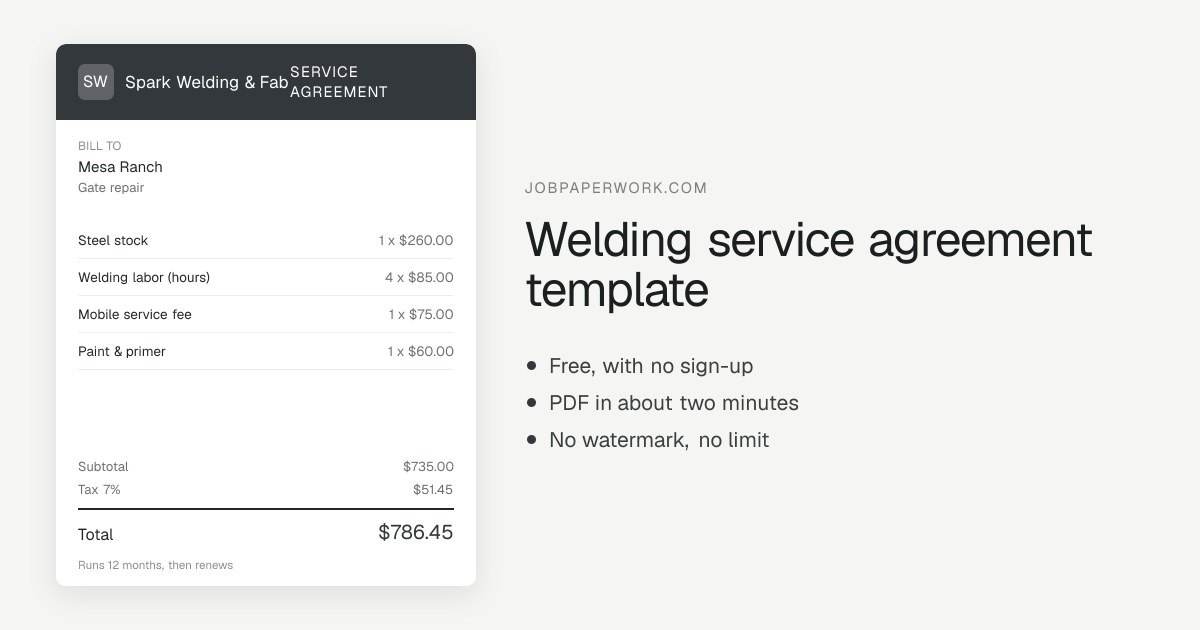
The sample line items and example prices this sheet opens with are on the welding invoice template — the same table, which is about the trade rather than about this paper, so it lives in one place rather than on all six.
What you get
A PDF, and a link your customer can open in any browser. Word and Excel versions are not available yet — if a spreadsheet is what you need, this is not yet the tool for it, and saying so is cheaper for both of us than you finding out after typing everything in.
Pick how it looks
Six looks, from a plain classic sheet through a bold top band to a shop ticket, and your initials go on automatically until you upload a logo. See all six.
How to send it
Most customers want the paper on their phone, so the service agreement goes out by WhatsApp, text or email, or as a link that needs no app and no account on their side. Or download the PDF to print it or keep it for your own records.
Questions
What is a farm or plant customer really buying?
Response. A machine down in harvest costs more per hour than any welding rate, and the customer will pay a premium for somebody who turns up the same day. Put the response time in the agreement — it is worth more to them than a discount on the hours.
Should scheduled inspections be part of it?
Offer them, because they turn an unpredictable trade into planned work. Cracks in a bucket or a boom are visible long before they fail, and a customer who has a scheduled look twice a year has fewer breakdowns — which costs you the emergency rate and buys you the diary.