

What goes on a catering service agreement
Office lunches and standing weekly deliveries are the quiet half of catering: low drama, predictable, and the thing that pays the staff between events. What the agreement has to settle is the ordering deadline, because a kitchen cannot absorb a count that changes on the morning.
- The delivery days, and the times
- The standing order, and how the menu rotates
- The ordering deadline, and what happens to a late change
- Per-head price, or a fixed figure per delivery, with minimum numbers
- Dietary requirements held on file, and how they are updated
- Delivery, setup and collection of equipment
- Invoicing monthly, the term, and the notice
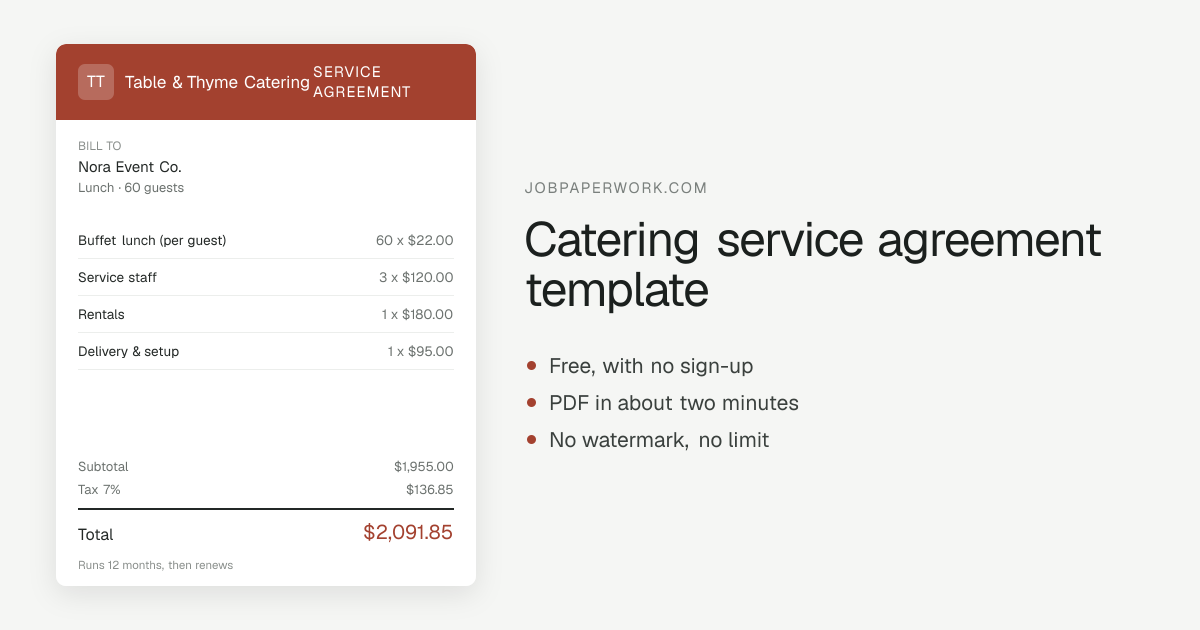
The sample line items and example prices this sheet opens with are on the catering invoice template — the same table, which is about the trade rather than about this paper, so it lives in one place rather than on all six.
What you get
A PDF, and a link your customer can open in any browser. Word and Excel versions are not available yet — if a spreadsheet is what you need, this is not yet the tool for it, and saying so is cheaper for both of us than you finding out after typing everything in.
Pick how it looks
Six looks, from a plain classic sheet through a bold top band to a shop ticket, and your initials go on automatically until you upload a logo. See all six.
How to send it
Most customers want the paper on their phone, so the service agreement goes out by WhatsApp, text or email, or as a link that needs no app and no account on their side. Or download the PDF to print it or keep it for your own records.
Questions
What is the most important term in an office catering agreement?
The ordering deadline. A kitchen buys and preps against a number, and an office that adds six people at nine in the morning is asking for something that cannot be done well. Name the cut-off and say what a late change costs, or what it means is that you absorb it every week.
How should the menu work on a standing order?
On a rotation, agreed in advance. The same lunch every Tuesday stops being welcome by the third week, and leaving it open means somebody has to decide every time. A four-week rotation written into the agreement solves both at once.