

What goes on a moving invoice
Moving is billed by crew and hours, and almost every dispute is about where the clock started and stopped. An invoice with the times on it ends most of them before they begin.
- Crew size and hours, with the start and finish times
- Truck and fuel, or a mileage line on a long move
- Packing materials — boxes, wrap, tape — by quantity
- Stairs, long carries and elevator waits, as their own lines
- Heavy or awkward items priced individually
- Both addresses, and the date of the move
Sample line items and example prices
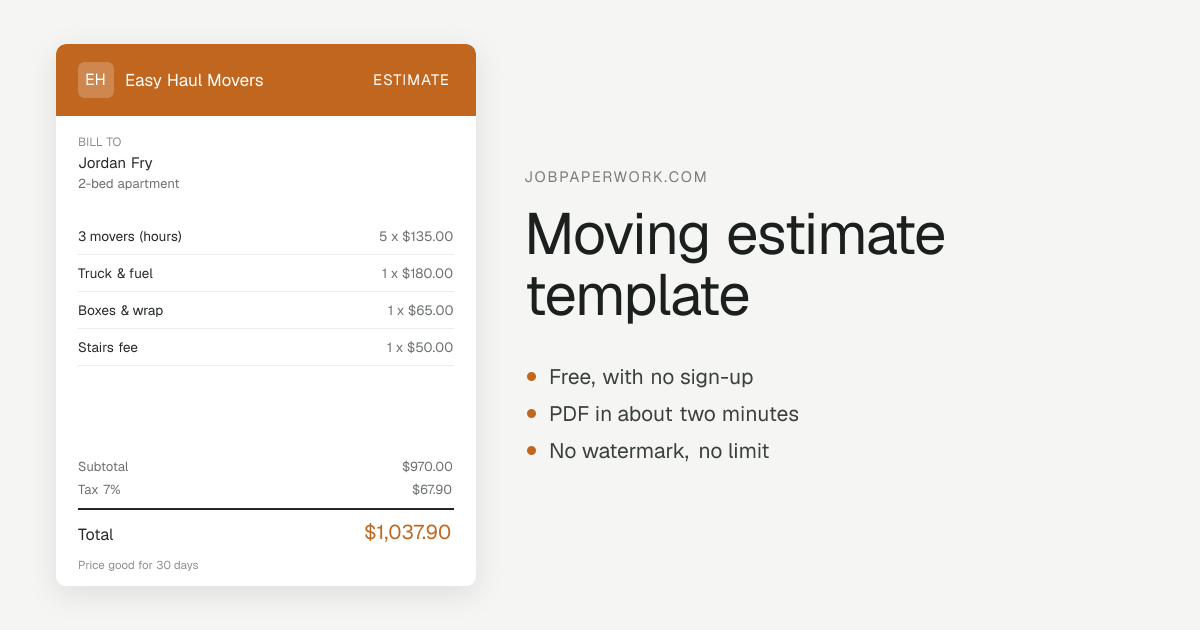
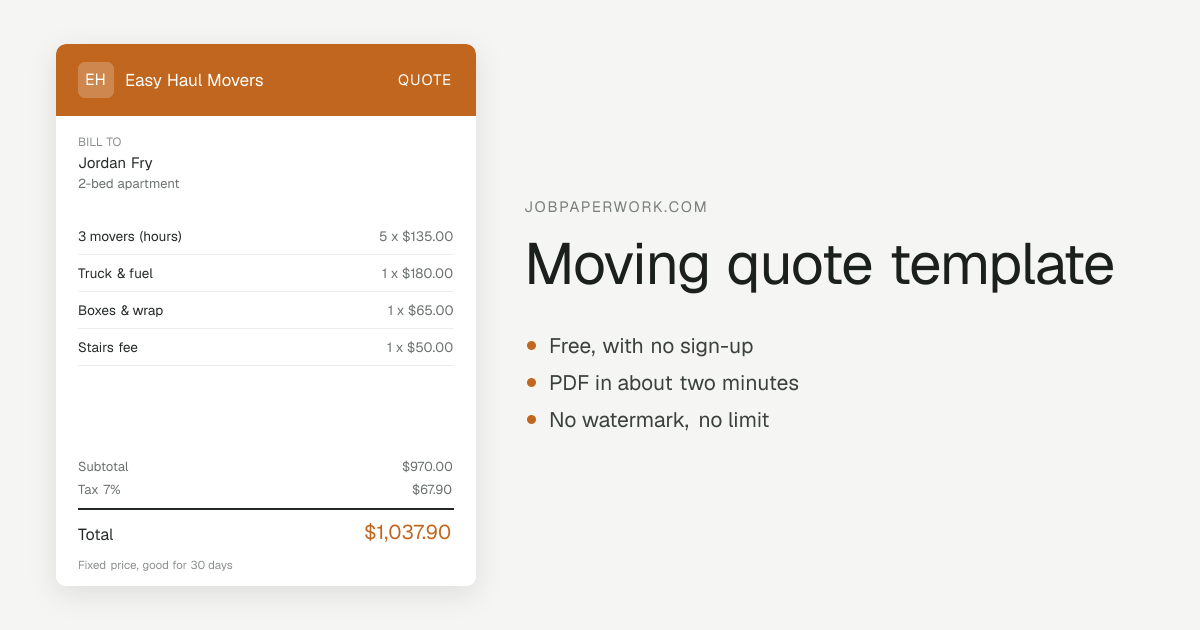
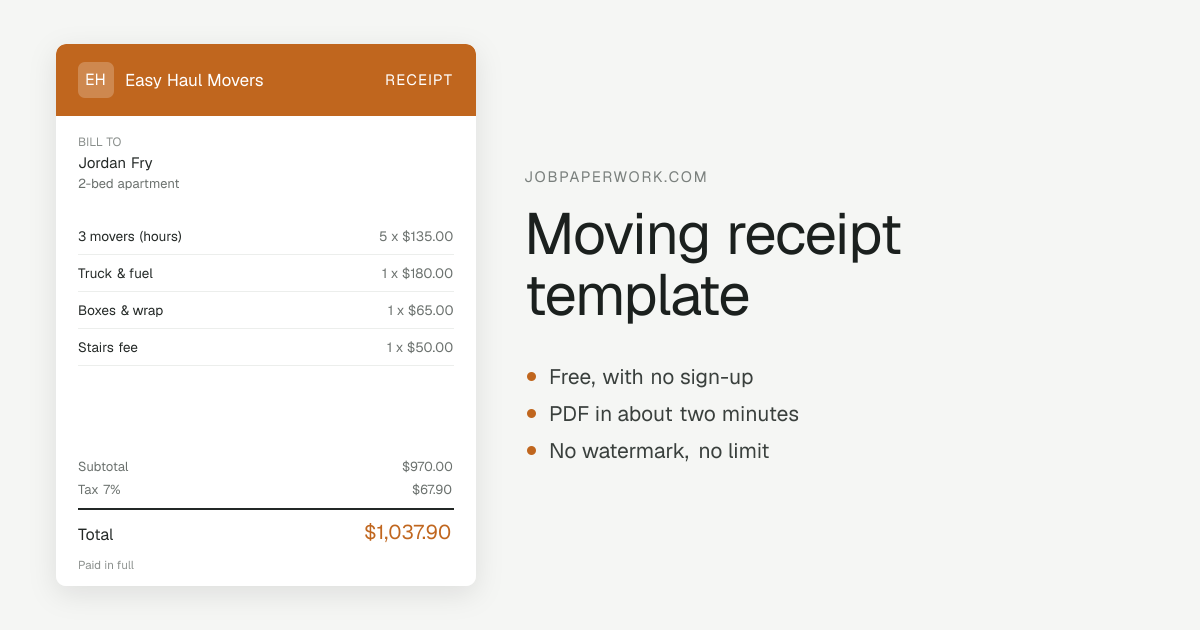
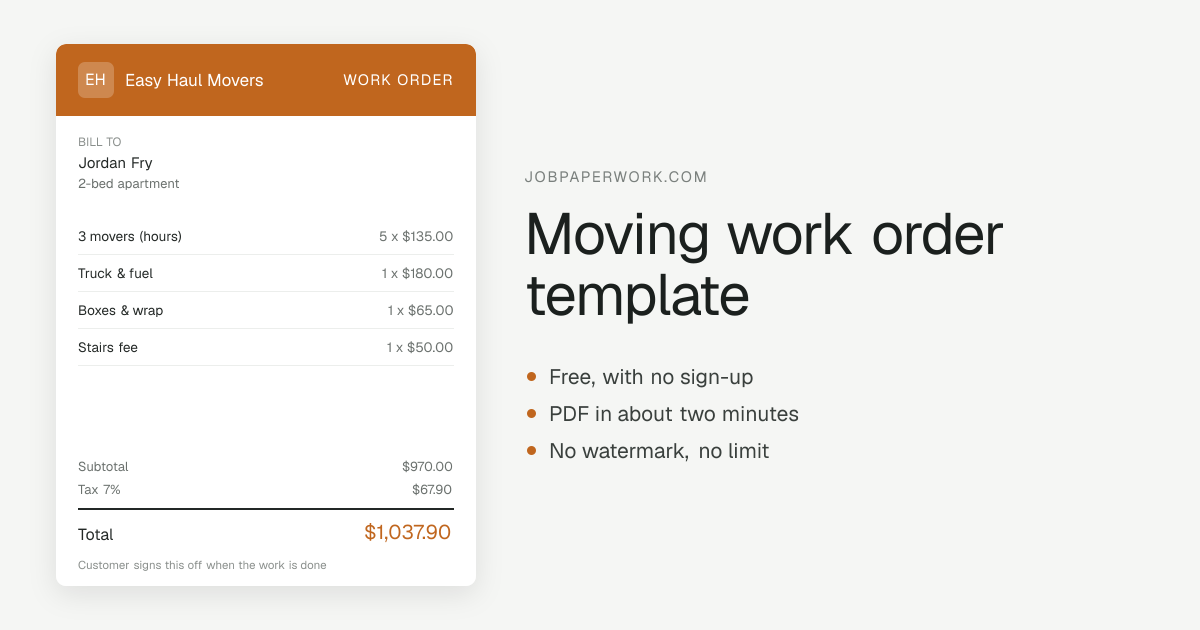
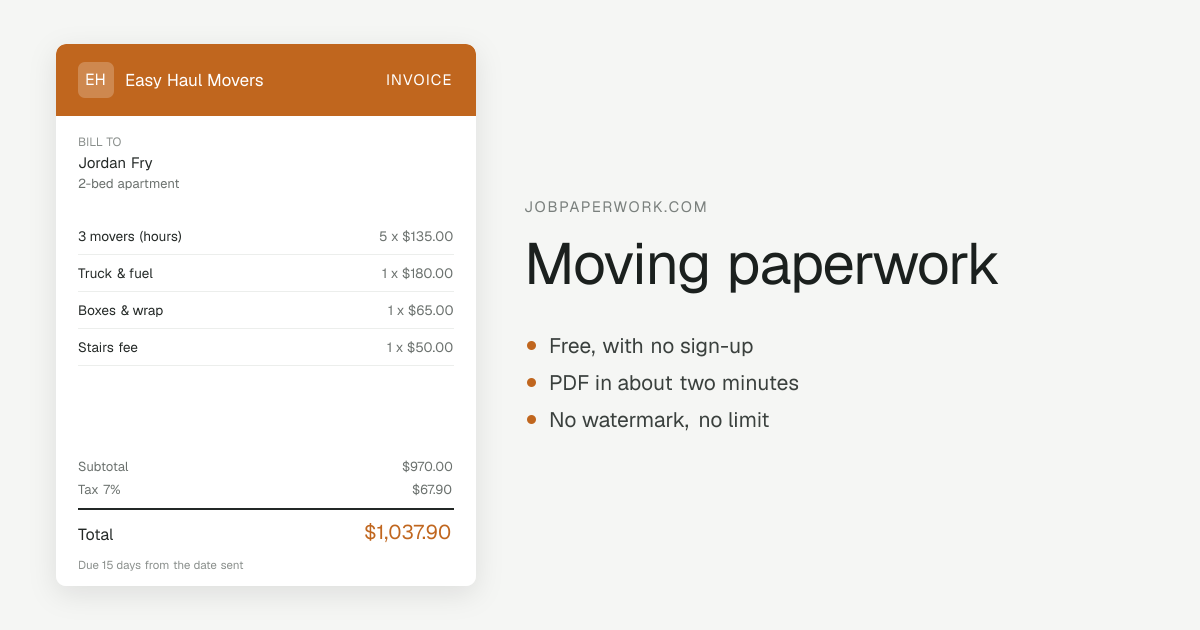
These are the sample lines and example prices this invoice opens with. They are starting points, not a survey of what anybody charges and not a recommendation — adjust every item to match your work, your rates and your customer before you create the PDF.
| Job | Usual quantity | Opens at |
|---|---|---|
| 3 movers (hours) | 5 | $135.00 |
| Truck & fuel | 1 | $180.00 |
| Boxes & wrap | 1 | $65.00 |
| Stairs fee | 1 | $50.00 |
Add, delete or rename any line. The math, the tax and any discount are worked out as you type. Setting the terms? The invoice due date calculator turns Net 15, 30 or 60 into the exact date to put on the invoice.
One moving invoice template: free, editable, printable and yours
Free moving invoice template
Free means the whole thing: no sign-up to start, no watermark on the PDF, no limit on how many moving invoices you make, and no card asked for at any point. An account is optional, and only does one job — keeping your papers in step between a phone and a computer.
Editable moving invoice template
It opens with 4 jobs a moving business usually bills — 3 movers (hours), truck & fuel, boxes & wrap — already priced, so most of the typing is done. Every line can be renamed, repriced or deleted, new ones added, and the subtotal, tax and any discount recalculate as you type.
Printable moving invoice template
Print it straight from the browser and only the invoice prints — no menus, no buttons — on whatever paper your printer holds. Or save it as a PDF to email, text or keep, and the customer’s copy is the same sheet you saw on screen.
Custom moving invoice template
Your business name, phone and address go at the top, with your logo if you upload one or your initials if you do not. Six looks to choose from, 5 accent colors, and your own payment terms in the footer — a moving invoice that looks like it came from your business, not from a website.
Every moving paper, as it comes out
The same jobs and the same look carry across all six papers, so one moving job can move from estimate to invoice to receipt without retyping.
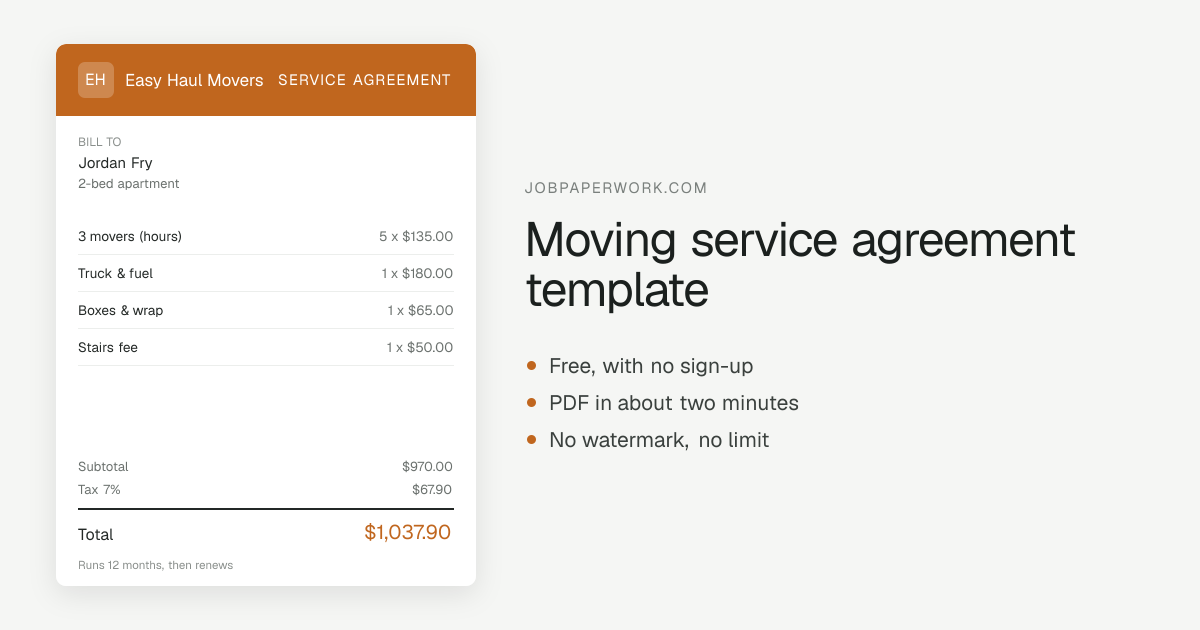
What you get
A PDF, and a link your customer can open in any browser. Word and Excel versions are not available yet — if a spreadsheet is what you need, this is not yet the tool for it, and saying so is cheaper for both of us than you finding out after typing everything in.
Pick how it looks
Six looks, from a plain classic sheet through a bold top band to a shop ticket, and your initials go on automatically until you upload a logo. See all six.
How to send it
Most customers want the paper on their phone, so the invoice goes out by WhatsApp, text or email, or as a link that needs no app and no account on their side. Or download the PDF to print it or keep it for your own records.
Questions
Should the clock start when the crew arrives or when they leave the yard?
Whichever you tell the customer, as long as you tell them before the day and the invoice shows the times. Travel time billed without warning is the most common complaint in moving.
How do I charge for stairs?
A flat line per flight, or a higher hourly rate agreed up front. Either works. What does not work is a bigger total with no line explaining it.
Should I take payment before the truck is unloaded?
Most movers take a deposit at booking and the balance on completion, and say which at the time of quoting. Deciding it on the driveway with a loaded truck is bad for everybody, so put the terms on the estimate.
How do I show valuation coverage on a moving bill?
Name the level the customer chose, such as basic released value or full value protection, and any charge for it, as its own line, and keep the signed choice with the paperwork. Interstate moves fall under FMCSA, which sets what movers must offer and disclose; intrastate moves fall under the state, often the public utilities commission or department of transportation. Check the agency that covers your move before quoting coverage.
Should I charge hourly or give a flat price for a local move?
Hourly is common for local moves, with crew size, truck and a minimum stated up front. A flat price suits a customer who wants certainty, but only after a walk-through or detailed inventory, and it should say what it covers and what would change it, such as extra items or an added stop. On long-distance moves, the rules on binding and non-binding estimates come from FMCSA or your state.
How do I bill packing materials and packing labor on a moving invoice?
As two separate things. Materials go by quantity and type: "Medium boxes x 30, wardrobe boxes x 4, mattress bags x 2, packing paper". Packing labor goes by crew hours or a flat price per room, on its own line. Customers who packed most of the house themselves want to see that they paid only for the kitchen, and the split makes that obvious.
How do I charge for a long carry or a shuttle truck when the truck cannot get to the door?
As a line of its own, priced per foot over an agreed distance, by the hour, or as a flat shuttle fee when a smaller truck has to ferry the load from a street the big one cannot use. Note the reason on the invoice: "Long carry, 150 ft from street, gated community". Spotting it at the survey and quoting it beats explaining it after the truck is loaded.
How do I invoice a piano, gun safe or pool table?
Priced individually, not by the hour, because they need extra crew, special equipment and more risk. Name the item and what it took: "Upright piano, 2 flights down, piano board and 3 crew", "Gun safe, about 600 lb, stair climber". Pool tables often need taking apart and releveling, which is worth its own line or a referral to a specialist.
How do I bill storage when the customer's new place is not ready yet?
Separate the move from the storage. Bill storage per month or per day by vault or by weight, plus a warehouse handling fee for unloading in and loading back out, and treat redelivery as a second move with its own date. Put the start date and the billing cycle on the invoice. For interstate shipments, FMCSA treats storage-in-transit differently from permanent storage, so check before quoting.