

How to fill out a receipt book
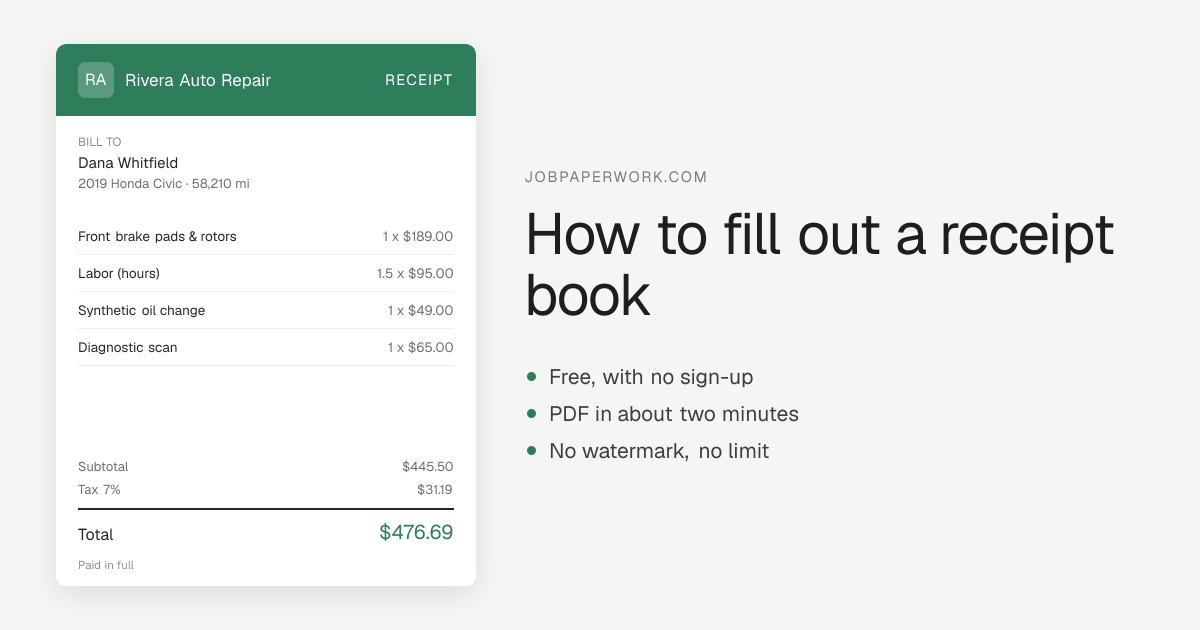
Fill out a receipt book top to bottom: the date and a unique receipt number, the customer’s name, a line for each item with its price, the subtotal, tax and total, then how they paid and your signature. Press hard for the carbon copy — you keep it, the customer gets the top sheet.
A receipt book is the oldest tool in the trade and still the fastest way to hand someone proof of payment on the spot when the signal drops or the phone dies. The layout is simple once you have done one, but the small habits — pressing through to the carbon, numbering in order, keeping the right copy — are what turn a drawer of stubs into records you can actually use at tax time.
What a receipt book is, and when it still beats an app
A receipt book is a pad of pre-printed receipts, usually two-part: a top sheet you tear off and hand over, and a carbon copy underneath that stays bound in the book as your record. You write once and press hard, and both copies carry the same thing.
It beats a phone whenever the phone is the problem — no signal, a dead battery, a customer who wants something in their hand right now. Plenty of tradespeople run a digital receipt most of the time and keep a book in the van for exactly those moments.
Fill it in, in this order
Work down the receipt top to bottom. Every pre-printed book has these fields, even if the labels vary:
- Date — the day the money changed hands
- Receipt number — the next one in sequence (most books print these for you)
- Received from — the customer’s name
- For — a short line per item or service, each with its amount
- Subtotal, tax, and the total received
- Paid by — cash, card, bank transfer or cheque
- Received by — your name or signature
Press hard — the carbon copy is the whole point
The reason a receipt book exists is the duplicate. Rest your hand lightly and the carbon copy comes out faint and half-missing, which is the copy you keep. Press firmly with a ballpoint, and if the book is three-part put the loose carbon sheet in the right place before you start writing.
The customer gets the top sheet. You keep the copy bound in the book. That split is fixed: the person who paid walks away with the original, and your record stays with you.
Number every receipt, with no gaps
Receipts run in a sequence for the same reason invoices do: it is how you prove, later, that none went missing. Most books come pre-numbered, which does the work for you — start a new book where the last one left off rather than from 001 again.
If a book is not pre-numbered, write the number yourself and keep a note of where each book starts and ends. A missing number looks, to anyone checking, like a sale you took in cash and left off the books.
Cash especially: write it down
A card payment leaves a trail at the bank whether you write a receipt or not. Cash leaves none, so the receipt is the only record it ever happened. The cash jobs are exactly the ones worth being disciplined about — both to protect yourself if the amount is ever questioned, and because unrecorded cash is the thing a tax audit looks for first.
If you make a mistake
Do not tear the page out. A missing page reads as a hidden receipt. Draw a line through the spoiled one, write "void" across it, leave both copies in the book, and move to the next number. The void page is evidence that the number was not skipped.
When the book fills up: keep it
A used receipt book is a tax record, so it goes in the same box as your invoices for as long as your tax authority asks you to keep records — often several years. Label the spine with the date range and the first and last receipt number so you can find a specific one without flicking through the whole pad.
If flicking through pads is the part you dread, that is the case for going digital: a receipt made on this site is numbered, searchable and backed up the moment you send it, and you can still hand the customer a PDF on the spot.
Questions
Who keeps the carbon copy, me or the customer?
You do. The customer takes the top sheet you tear off; the carbon copy stays bound in the book as your record. Press hard enough that the copy is fully legible.
How do I number receipts in a book?
In a single unbroken sequence. Most books are pre-numbered — when one runs out, start the next book where it ended rather than at 001. Gaps look like receipts you removed.
Is a handwritten receipt legal?
Yes. A receipt is valid as long as it shows who paid, how much, for what, when and how it was paid — handwriting changes none of that. Keep your copy as the record.
Do I write the receipt before or after payment?
After. A receipt proves money was received, so it is written once the cash, card or transfer has actually gone through. Before payment you would send an invoice instead.
What if I make a mistake in the receipt book?
Strike it through, write “void”, and leave both copies in the book — then use the next number. Never tear the page out: a missing page looks like a receipt you hid.