

Invoice vs bill vs receipt: what is the difference?
An invoice is a request for payment for work or goods, usually with a number and a due date. A bill is the same request seen from the side that pays it, or one due at once. A receipt is proof that payment was made: invoices and bills ask for money, receipts confirm it arrived.
The three words get used loosely, and most of the time that does no harm. It matters when a customer’s bookkeeper asks for one and you send another, or when you need to show that a job was paid for. Here is what each one is for.
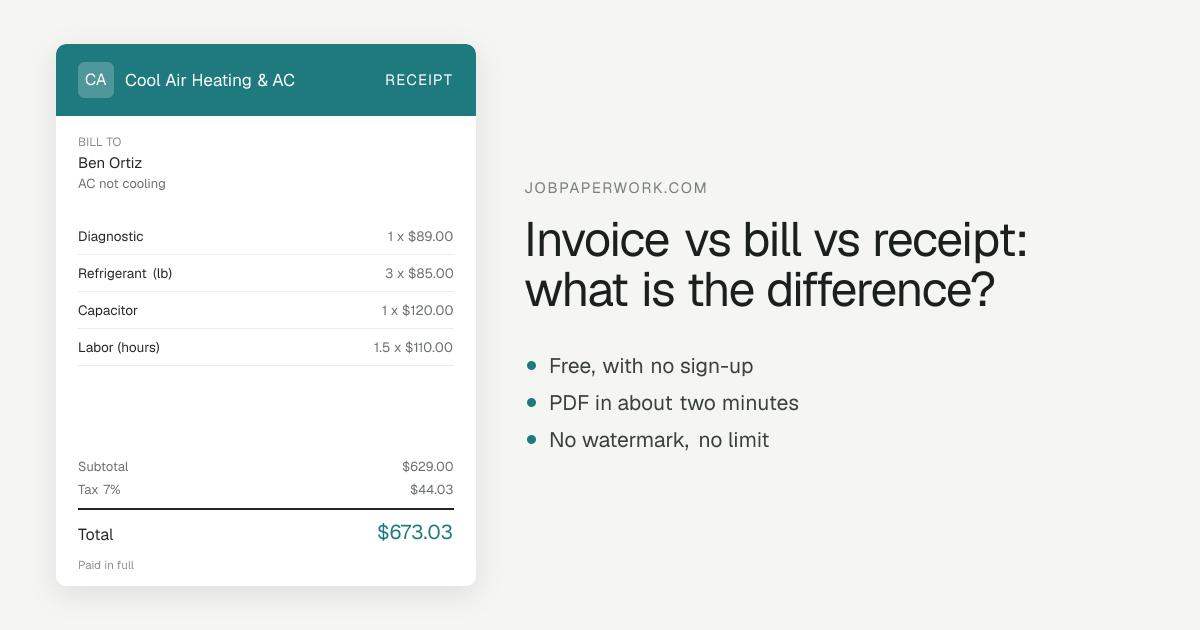
Two moments: before payment and after
The simplest way to keep them apart is to ask whether the money has changed hands yet. An invoice and a bill both come before payment: they say what is owed. A receipt comes after: it says what was paid. Everything else on the papers follows from that.
Getting the word right is not pedantry. A business customer’s accounts department pays invoices and files receipts, and a paper that is labeled as one but reads like the other gets sent back. In a dispute, the difference between “I asked to be paid” and “I was paid” is the whole argument, and the paper you hold is the evidence for whichever side of it you are on.
Invoice
An invoice is the document a seller sends to ask for payment, normally after the work is done or the goods are delivered. It is the formal version: it carries a unique invoice number, the date, who is billing whom, an itemized list of the work and materials, any tax, the total, the due date or payment terms, and how to pay.
Because it is numbered and dated, an invoice is also a record in your books. It is what you point to when you show what you billed in a year, and what a business customer’s accounts department needs before it will pay anything.
Bill
In everyday speech a bill is any request to pay: the electric bill, the bill at a restaurant. Often it is due straight away, or it is a recurring statement from a utility or service rather than a one-off document for a job.
In bookkeeping the word has a narrower meaning. An invoice you send is income you are owed; the same invoice, arriving at your customer, is a bill they have to pay — an entry in their accounts payable. So when a supplier sends you an invoice for materials, that is your bill. Same paper, other side of the counter.
Receipt
A receipt is proof that payment was received. It shows the amount paid, the date, how it was paid, what it was for, and — when it settles an invoice — that invoice’s number, plus any balance left. A receipt asks for nothing; it closes the account for that amount.
It is also the paper a customer reaches for later — for a warranty claim, an insurance claim, or to show a landlord or an HOA that the work was done and paid for. That is why a good receipt names the job and not just the amount.
On a job paid on the spot, a receipt can be the only paper there is. On a job that was invoiced first, the receipt comes afterwards and refers back to the invoice, so the two together show the whole transaction.
Side by side
The same questions, answered for each:
- Who issues it: invoice — the seller; bill — the seller, though the word is the payer’s; receipt — whoever was paid.
- When: invoice — after the work, before payment; bill — before payment, often due at once; receipt — after payment.
- What it does: invoice and bill ask for money; a receipt confirms it arrived.
- Key details: invoice — number, itemized lines, total, due date, how to pay; receipt — amount paid, date, method, invoice it settles.
- Balance: on an invoice or bill, the amount owed; on a receipt, usually zero.
- In the books: an invoice you send is income owed to you; a bill you receive is money you owe; a receipt is evidence for either.
Which one should you send?
Run the job through these and the answer is usually obvious:
- Work done, not yet paid: an invoice.
- Paid on the spot: a receipt. Add an invoice only if the customer needs one for their records, as many businesses do.
- Paid after you invoiced: a receipt that names the invoice number, or the invoice marked as paid.
- Customer asks for “the bill”: they mean the invoice. Send that.
- Buying from a supplier: their invoice is your bill; a purchase order is what you send them before they supply.
On this site
JobPaperwork makes invoices and receipts as separate papers, each with its own number series, so a receipt is never mistaken for an invoice. A receipt prints a “Paid on” date and “Paid in full” where an invoice prints a due date and how to pay. There is no separate “bill” paper, because a bill is an invoice seen from the other side. Keep copies of both kinds: how long to keep business records is set by the IRS and your state, so check what applies to you.
Questions
Is a paid invoice the same as a receipt?
Close, but not quite. An invoice marked “paid” with the date and method does show payment, and many small businesses use it that way. A separate receipt is cleaner when a payment covers part of an invoice, several invoices, or was taken before any invoice existed.
Do I need to give a receipt if the customer paid by card or bank transfer?
Their bank or card statement shows money left their account, but not what it was for. A receipt ties the payment to the job and the invoice number, which is what they need for their records or a warranty claim. It is a courtesy that saves questions later.
What is the difference between a bill and a statement?
A bill or invoice asks for payment for one piece of work. A statement summarizes an account over a period — every invoice, payment and credit for that customer, and the balance at the end. Businesses with regular customers often send a monthly statement alongside their invoices.