

How to price a roofing job
Measure the roof in squares — 100 square feet each — and add a waste allowance for cuts, hips and valleys. Cost the materials per square, the crew’s labor for the days the pitch and tear-off will take, disposal and permits, then add your markup. Price decking you cannot yet see per sheet.
A roof is priced by the square, and almost every roofing estimate that goes wrong goes wrong in one of three places: the waste allowance, the tear-off, or the decking nobody could see until the shingles came off. Here is how to build the number so all three are covered.
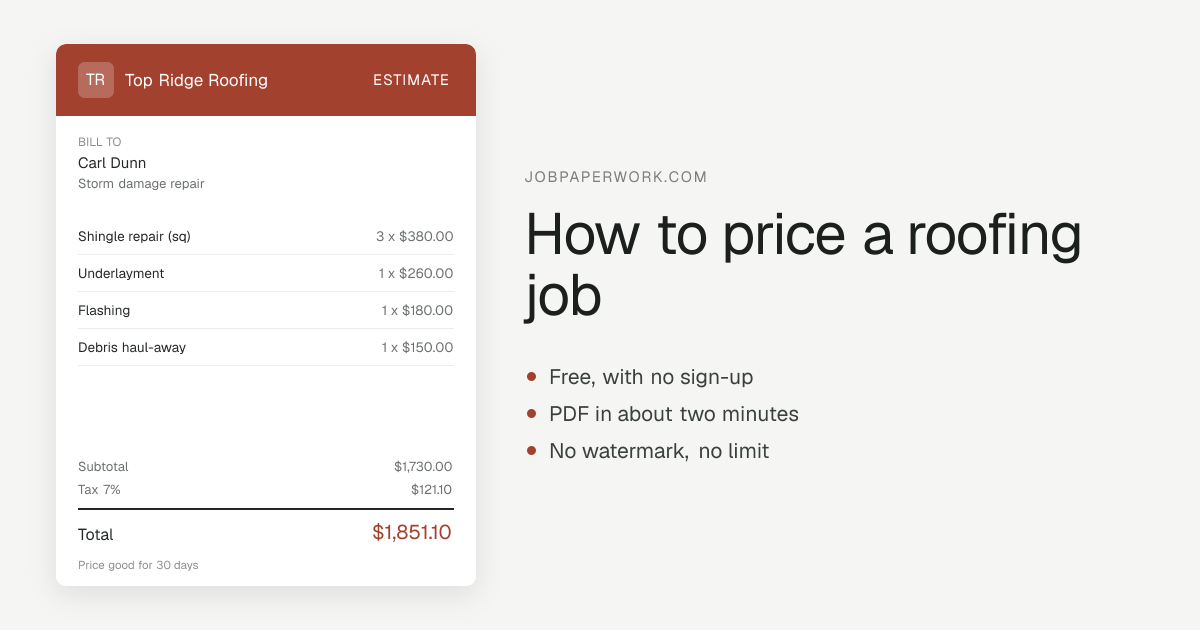
Pricing by the square
Roofing is measured in squares, and one square is 100 square feet of roof surface. Shingles and underlayment are bought by the square, crews think in squares per day, and customers comparing bids can follow a price per square. Repairs are the exception: a leak, a few missing shingles or a flashing fix is usually a per-job price with a minimum, because the time is in getting up there rather than in the area.
Measure the roof surface, not the house footprint. A steeper pitch has more roof over the same floor, and overhangs add area too. Satellite measurement reports are widely used for this, but check the numbers against what you can see on site.
Waste, pitch and tear-off
Add a waste allowance to the measured squares for the material cut away at edges, hips and valleys. A plain gable roof wastes little; a cut-up roof with dormers and valleys wastes a good deal more, so the allowance should follow the roof, not a habit.
Pitch and height change the labor. A steep roof needs harnesses, roof jacks and slower work; a third story needs more ladder time and more care with materials. Tear-off is its own cost: say how many layers are coming off, because a second layer is a second day of stripping and a heavier load to dispose of.
What to count as cost
Roofing carries more cost outside the materials than most trades realize until they price their first full replacement. Count:
- Materials per square — shingles, underlayment, ice and water barrier, starter, ridge cap and fasteners
- Flashing, drip edge, pipe boots and ventilation, priced as their own items
- Crew labor for the days the job takes, at a cost that includes payroll and insurance
- Dumpster or haul-away, and disposal fees by weight
- Permits where your city or county requires them, and safety equipment
- Your overhead: truck, insurance, estimating time and warranty call-backs
A worked example
Every figure here is illustrative, not a market rate — use your own supplier prices and labor costs. A roof measures 26 squares. With a 10% waste allowance in this example, that is 28.6, so you order 29 squares. If shingles, underlayment and fasteners come to $150 a square, materials are 29 × $150 = $4,350.
A crew of four takes two eight-hour days to tear off one layer and re-roof, at a cost to you of $45 an hour per person: 4 × 16 × $45 = $2,880. Disposal for the tear-off is $500. The job costs you $4,350 + $2,880 + $500 = $7,730.
At a 30% markup, the price is $7,730 × 1.3 = $10,049. The markup calculator will show that this leaves a margin of about 23% of the price — which is the number that has to pay for the office, the truck and the warranty work.
Decking, insurance jobs and the unknowns
You cannot see the decking until the old roof is off. Rather than guess, put a price per sheet of replacement decking on the estimate and say that rotten or damaged sheets will be replaced at that rate. The customer agrees the rate before anyone is on the roof, and the conversation on the day is about how many, not how much.
If the work is an insurance claim, keep your estimate in your own terms and let the homeowner deal with their insurer. Some states restrict how contractors may handle a homeowner’s deductible, so check your state’s rules before offering anything around it.
Repairs: pricing the small roof job
Most of what a repair costs is getting up there safely: ladders, harness, setting up, and often a second trip once you have seen what the leak actually is. The materials are small; the time is not. That is why repairs are usually priced per job with a minimum rather than per square.
Price the inspection and the repair as separate steps where you can. A leak traced to a cracked pipe boot is a short, fixed job; a leak that turns out to be failed flashing along a wall is a different one, and the customer should agree that price once you know which it is. Say on the estimate that the repair price covers the cause you found, and that a roof near the end of its life may leak again elsewhere.
Putting the price on the estimate
Lay it out so the customer can compare it with the next bid: the number of squares, the layers being torn off, the shingle line and color, underlayment, flashing and ventilation, the decking rate per sheet, disposal, the permit, and clean-up including a magnetic sweep for nails. Keep the manufacturer’s warranty and your workmanship warranty as separate lines. The roofing estimate template opens with these lines ready to edit, and the guide to asking for a deposit covers the money you need before materials are ordered.
Questions
What is a square in roofing?
One hundred square feet of roof surface. A roof of 2,600 square feet is 26 squares. Shingles are sold in bundles, commonly three to a square for standard shingles, though it varies by product, so check the coverage printed on the wrapper.
How do I price rotten decking I cannot see until the tear-off?
With a unit price. Put a rate per sheet of replacement decking on the estimate and say that damaged sheets will be replaced at that rate once the roof is open. The customer agrees the price in advance, and you show them the damage before you replace it.
Should a roof replacement be an estimate or a quote?
The measured part — the squares, the materials, the tear-off — can be a fixed price, because you can see it. The hidden part, mainly the decking, cannot. Many roofers quote the visible work and give a unit rate for the unknowns, so the document is fixed where it can be and honest where it cannot.