

How to price a pressure washing job
Measure each surface in square feet, work out how long it takes including setup and pack-up, and multiply by an hourly rate that covers chemicals, fuel, equipment and your pay. Check that against a per-square-foot price, quote the higher of the two, apply a minimum charge, and list each surface on its own line.
Pressure washing is one of the few trades where you can measure the job from the driveway before you knock. That makes square-foot pricing tempting — and it works, as long as the rate underneath it is checked against how long the job takes and what the chemicals cost.
Per square foot, per job, or per hour
Per square foot is the common way to price flatwork — driveways, patios, pool decks — and decks and fences, because it scales with the job and the customer can follow it. A whole-house wash is more often a flat price per job, set by the size of the house and the number of stories, because the siding area is awkward to measure and the time is driven by height and access more than area.
Hourly pricing is rarer, and mostly used for odd jobs — a graffiti wall, equipment, a commercial dumpster area — where nothing about the surface predicts the time.
Different surfaces are different jobs
Concrete takes high pressure and a surface cleaner, and goes quickly per square foot. Wood decks and fences need lower pressure and more care, or the grain is raised and the customer has a furry deck. Siding and roofs are usually soft-washed — low pressure with a cleaning solution doing the work — which costs more in chemicals and less in force.
So price surfaces separately, at their own rates. A single square-foot rate across a driveway and a deck either overcharges the concrete or undercharges the wood.
Condition matters as much as material. A driveway cleaned every spring comes up in one pass; one that has not been touched in ten years, under trees, may need a pre-treatment, a second pass and a much longer rinse. Look at it before you price it, or ask for photos, and say on the estimate what condition the price assumes. It is the difference between a fixed price and an argument on the day.
What to count as cost
Square-foot rates hide the time you spend not washing. Count:
- Setup and pack-up: unloading, hoses, protecting plants and doors, rinsing down, reloading
- Chemicals — surfactants, degreasers, and the solution used for soft washing
- Fuel for the machine and the truck, and water if you bring your own
- Equipment wear: pumps, hoses, nozzles, surface cleaners, and the trailer or tank
- Insurance, travel between jobs, and the time spent measuring and quoting
A worked example
The figures here are illustrative, not a market rate. A driveway measures 20 by 40 feet, which is 800 square feet. At an example rate of $0.20 a square foot, that is $160.
Now check it against time. Twenty minutes to set up, an hour to clean, twenty minutes to rinse and pack up: an hour and forty minutes. If your all-in hourly rate is $90, that is 1.67 × $90 = $150, plus about $10 of chemicals — $160 again. The two methods agree, so the square-foot rate is holding up. Where they disagree, quote the higher one: a small job priced per square foot will often come in below what the visit costs, which is what a minimum charge is for.
An optional sealer after cleaning is a separate line with its own materials cost, not an add-on to the washing rate.
Water, runoff and stains: say it before you start
Say whose water you are using. Many jobs run off the customer’s outside faucet, and a few customers are surprised by that; the quote is the place to mention it.
Some cities and counties regulate washwater running into storm drains, especially when chemicals are involved. The rules are local, so check with yours. And be careful promising stain removal: oil, rust and some organic stains do not always lift. “Cleaned, with oil staining improved but not guaranteed” on the quote saves a complaint later.
Minimums, bundles and add-ons
Every job carries the same fixed time — loading, driving, setting up, packing away — before a single square foot is cleaned. On a small patio priced by the square foot, that fixed time can be most of the visit. A minimum charge covers it, so that the smallest job you take still pays for the trip.
The same fixed time is why bundling works in your favor. A driveway, a patio and a house wash at one address share one setup, so you can price the second and third surfaces a little sharper and still earn more per hour than on three separate visits.
Add-ons are worth listing as options on the estimate rather than mentioning on site: gutter brightening, sealing a deck or pavers after cleaning, or a rust treatment. Each has its own materials and time, and a customer who sees them priced in advance can say yes before you have unloaded.
Putting the price on the estimate
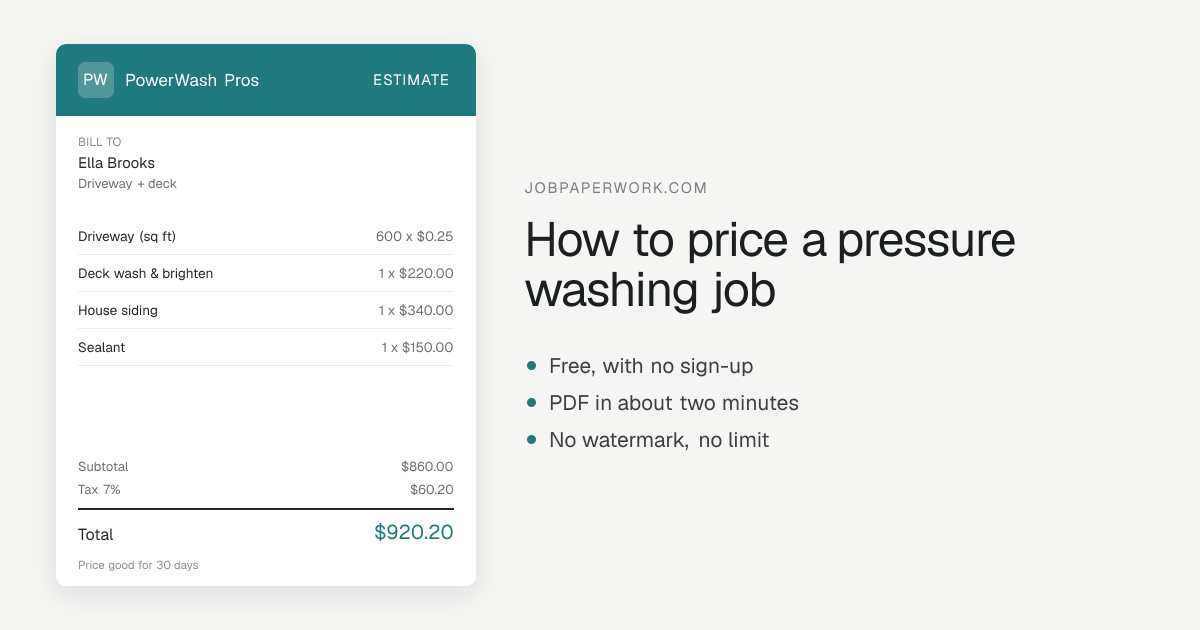
One line per surface with its measurement and rate — driveway 800 sq ft, deck 300 sq ft, house wash two stories — so the customer can see what each part costs and drop one if they want to. Add the minimum charge if the job falls under it, and note any exclusions. The pressure washing estimate template opens with these lines ready to edit, and the markup calculator helps with sealers and other materials.
Questions
Should I charge the customer for water?
Most residential jobs use the customer’s outside faucet, and the water is not usually billed — but say on the quote that you will be using it. If you bring water in your own tank, because there is no faucet or the customer asks, it has a cost and belongs in your price.
Can I guarantee a pressure washer will remove every stain?
It is safer not to. Oil, rust, tannin and some mildew stains can be lightened without disappearing, and a promise on the quote becomes a refund conversation afterwards. Say what you expect — cleaned, with staining improved — and let the result exceed it.
How do I measure a house for a house wash?
Many washers price a house by its footprint and number of stories rather than by exact siding area, because height and access drive the time. If you do measure, multiply the perimeter by the wall height for each story and leave the windows in — they are washed too.