

How to price a lawn mowing job
Time the lawn — mowing, trimming, edging and blowing off — add the drive to reach it, and multiply by an hourly rate that covers your equipment, fuel, insurance and pay. Quote the result as a flat price per cut, price the overgrown first cut separately, and state the frequency and what each visit includes.
A mowing price is a time estimate wearing a flat-rate costume. Customers want one number per cut; you need that number to pay for the minutes the lawn actually takes, the drive to it, and the mower that is wearing out underneath you. Here is how to get from one to the other.
The three ways mowing gets priced
Per cut is what most residential customers expect: one flat figure for each visit, the same every week. It is easy to sell and easy to invoice, and it rewards you for getting faster, because the price stays put while your time on the lawn comes down.
Per hour suits the jobs you cannot judge from the curb — the first cut on a yard that has been left for a month, or a property full of beds and obstacles. Per area, by the thousand square feet or the acre, is how larger lots and commercial bids are usually worked out, because the property manager comparing three bids wants them on the same basis. Underneath all three is the same calculation: how long it takes, and what an hour of your time has to earn.
Start from the time the lawn really takes
Walk it before you price it, and count everything that happens between parking and driving off: unloading, mowing, string-trimming the edges and fence lines, edging the path and driveway, blowing the clippings off hard surfaces, and loading back up.
The things that stretch that time are visible if you look for them — a slope you cannot ride, a narrow gate that rules out the bigger mower, trees and play equipment to work around, beds to trim along, and whether the clippings are bagged and hauled or left. Every two weeks service takes longer per cut than weekly, because the grass is taller each time you arrive.
What to count as cost
The hourly rate you multiply by has to carry the whole business, not just the fuel in the tank. Count:
- Fuel for the mower, trimmer and blower, and for the truck between yards
- Equipment wear: blades, belts, line, servicing, and the replacement mower you will one day need
- The truck and trailer, insurance, phone and the software you invoice from
- Disposal, if you haul clippings or debris
- Your own time at a wage that pays you, including the unpaid hours spent quoting and on rained-off days
A worked example
The numbers here are illustrative, not a market rate — use your own. Say your costs and the pay you want work out to $60 an hour of on-site time. A lawn takes 35 minutes from unloading to loading back up, and it is a 10-minute drive from the previous stop. That is 45 minutes, or 0.75 of an hour, so the per-cut price is 0.75 × $60 = $45.
If the customer wants clippings bagged and taken away, and that adds ten minutes plus a disposal cost, price it as its own line rather than quietly absorbing it. And if the first visit is a month of growth that will take an hour and a half, quote that first cut on its own at the hourly figure — 1.5 × $60 = $90 in this example — and the regular per-cut price after it.
Tight routes are where this sum gets better. Five lawns on one street with no drive between them earn the same price each for less of your time, which is why some mowers price a little lower for a neighbor of an existing customer.
Recurring service and the season
A weekly or every two weeks customer is worth more than the sum of their cuts, because they fill the route without another quote. Decide how you bill them: per cut as it happens, or a seasonal agreement spread into equal monthly payments. If it is the second, write down how many cuts the season includes and what happens on weeks you skip for rain or drought, because that is the conversation a seasonal price always ends up having.
Reviewing the price each season
A per-cut price set three years ago is probably wrong now, because the costs under it have moved even if the lawn has not. Fuel, insurance, a new mower and your own time all change, and a flat price hides that until the season’s total comes in short.
Before each season, re-time a few of your regular lawns and rerun the sum with this year’s costs. Some lawns will have got harder — a new bed, a trampoline, a fence line that now needs trimming — and those are the ones to reprice first. Tell customers in writing, before the first cut, rather than on the first invoice.
If a lawn still does not pay at the price the customer will accept, it is fair to let it go. A route of fewer, better-priced lawns close together often earns more for fewer hours than a long route of cheap ones.
Putting the price on the estimate
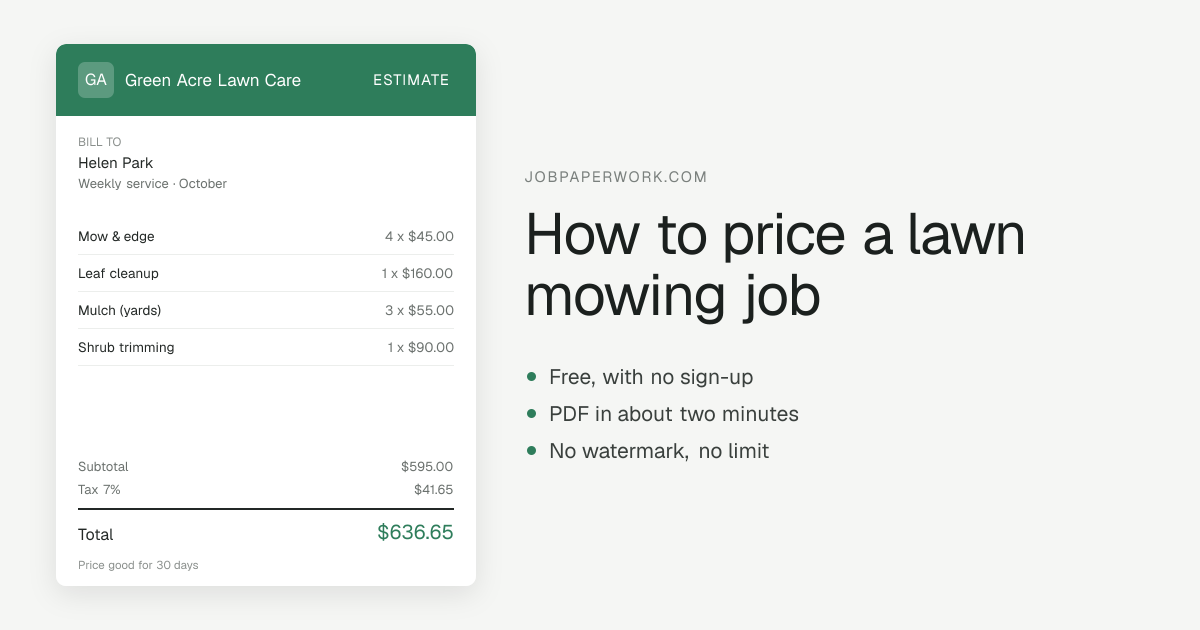
Give each thing its own line: the first cut if it is different, the per-cut price with its frequency, and the extras — edging beds, leaf clean-up, hedge trimming — priced separately so the customer can see what is and is not in the visit. Say how long the price stands, and that a lawn left to overgrow between visits goes back to the hourly rate.
The landscaping estimate template opens with lawn-care lines ready to edit, and the markup calculator helps where you are supplying materials like seed or fertiliser. Whether lawn care is taxable varies from state to state, so check yours before you add a tax line.
Questions
Should I charge more for the first mow?
Usually, if the lawn is overgrown. Grass left for weeks takes far longer to cut and often needs a second pass, so the first visit is commonly quoted on its own — by the hour or as a one-off price — with the regular per-cut price starting from the second visit. Put both on the estimate so the difference is agreed before you start.
Is a every two weeks mowing price just double the weekly one?
No. A every two weeks cut covers taller grass, so each visit takes longer and is worth more than a weekly one, but it is still one visit and one drive, not two. Time a every two weeks cut on its own and price it from that, rather than doubling or halving the weekly figure.
How do I handle weeks when it rains or the grass stops growing?
Decide it before the season starts and write it on the estimate or agreement. Billing per cut means a skipped week simply is not billed. A seasonal price paid monthly should say how many cuts it includes, so a dry August is not a dispute about whether the customer still owes for visits that did not happen.