

How to price a house cleaning job
Estimate the cleaner-hours the home needs for the type of clean — standard, deep or move-out — and multiply by what a cleaner-hour costs you, including wages, supplies and travel. Add your markup, then quote a flat price per visit, with the first deep clean priced separately and the checklist written down.
Cleaning is sold by the house and costed by the hour. The customer wants to know what a three-bedroom clean costs; you need to know how many cleaner-hours it takes and what each of those hours costs you. Here is how to connect the two without guessing.
By the hour, by the home, or by the square foot
Hourly pricing — per cleaner-hour — protects you on homes you have never seen, and it is common for one-off and first visits. Its weakness is that the customer cannot budget for it and may hover to see how fast you work.
A flat price per visit, set by bedrooms and bathrooms or by the condition of the home, is what most recurring residential customers prefer. Price per square foot is more common in commercial cleaning, where the buyer compares bids on the same basis. The flat price and the square-foot price are both hourly pricing underneath: a figure for how long it takes, turned into a number the customer can plan around.
The type of clean changes the hours, not just the price
A standard recurring clean maintains a home that is already clean: surfaces, floors, kitchen and bathrooms. A deep clean is the first visit, or the spring clean — baseboards, inside cupboards, built-up grime in the shower — and takes considerably longer in the same house. A move-out clean adds the inside of appliances and empty cupboards, and usually has a deadline set by a landlord.
Price each as a different job. The commonest mistake is quoting the recurring price for a first visit, which means the hardest clean of the relationship is done at the lowest rate.
What to count as cost
What an hour costs you is more than the wage. Count:
- Cleaner wages, and the payroll costs on top of them if they are employees
- Supplies — chemicals, cloths, mop heads, vacuum bags — if you bring them
- Equipment: vacuums and their repair or replacement
- Travel time between homes, which is paid time if your cleaners are employees
- Insurance or bonding, scheduling software, phone and the time spent quoting
A worked example
Every number here is illustrative, not a market rate. Say a three-bedroom, two-bathroom home takes one cleaner three hours for a standard clean, and your all-in cost per cleaner-hour — wages, supplies, travel share and overhead — is $28. The clean costs you 3 × $28 = $84.
At a 40% markup, the price is $84 × 1.4 = $117.60, which you might quote as $118 per visit. The first deep clean of the same home takes five hours: 5 × $28 × 1.4 = $196. Quote that as its own line, with the recurring price starting from the second visit.
Two cleaners finish the same home in an hour and a half on site, but that is still three cleaner-hours of wages, so the cost is the same $84 — the team changes the schedule, not the sum.
What the price includes, written down
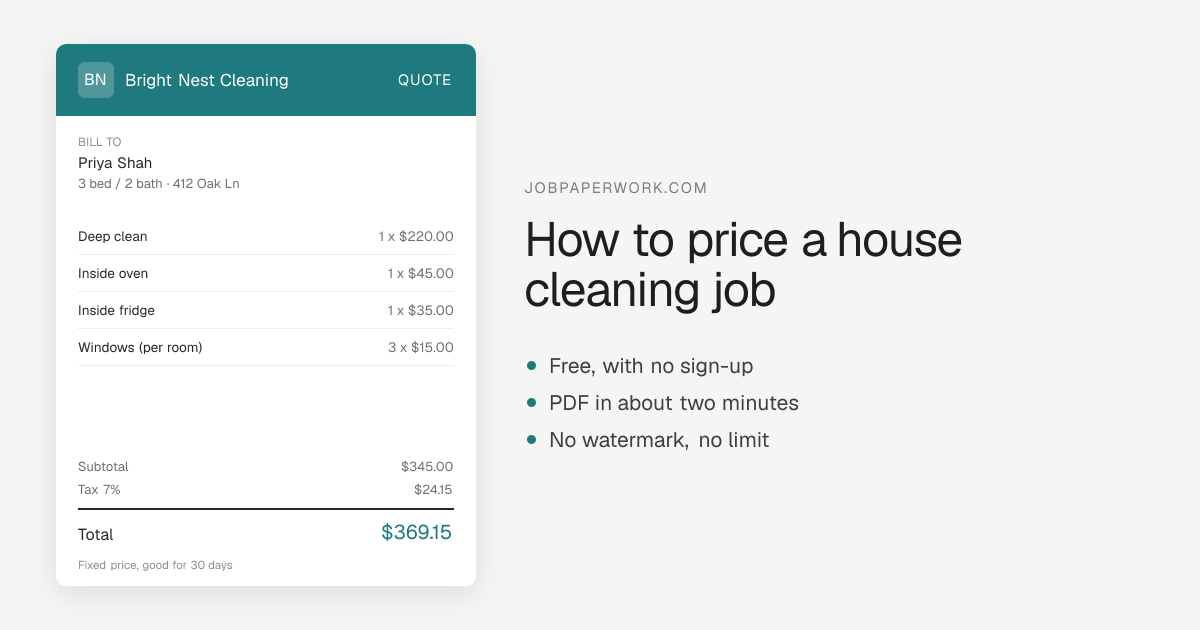
Most cleaning disputes are about what was supposed to be done, not how well. Put the checklist on the quote: which rooms, which surfaces, and which tasks are extras — inside the oven, inside the fridge, interior windows, laundry. A customer who has signed a checklist does not ring to ask why the oven was not done.
Say what happens if you arrive and cannot get in, and how much notice a cancellation needs. A lockout costs you the same time as a clean.
Say what condition the price assumes, too. A quote given over the phone for a three-bedroom home is a quote for an ordinarily lived-in three-bedroom home; if you arrive to a house after a renovation, or one with several pets, the quote should already say that the price will be revisited before you start rather than after you finish. Photos sent before the first visit settle most of this in advance.
How often they book changes the price per visit
A home cleaned weekly stays close to clean, so each visit is quick. The same home cleaned monthly has had four weeks to build up, and each visit takes noticeably longer. That is why many cleaners charge less per visit for weekly service than for every two weeks, and less for every two weeks than monthly — the lower price follows the shorter clean, not a discount for loyalty.
Time the visits at each frequency in the first few weeks rather than assuming, and set the price from what you find. If a weekly customer drops to monthly, the price per visit should change with them, and the quote can say so in advance so it is not a surprise.
One-off cleans sit at the top of the range for the same reason, plus the fact that they do not fill a regular slot on the schedule.
Putting the price on the quote
Give the first clean and the recurring clean separate lines, state the frequency, and list the extras with their own prices. The cleaning quote template opens with these lines ready, and the markup calculator turns your cost per visit into the price. Whether cleaning services are taxable depends on your state, so check before adding a tax line.
Questions
Should I charge by the hour or a flat rate for house cleaning?
Many cleaners quote the first visit by the hour, or as a fixed deep-clean price, and then move to a flat price per visit once they know the home. The flat price is easier for the customer to budget; the hourly rate protects you when a home turns out to be in worse condition than described.
Should I use my own cleaning supplies or the customer’s?
Either can work, as long as the quote says which. Bringing your own means you control what is used and should cost it into the price. Using the customer’s lowers your cost but leaves you working with whatever is under their sink. Some customers ask for particular products for allergies, which is worth noting on the quote.
Why does a move-out clean cost more than a regular clean?
It covers more: inside empty cupboards and appliances, marks on walls, and everything furniture used to hide. It usually has a hard deadline before a landlord’s inspection too. Price it from the hours it takes in that home, not from the recurring rate.